



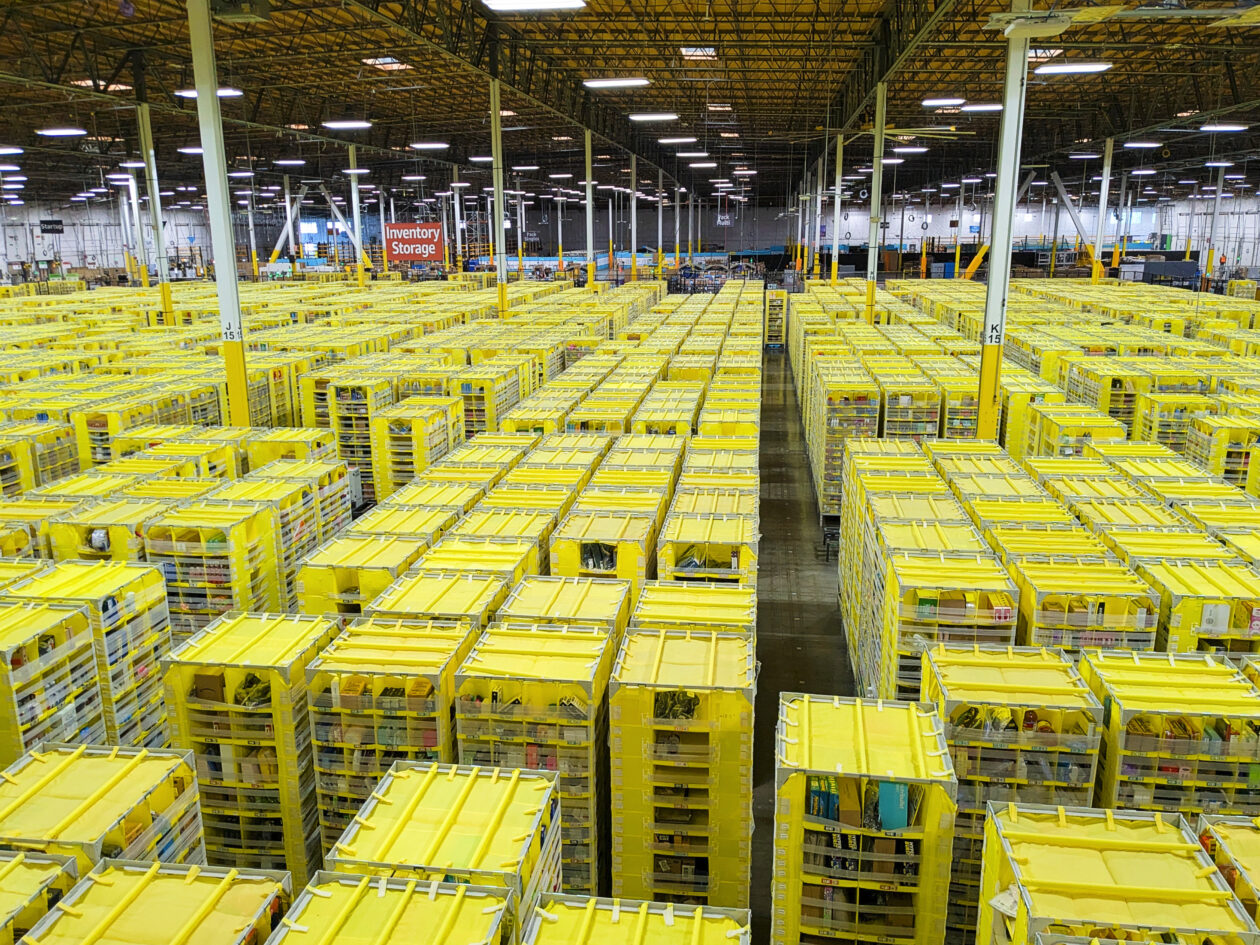
Imagine walking through an Amazon fulfillment center a few miles south of Seattle. Mobile shelving towers hum across the polished concrete floor, carrying bins of products from dog treats to phone chargers. Human employees stand at stations, scanning barcodes and packing orders before they’re swept into waiting trucks. This enormous logistical dance has become the backbone of modern e-commerce. For hundreds of thousands of small businesses, these warehouses are more than just storage—they are the engine of their livelihoods. They list their products on Amazon, pay for sponsored placements, and trust that the marketplace is as honest as it is efficient. That trust is now under a microscope. On Monday, Washington State’s attorney general, the Federal Trade Commission, and the attorneys general of 21 other states filed a lawsuit accusing Amazon of artificially inflating the prices of ads sold on its platform. The complaint, filed in U.S. District Court for the Western District of Washington in Seattle, alleges that Amazon quietly changed the way its ad auctions worked in order to squeeze more money out of the very sellers who had helped make the company a retail giant. The numbers are staggering: roughly 1.2 million advertisers were allegedly overcharged, and the total amount collected through the supposedly deceptive pricing scheme reached $20 billion. In other words, what should have been a simple, honest transaction—paying to promote a product on a digital shelf—may have become a hidden tax on small businesses. The allegation is not that Amazon raised prices openly; it is that Amazon did so behind a veil of carefully preserved auction mechanics that no longer worked the way advertisers were led to believe. For the seller of handmade soap in a converted garage, or the family-owned parts supplier that has been shipping through Amazon for years, those mechanics are not academic. They determine whether an ad budget is wasted or working. And when the pricing rules are hidden, the entire foundation of the relationship begins to crumble. This goes to the heart of how much faith sellers can place in the platform that controls their access to customers.
To understand why the lawsuit matters, it helps to understand how Amazon’s advertising auctions were supposed to function. When a shopper searches for “coffee beans” or “yoga mat,” several sponsored results appear at the top of the page. The order of those results is decided by an auction that takes place in milliseconds. In a traditional auction, buyers might know the highest bid and react. But Amazon used what’s called a second-price, sealed-bid auction. Advertisers were allowed to set a maximum price they were willing to pay for, say, a sponsored search ad. They could not see what other bidders were offering. If they won, they would not necessarily pay their maximum bid. Instead, the winner would pay just one cent more than the second-highest bid. This is a well-known auction design that encourages honest bidding: since you pay only enough to beat the competition, you can safely bid what an ad is actually worth to you without worrying about overpaying. Amazon’s sellers understood this system. They built their profit margins around it. But the lawsuit alleges that beginning in late 2018, Amazon started adding surcharges to the prices, even as it continued to represent that it was using a second-price system. According to the plaintiffs, Amazon didn’t just introduce a small fee or adjust its algorithm in a transparent way. Instead, it is accused of overriding and replacing the correct auction results with higher prices set by Amazon to increase its own profits. If true, this would mean that the very logic of the auction was turned on its head. Advertisers were no longer paying the true second-highest bid; they were paying whatever Amazon decided the auction should produce. The impact has been immense: more than a million advertisers, many of them small online retailers, may have been charged billions of dollars more than they should have been. The attorneys general representing Washington and 21 other states are not just looking at spreadsheets; they are hearing from businesses whose livelihoods depend on these costs. As Nick Brown, Washington’s attorney general, put it, “Many small business owners in Washington rely on Amazon for their livelihoods, and our office is committed to making sure Amazon treats them fairly, transparently, and in accordance with the law.” That sentiment echoes far beyond Washington, which is likely why so many states joined the case. For an independent seller, an extra few cents or dollars per click can be the difference between being profitable and being priced out of the platform altogether.
Amazon is pushing back hard. On the same day the lawsuit was announced, Amazon posted an online response, arguing that the FTC’s claim “fundamentally misunderstands how advertisers operate.” The company explained that advertisers don’t base their decisions on abstract descriptions of auction mechanics; they adjust bids based on what actually happens in the marketplace. “Advertisers adjust bids based on real-world performance, not descriptions of auction mechanics,” Amazon said. The company is also trying to reframe the argument around outcomes. It says its advertising system has never been solely about who is willing to pay the most. Instead, Amazon says it prioritizes how relevant an ad is to the shopper being targeted. The more useful an ad is, the more likely a customer is to click and buy, which benefits sellers and Amazon alike. To back this up, Amazon revealed that 92% of winning ads in recent years were not the highest bid. That sounds odd for a company accused of manipulating prices, but Amazon says it’s a sign of a healthy system. Because relevance matters more than bid, advertisers are getting better results. Conversion rates—the percentage of shoppers who take a desired action after interacting with an ad—rose 24% from 2021 to 2025. The company also pointed out that between 2019 and 2024, the average cost-per-click for sponsored product search ads was flat after adjusting for inflation. In other words, Amazon is saying that its advertising prices have not actually gone up in real terms, and that sellers are getting more for their money. That may sound reassuring, but the plaintiffs are not convinced. The issue isn’t just whether aggregate metrics improved; it’s whether Amazon breached a promise about how individual prices were set. A seller could see better conversion rates and still be paying more than the honest result of a fair auction. You can enjoy a better meal at a restaurant and still object if the kitchen quietly changes the menu prices after you ordered. The same logic applies here: outcomes matter, but so do honesty and transparency.
Perhaps the most serious part of the lawsuit is what it alleges about Amazon’s internal behavior. Amazon has admitted that its ad pricing strategy shifted over time. The company says this shift was a natural response to a system that became more focused on ad relevance. Because winning bids increasingly fell below what Amazon believed the ad slot was actually worth, the company set minimum prices, or “reserves,” that advertisers had to meet to participate in an auction. It also set floors for the minimum market value of an ad. Amazon is quick to note that reserves like these are common across the advertising industry, and it says it never charges advertisers more than their own bid. But the plaintiffs claim the reality is much darker. They point to statements from Amazon employees who described creating fake auction participants. According to the lawsuit, one Amazon senior scientist said that to increase auction prices, the company inserts “an invented auction participant representing how much Amazon thinks that particular ad slot is worth.” This is a highly controversial move. In a real second-price auction, the price is set by genuine competition. If Amazon creates a phantom bidder—a kind of ghost in the machine—that phantom can lift the price to Amazon’s desired level without any real competitor existing. It would be like going to an art auction where the auctioneer plants a fake bidder in the audience solely to make you pay more for a painting, all while telling everyone that the winning price is fair and competitive. Amazon says it clearly explains its pricing process to advertisers. The plaintiffs strongly disagree. They argue that sellers were told one thing—that they were participating in a second-price auction—while Amazon was, in practice, running a system engineered to extract higher payments. If the allegations are true, the gap between Amazon’s public story and its actual behavior is more than a minor institutional slip. It would be a deliberate deception of the very sellers who pay billions of dollars in advertising fees each year. That would transform a routine commercial relationship into something far more troubling: a marketplace where the trusted platform quietly stacks the odds against its own customers.
This new lawsuit is not happening in a vacuum. Amazon is also facing a separate, broader antitrust case brought by the FTC, which accuses the company of maintaining an illegal monopoly in online retail. That case, which involves some of the same states and legal theories, is scheduled to go to trial next year. The ad-pricing case, filed Monday, is led by the FTC and includes attorneys general from Alaska, Arizona, California, Colorado, Florida, Idaho, Illinois, Indiana, Iowa, Kentucky, Louisiana, Maryland, Nebraska, New Jersey, New York, North Carolina, Oklahoma, Pennsylvania, Rhode Island, South Carolina, and Vermont. The geographic reach shows how deeply Amazon’s marketplace is woven into the economy; small retailers in every corner of the country rely on it. The plaintiffs are asking the court to order Amazon to reform its practices, pay restitution to the advertisers who were overcharged, and pay civil penalties for each violation. They also want Amazon to cover attorneys’ fees. For the affected sellers, the lawsuit is not just about legal technicalities. Many are family-run businesses that don’t have teams of lawyers or negotiators. They live and die by Amazon’s algorithms, fee structures, and ad prices. A $20 billion overcharge, spread across 1.2 million customers, is not abstract. It represents real money that could have been used to buy inventory, pay employees, improve packaging, or simply keep prices competitive for consumers. The emotional tone of the complaint reflects this frustration. It describes a company that might have exploited the very users who helped make Amazon what it is today. Amazon has responded with the confidence of a successful enterprise, arguing that its ad system is more relevant and efficient than ever. But the government’s case suggests a different story—one in which Amazon used its enormous market power to quietly turn a fair auction into a money-printing operation at the expense of small sellers. The outcome of this case could reshape how Amazon and other large platforms decide not just what they charge, but how honestly they describe those charges.
At the core of all these legal battles is a question about trust in the digital economy. Amazon has built its reputation on being the “everything store,” a place where you can find almost anything, often at a low price. But for the people who sell on Amazon, the platform is not just a store; it is a critical part of their business infrastructure. Many sellers have no realistic alternative because Amazon controls so much of online shopping traffic. That gives Amazon a lot of power, and with power comes the responsibility to be transparent. The ad-pricing lawsuit asks whether Amazon abused that responsibility. Is setting a minimum price for an ad slot legitimate business practice, or is it a disguised way of inflating prices? Is an “invented auction participant” just a clever way to estimate value, or is it a fraudulent phantom designed to deceive? The answer may determine not just how much advertisers pay, but how much they can trust the platform that stands between them and millions of shoppers. Amazon has insisted that its actions have not harmed advertisers or shoppers, and that the FTC’s claims are based on a misreading of how the system works. It argues that the auction is only one part of a much larger, more complex advertising business. Advertisers, after all, do not blindly bid based on auction rules; they watch their sales and adjust their budgets accordingly. But the government and more than twenty states see something more sinister. They believe the company crossed the line between legitimate auction mechanics and deceptive pricing. The court will now have to untangle the algorithms, the internal emails, and the public promises to decide who is telling the truth. Until then, the movable shelving towers will keep gliding across the warehouse floors, the boxes will keep shipping, and business will go on. But the doubt will linger, not only in the minds of regulators, but in the millions of sellers who wonder whether the price they pay to be seen on Amazon is honest, fair, and truly the result of an open and competitive system.