

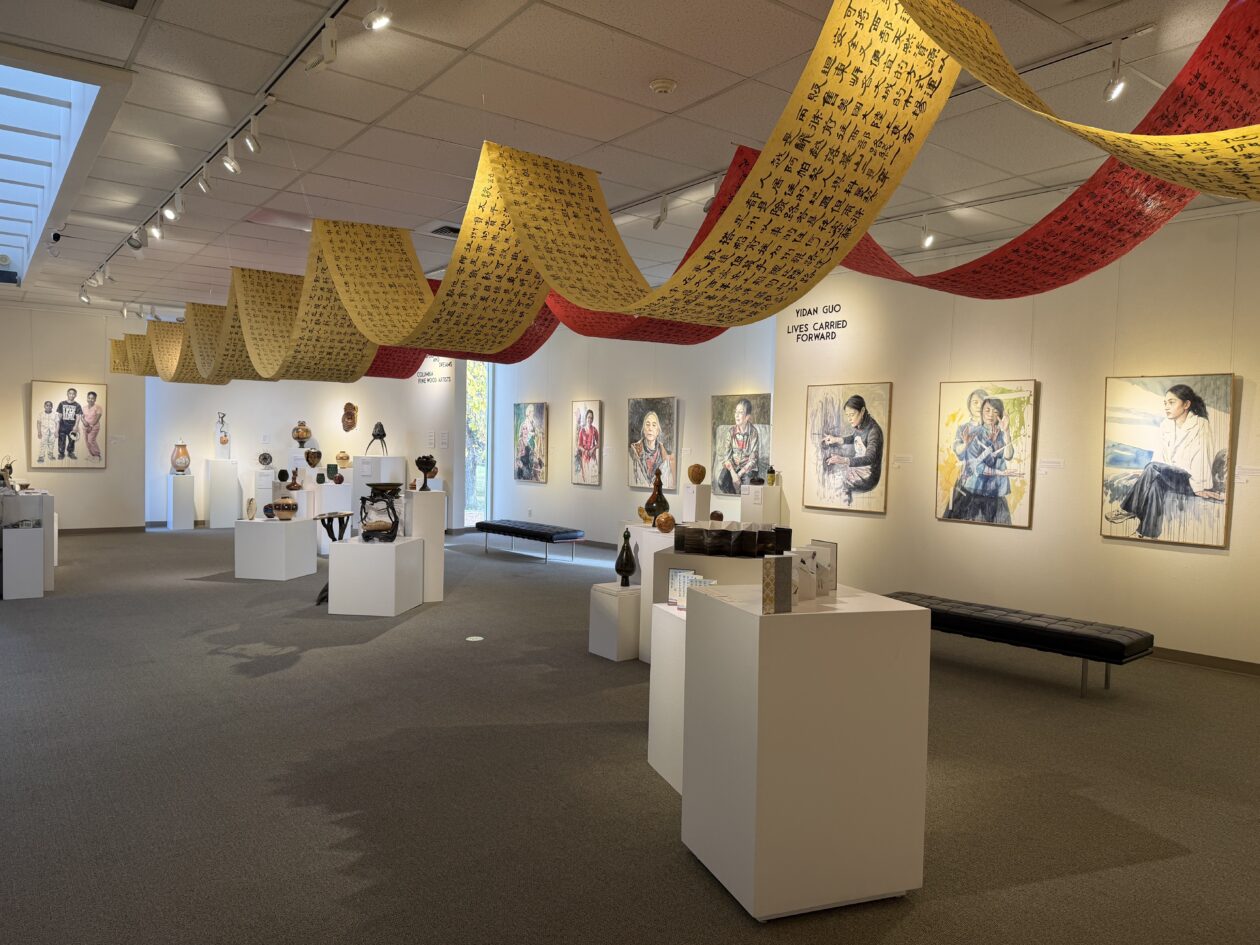
At the Gallery at the Park in Richland, Washington, an exhibition by artist Yidan Guo carries a title that feels especially resonant right now: “Lives Carried Forward.” The paintings in that gallery tell stories of persistence, memory, and connection, but the gallery itself is also part of a larger story—one about the fragile lives of small arts institutions across Washington state. These are the spaces where emerging artists get their first shows, where children see a painting up close for the first time, where seniors gather for a lecture, and where a community recognizes itself in the creativity of its neighbors. For years, many such spaces have existed on the edge of survival, held together by part-time directors, dedicated volunteers, and the stubborn belief that art matters. That belief has now received a powerful vote of confidence. Allen Family Philanthropies and Seattle-based ArtsFund have awarded $10 million through the Community Accelerator Grant program to 745 small arts and culture organizations across Washington. The awards range from $2,500 to $25,000, and they reached groups in 37 of the state’s 39 counties. In addition, the program was renewed for another $10 million next year, bringing its total commitment to $50 million over five years. The scale is remarkable, but what matters most is what that scale means for individual places: a neighborhood theater can keep its lights on; a rural arts council can afford to hire someone; a tribal museum can preserve and share the culture of its people. The timing matters too, because the pandemic did not really end for small nonprofits. It was followed by inflation, staffing losses, and audiences still finding their way back. For many groups, a grant like this is not a luxury. It is the difference between a future and a closure notice. Small arts organizations are often the first to be overlooked and the last to receive support, yet they are the ones who keep the cultural ecosystem alive between the big landmark museums and concert halls. This program treats them not as afterthoughts, but as essential.
The decision to focus this year’s grants on the smallest organizations was not accidental. It came from looking at the data. Allen Family Philanthropies, working with SMU DataArts, a research group that studies arts and culture, found an unsettling pattern: between 2023 and 2024, arts organizations with annual budgets under $1 million lost an average of one staff position. During the same period, institutions with budgets over $1 million gained an average of five staff positions. That tiny number—one lost position—may seem insignificant in a corporate context, but in a small nonprofit it can be catastrophic. It means no one to answer the phone, no one to apply for emergency funds, no one to coordinate volunteers. It can result in shortened hours, cancelled programs, and a spiral of exhaustion for whoever remains. The analysis led Allen Family Philanthropies to pivot its 2026 program toward those smaller groups and, in the process, raise the average award by about 25 percent, from $10,753 last year to $13,423. The extra money gives small organizations a little more room to invest in stability rather than crisis management. Lara Littlefield, executive director of Allen Family Philanthropies, said in the announcement that both the reach of the program and the findings from the report show “just how much this type of flexible support is needed to bolster Washington’s rich and diverse arts and culture sector.” The word flexible is important. Too often, arts funding is tied to specific projects, leaving nonprofits to scramble for operating support. A flexible grant can be used for the roof, for payroll, for programming, for the unexpected cost that always appears. It treats nonprofit leaders as professionals who know better than funders what their communities need. It also gives them dignity—the same dignity we assume when we hire a plumber or a doctor. In a sector that survives on passion and sacrifice, being trusted with flexible resources can be almost as powerful as the funds themselves.
The geography of the grants demonstrates an uncommon breadth. Of the 745 recipients, 496 are in Northwest Washington, 132 in Southwest Washington, 67 in Eastern Washington, and 50 in Central Washington. The list includes 12 of the state’s 29 federally recognized tribes, and more than 22 percent of grantee organizations are located in rural counties. This is a program that understands culture is not confined to urban centers. In Washington, a state defined as much by its small towns and remote valleys as by Seattle’s skyline, the fate of rural arts institutions matters profoundly. A community theater in the Palouse, a music festival on the Columbia River, a Native language program in a coastal village—these are threads in a social fabric that can fray quickly when ignored. Small grants to these organizations can have outsized effects. They may help a rural museum heat its building through the winter or allow a tribal arts instructor to travel between communities. They may let an after-school program buy supplies and pay a stipend to a teaching artist who would otherwise have to work for free. For communities that have too often been left out of traditional philanthropy, the message is about more than money. It says that their stories, their expressions, and their cultural knowledge are recognized as legitimate and valuable. The inclusion of tribal nations is particularly meaningful, because for Native communities, art is inseparable from sovereignty, language, and survival. Supporting a tribal arts program is not merely funding a nice activity; it is helping to carry a people’s heritage into the future. And the grant program’s reach into rural counties suggests an understanding that the divide between urban and rural America can be partly addressed by investing in the places that hold communities together. It is no exaggeration to say that a small grant delivered in the right moment can ripple through an entire county, supporting local economies, strengthening local identity, and inspiring young people to imagine a future in their own hometowns.
Perhaps the clearest illustration of the grant program’s impact is the Old Hotel Art Gallery in Othello, a small city in Adams County. The gallery has received $25,000 every year since 2024, and director Samantha Copas says the 2025 award “truly kept our doors open.” That is not hyperbole. The grant enabled the gallery to pay its staff a living wage, something many arts nonprofits cannot do even with prestigious grants. It also allowed the organization to stay operational in the months leading up to its annual fundraiser, the quiet season when many small nonprofits run dangerously low on cash. And it funded renovations to the historic building that houses the gallery, transforming an aging structure into an asset that now generates rental income. In other words, the grant was not merely a charitable donation; it was a strategic investment in the institution’s long-term survival. That kind of impact is exactly what the program seems designed to achieve. Another striking element of this year’s grantee list is its inclusion of organizations at the intersection of art and technology. Tacoma’s Fablab Nonprofit, which opens digital fabrication tools to the public, received $25,000. Seattle-based Simulated Immersive Experimental Realities, a collective exploring virtual reality and interactive experiences, received $15,000. Bellingham Makerspace, a community workshop where people share machines and skills, received $2,500. These are not the typical arts organizations of yesterday, but they reflect how creativity is being practiced today. They are places where people learn to code, build, design, and prototype alongside one another. Funding them sends a signal that the arts ecosystem is broad enough to encompass both the traditional and the experimental, the rural gallery and the urban lab. Taken together, the individual grants demonstrate a recognition that supporting culture means supporting many different kinds of people and many different approaches to making meaning. It means trusting that a small group with a big idea can make the same kind of contribution as a major institution—and often, because it is rooted in a specific community, an even more relevant one.
The philanthropic vision behind these grants has deep roots in the Pacific Northwest. Allen Family Philanthropies was formerly known as the Paul G. Allen Family Foundation, founded in 1988 by the late Microsoft co-founder Paul G. Allen and his sister, Jody Allen. For decades, the foundation has been a major supporter of arts and culture, youth development, and environmental causes. It has funded everything from wild salmon habitat restoration to emerging orchestras. The Community Accelerator Grant is just one part of that legacy. Last year, the foundation committed nearly $7 million to eight Seattle Center nonprofits, including KEXP and the Museum of Pop Culture, to help expand youth access to the arts. That investment supports large institutions that attract visitors from all over the world. But the $50 million commitment to small organizations through this grant program shows an equal commitment to the grassroots, to the places where culture is created rather than merely displayed. It is a philosophy that sees both sides of the arts ecosystem as necessary. A thriving regional arts scene requires flagship institutions and neighborhood spaces, professional companies and volunteer collectives, digital makerspaces and traditional galleries. By supporting such a diverse range of organizations, the foundation is also adapting to changing times. The data-driven adjustment in award amounts, the focus on smaller budgets, and the decision to renew the program all indicate a learning organization rather than a static one. In that spirit, the foundation seems to be saying that philanthropy should not be a top-down transaction. It should be a partnership built on trust, research, and a willingness to invest in people who may not have polished applications or large development offices but who have deep roots and real relationships in their communities. Paul Allen himself was known for his curiosity and willingness to take risks on unconventional ideas. The Community Accelerator Grant feels very much in that tradition—a bet on the small, the unexpected, and the human.
As the program moves into its next phase, the opportunities for organizations are concrete. ArtsFund will hold a virtual webinar in the spring for anyone interested in applying for the 2027 grants, and details will be posted on its website. The full list of 2026 recipients is available online, and it reads as a map of Washington’s cultural heart. For a small organization, applying for a grant can feel intimidating; this program seems designed to make that process as accessible as possible. In the end, the story of this funding initiative is not just about numbers, even though the numbers are impressive: 745 organizations, $10 million in a single year, $50 million over five years. It is about the lives behind those numbers. It is about the artist Yidan Guo, whose exhibition title “Lives Carried Forward” is a poignant reminder of why we sustain the arts in the first place. It is about the gallery director who can finally pay her staff a living wage, the makerspace volunteer who gets to buy new tools, the tribal community that can document its language, and the child who walks into a small theater and sees themselves reflected on stage. These are the people and places that carry not only artworks, but stories, identities, and hopes, from one generation to the next. They are the reason flexible support matters and the reason a grant of $2,500 can be just as meaningful as $25,000 in the right hands. The renewed commitment from Allen Family Philanthropies and ArtsFund is a promise that the arts will not be left to fend for themselves in a difficult economy. It is a recognition that small arts organizations are not minor players. They are the foundation of everything else, the root system from which a vibrant cultural life grows. As the next grant cycle approaches, the message is clear: the doors of Washington’s small arts organizations have been opened, thanks in part to those who believe in them—and those doors will remain open, carrying lives forward.