

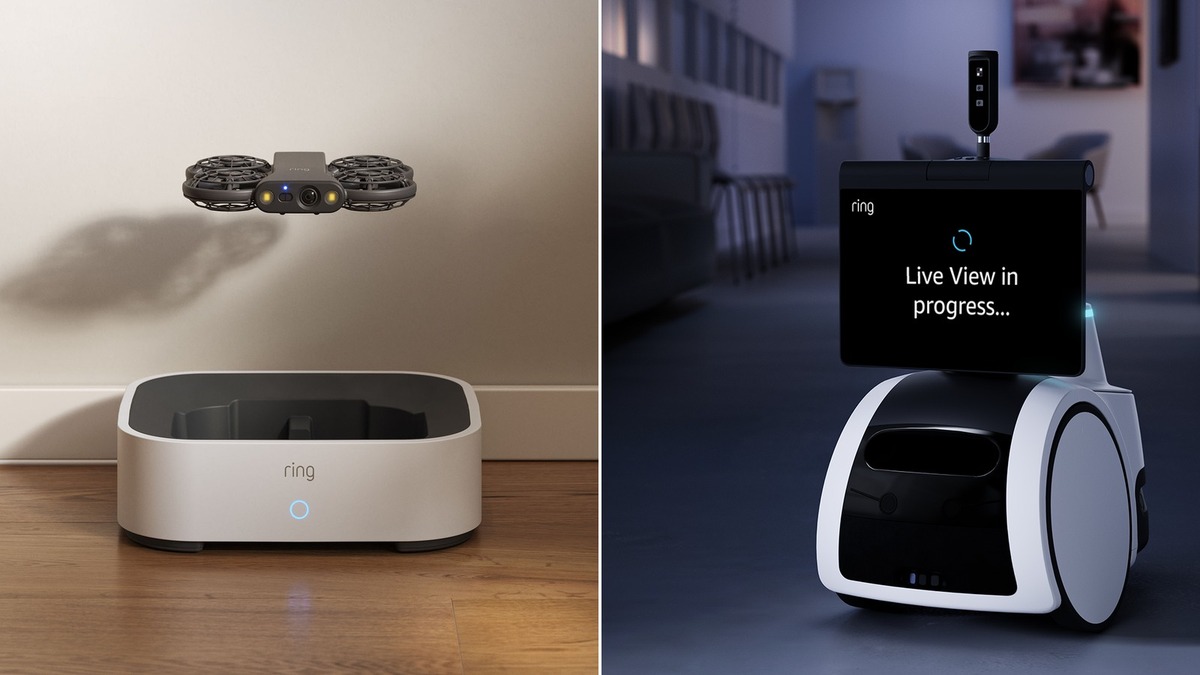
Amazon’s Ring is taking a big swing at the future of home and business security, and this time it has wings and wheels. The company has unveiled two new devices: the Ring Drone Cam, a $249.99 indoor flying security drone, and the Ring Rover Cam, a $999.99 mobile patrol robot aimed at businesses. Together, they are the first products under the new Ring Robotics banner, which the company describes as “a new category of autonomous, mobile security.” The idea is simple but ambitious: instead of relying on fixed cameras that can only watch one angle, these devices can move through a space, check out what’s happening, and go where a stationary lens can’t. Both rely on a system called AI Pilot, which lets the devices map a home or business, suggest places that might be worth monitoring, and navigate around everyday obstacles like furniture, shelving, or a stack of boxes. For a homeowner, that means the possibility of a small drone gliding through a darkened hallway to see whether a window sensor was triggered. For a store owner, it means a robot rolling down aisles after hours, checking for intruders or simply confirming that nothing is out of place. Announced Tuesday, Nov. 10, 2026, the products represent not just new gadgets but a philosophical shift for Ring: the company that built its name on little white cameras stuck to front doors is now betting that security should be able to move around. At a time when smart home tech often feels like a collection of separate screens and sensors, Ring is trying to make security feel more proactive, even alive. The drone and rover are not meant to replace the cameras people already have; they’re meant to go where those cameras can’t. And because they can be triggered by other Ring devices, they turn the whole system into something closer to a team: when a doorbell detects a person on the porch, the drone can leave its dock and fly to the back window to see if someone is trying to sneak around. It’s a vision that has been attempted before, as Ring itself knows all too well. But the company is hoping that the second time around, with better mapping, smarter navigation, and a clearer sense of what customers actually want, these mobile security machines will finally find a place in everyday life.
The Ring Drone Cam is deliberately designed to be unobtrusive. It lives in a dock, where its camera remains off, until it is needed. Owners can send it out on a schedule, summon it on demand, or let it launch automatically when another Ring device is triggered—say, a motion sensor in the living room or a contact sensor on a door. The drone then flies through the home, following a route that AI Pilot has planned based on a floor plan the owner helped create. Ring says the drone is not meant to hover overhead constantly; it is more like a guard who wakes up when something happens. The Ring Rover Cam, on the other hand, is built for the commercial world. It patrols stores and offices, and because its camera sits on a periscope-like mast, it can see over counters and shelving that would block a human view or a stationary camera. The Rover is available for preorder in the United States now and is scheduled to ship Dec. 16. The Drone Cam is expected to arrive later, on Jan. 27, 2027, but Ring is not taking preorders for it yet; interested customers can only sign up for email updates. The reason, the fine print says, is that the drone has not yet received the required authorization from the Federal Communications Commission. There is also a catch for people who want to use these devices on a schedule: Ring says scheduled flights and patrols, as well as reviewing recorded video from the Rover, require a Ring Protect subscription. The company has not yet said which subscription tiers qualify, which may leave early adopters guessing about the true cost of ownership. Ring’s founder, Jamie Siminoff, framed the devices as the answer to a question customers kept asking: how can we see what’s happening in places where a fixed camera can’t go? “The honest answer wasn’t more cameras; it meant reimagining what a security device could be,” Siminoff said. “That kind of invention is hard, and it takes time.”
This is not Ring’s first attempt at a flying camera. In 2020, the company unveiled a product called the Always Home Cam, a $249.99 indoor drone that also docked and flew out when needed. At the time, it felt like a glimpse of the future, full of promise and a little unsettling. Ring opened an invitation list for the device, but it never went on general sale; it quietly faded away, becoming a footnote in the company’s history. The original version had a significant limitation: it could only fly along paths that owners mapped out with it in advance. That meant the drone was less a smart security guard and more a train on a track, capable of going to predetermined spots but not really thinking for itself. The new Drone Cam is meant to be different. Ring says it builds a floor plan as the owner carries it through the house, essentially learning the layout of the home from a slow walk around each room. From that map, it suggests spots that might be worth checking, and it plans its own routes to get there, avoiding furniture, plants, and other obstacles along the way. This is a meaningful improvement, and not just because it makes the drone more useful. It also makes the device feel less like a remote-controlled toy and more like a genuinely autonomous security tool. The company is careful to frame the drone as a companion to the home’s existing security system, not a replacement. You won’t need to set up a camera on every shelf, because the drone can go and look for you. But the history of the Always Home Cam is a reminder that this kind of product is hard to get right. The hardware is only part of the challenge; the software has to make people trust it enough to let a flying camera into their homes. Even so, Ring seems to believe the timing is finally right. The new Drone Cam is not being marketed as a novelty or a first-generation experiment; it is being sold as a practical security device, with the same price as the original and a clearer sense of what it is for. The company has had years to learn from the Always Home Cam’s failures and from the rapid improvement of robotics and mapping technology. The result is a product that still asks a lot of trust from homeowners, but at least it is designed to earn that trust by being useful rather than merely impressive.
The Rover Cam has an even more tangled history. It traces back to Astro for Business, a rolling security robot that Amazon launched in November 2023 at a starting price of $2,350. At the time, it seemed like a natural fit: Amazon had already built Astro, a home robot with a screen and an expressive face, and the business version would use the same wheels and sensors to patrol stores, warehouses, and offices. But the product was discontinued less than a year later. Amazon refunded customers and shut the robots off, leaving businesses that had paid thousands of dollars for a security robot with nothing to show for it. It was a cautionary tale about the gap between a promising demo and a product that people actually want to use. Ring, however, found a silver lining in that failure. The company says the new Rover was inspired by Astro customers who told Amazon that roving security was their favorite feature. Those customers didn’t want a friendly home robot that occasionally checked the house; they wanted a reliable security guard on wheels. So Ring says it “leveraged the best of Astro” to build something more focused. The Rover is deliberately pitched not as a home robot that also does security, but as a purpose-built security robot. It doesn’t have the playful personality of Astro, at least not in the way the product is described; instead, it has a periscope camera designed to give it a view over counters and warehouse shelving, and it is priced at $999.99, less than half the cost of Astro for Business. The Rover also enters a crowded market. Security robots have been around for years, and companies like Knightscope have built entire businesses renting robots through subscriptions, while Cobalt AI offers similar autonomous patrol services. Ring’s advantage, at least in theory, is its existing footprint in homes and small businesses, as well as a brand that already knows how to make security feel approachable. But the Rover’s success will depend on whether businesses trust it enough to make it part of their daily routines, and whether Ring can avoid repeating the missteps that sank Astro for Business.
These announcements are part of a broader strategy at Ring, and they come at a moment of transition. Jamie Siminoff, who launched Ring’s predecessor, Doorbot, in 2012 and sold Ring to Amazon in 2018, left the company in 2023 and returned last year to lead Ring and Amazon’s related home security businesses. His return signaled that Amazon was taking Ring’s future seriously, and the company has been expanding beyond the doorbell ever since. In January, Ring unveiled a $5,000 surveillance trailer designed for parking lots, a product that would have been unthinkable for a company once known for a single device on a front door. Last month, Ring introduced its first smart lock, a $249 deadbolt with no keyhole and a dial that can recharge a dead battery by hand. Now, with the Drone Cam and Rover Cam, Ring is moving further into robotics, a field that Amazon has been investing in heavily. According to a CNBC report on Sunday, Amazon has redeployed much of the Astro team to work on a new home robot. In March, Amazon acquired Fauna Robotics, a New York startup building humanoid robots, saying it would become part of a new Personal Robotics Group. Ring’s announcement does not mention either effort, and it is not clear whether the Drone Cam and Rover Cam are connected to those projects. But the broader picture is unmistakable: Amazon and Ring are trying to build a future in which robots are as common in everyday spaces as smartphones. The challenge is that Amazon’s track record with robots has been mixed. Astro for the home remains an invite-only product, and the business version was killed. The new products will have to prove that they can do more than just exist. For Ring, the stakes are not just about sales; they are about establishing the brand as a leader in a new category of autonomous security. If the Drone Cam and Rover Cam catch on, they could redefine what people expect from a security system. If they fail, they will join the long list of ambitious robot products that were ahead of their time.
What should a normal person make of all this? On one level, the Drone Cam and Rover Cam are simply new tools in an ongoing effort to make security more responsive. On another, they represent something more intimate: the decision to invite a moving, seeing machine into the spaces where we live and work. Ring is clearly aware of the sensitivities. The Drone Cam’s camera stays off while it is docked, and the device is positioned as a reactive tool rather than a constantly watching eye. The Rover, with its periscope camera, is aimed at businesses where security cameras are already common. But autonomous robots raise questions that fixed cameras don’t. Who decides where they can go? How long do they record? What happens when a robot sees something it shouldn’t? Ring says AI Pilot can map spaces and suggest routes, but customers will have to trust that the system understands their limits. The company’s history with devices like the Always Home Cam and Astro for Business suggests that trust is not automatic. Flying security cameras for the home, in particular, remain rare; Indoor Robotics makes a ceiling-docking drone for offices and warehouses, but there is no mass market for residential drones yet. Ring is trying to create that market, and it has some advantages: a familiar brand, a large installed base of existing devices, and a founder who has shown he can turn a bold idea into an everyday product. The doorbell, after all, started as a kind of connected camera with a button, and now it’s one of the most common smart home devices in the country. The company is hoping that the Drone Cam and Rover Cam can follow a similar path, starting as unusual products and becoming ordinary. Whether that happens will depend on how well they work, how responsibly they are used, and whether people can get comfortable with the idea of a robot moving through their home after the lights go out. Ring is betting that once people see how useful that can be, the idea won’t feel strange for long. For now, the future of security is on wheels, and occasionally on wings.