


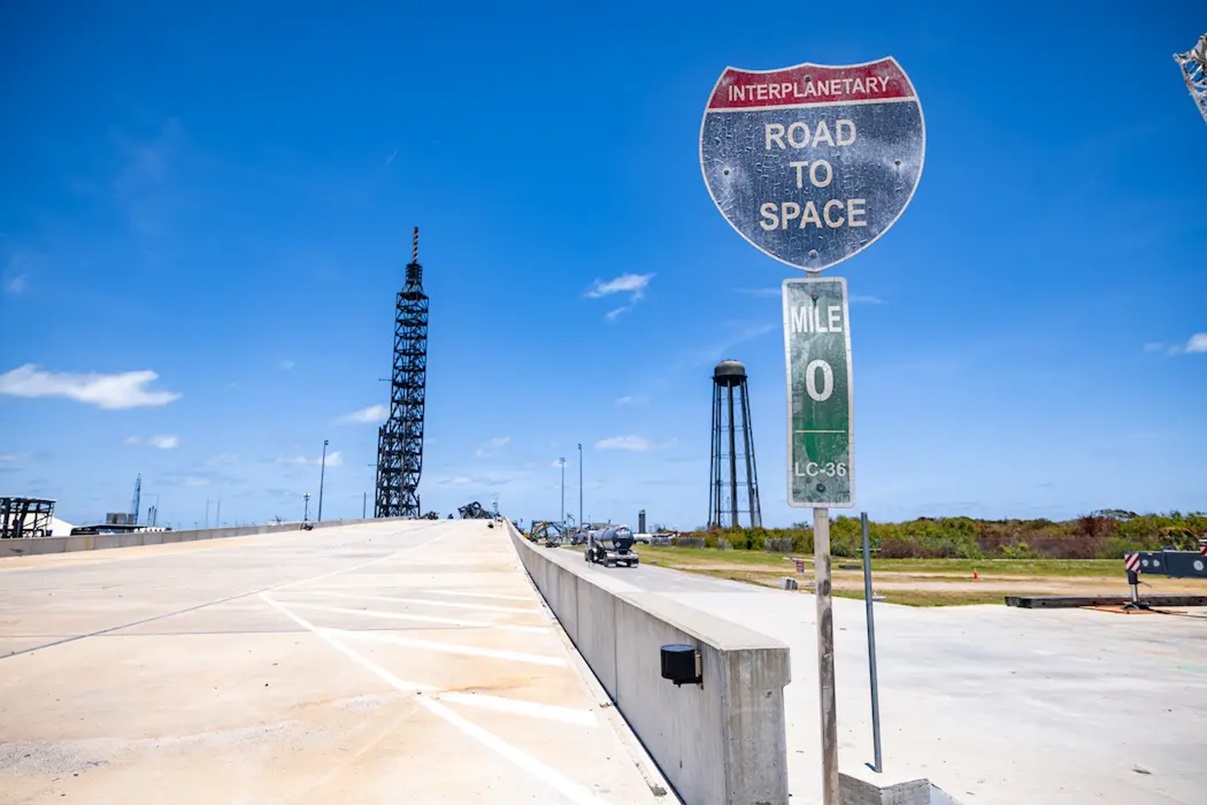
Standing beneath the Florida sun, a charred and weathered metal sign reading “Road to Space” serves as a poignant reminder of the volatile nature of cosmic ambition. Just beyond it sits the battered remains of Launch Complex 36 at Cape Canaveral, where Jeff Bezos’ space venture, Blue Origin, recently faced one of its most severe trials. On May 28, 2026, a devastating explosion tore through the lower section of a New Glenn rocket during pre-flight preparations, instantly shattering the quiet of the Space Coast and sending shockwaves through the global aerospace industry. The rocket, which had been meticulously prepared to deploy 48 satellites for Amazon’s high-stakes Project Kuiper internet constellation, was lost in the anomaly. In the immediate aftermath, the Federal Aviation Administration stepped in to ground the powerhouse vehicle, demanding a rigorous investigation before any further permits would be issued. For an organization striving to prove itself against formidable competitors like SpaceX, the fiery setback could have prompted a period of paralyzed introspection. Instead, the disaster has catalyzed an audacious pivot, transforming a scene of ruin into a masterclass in operational Agility and human resilience.
In a candid and surprisingly optimistic public update, Blue Origin CEO Dave Limp laid out the harsh realities of the destruction while celebrating the narrow escapes that saved the facility from total annihilation. The violent force of the blast obliterated key infrastructure, including the pad’s towering lightning mast, the complex transporter-erector mechanism, and the massive hydraulic cylinders designed to lift the rocket upright. Yet, amidst the twisted metal, Limp pointed out that fortune had favored their long-term prospects; the integration facilities, the fuel storage tank farm, the essential water tower, and the primary vehicle access tower remained entirely untouched. Engineers conducting the post-incident autopsy have already traced the root cause of the failure back to the aft section of the first stage, where the immense pressure of preparing the engines apparently overwhelmed a critical system. Rather than succumbing to despair, the recovery crews have already begun clearing away the rubble, treating the physical cleanup not merely as a chore, but as the ceremonial first step toward an entirely redesigned future.
Rather than wasting precious months meticulously rebuilding the launchpad to its exact pre-explosion specifications, Blue Origin’s leadership has made the strategic decision to leapfrog directly into their next technological generation. Limp announced that the company is abandoning the legacy vertical assembly method at Launch Complex 36A in favor of a revolutionary hybrid horizontal-to-vertical configuration—colloquially known in rocket science as a “hybrid ConOps.” This operational concept, which allows teams to assemble the main stages of the rocket horizontally on the ground before erecting them vertically for final fueling and launch, was already quietly in development for a second, larger launch site nearby, known as Pad 36B. By standardizing this hybrid approach across both locations, Blue Origin will create a unified, stream-lined assembly workflow. This technological harmonization will not only simplify the supply chain and training processes for ground crews but will also significantly boost the company’s overall flight frequency once regular operations commence.
The physical reality of this transition is currently playing out on the dusty hangar floors of Cape Canaveral, where teams of engineers, technicians, and mechanics are working long hours to reshape the company’s destiny. In a massive logistics operation, crews have successfully cleared out the main Integration Facility, carefully relocating three giant New Glenn upper stages and a celebrated, twice-flown first-stage booster affectionately nicknamed “Never Tell Me the Odds.” There is a profound human element in this nomenclature, a nod to the Han Solo-esque defiance required to work in an industry where gravity is a constant adversary and the margin for error is non-existent. Watching these colossal cylinders of aluminum and composite materials being rolled out of the hangars highlights the sheer scale of human ingenuity required to conquer the skies, reminding observers that behind every press release is a dedicated workforce that feels every failure personally and approaches every recovery with renewed pride.
The pressure on these workers to succeed remains immense, as Blue Origin’s upcoming manifest is crowded with missions of critical global and scientific importance. Beyond its commitments to establish Amazon’s low-Earth-orbit satellite constellation, the New Glenn rocket is a linchpin in NASA’s grand return to the Moon through the Artemis program. The heavy-lift launcher is scheduled to carry the uncrewed Blue Moon Mark 1 cargo lander to the lunar dust, followed closely by the more sophisticated Mark 2 lander, which will be tested in Earth orbit to prepare for future astronaut-led landings. Additionally, commercial telecommunications pioneers like AST SpaceMobile are waiting in the wings, relying on Blue Origin’s giant fairing to loft their next-generation mobile broadband satellites into orbit. The global space economy is watching Cape Canaveral with bated breath, knowing that the timeline for humanity’s next steps on the lunar surface rests squarely on the shoulders of the designers rebuilding the broken pad.
Ultimately, the story of Blue Origin’s current struggle is not one of engineering failure, but of the stubborn optimism that has defined human exploration for generations. Dave Limp closed his update with a defiant battle cry, promising that the company’s “Road to Space” does not pause in the ashes of Complex 36, and pledging a triumphant return to flight before the calendar turns to 2027. This ambitious timeline reflects a deep-seated belief that failure is not an end point, but an expensive, illuminated lesson on the path to progress. By choosing to adapt rather than merely repair, the team at Blue Origin has turned a catastrophic explosion into a springboard for innovation. As high-value manufacturing continues at a rapid pace in their nearby production facilities, the workers look toward the horizon, fueled by the simple, enduring philosophy that navigating the dangerous journey to the stars, despite the heartbreak and the fire, is always worth the cost.