




There is an agonizing isolation that comes with leading a major golf championship on a Sunday afternoon, a psychological weight that can turn a six-stroke lead into an asphyxiating trap. As Wyndham Clark stepped onto the first tee at Shinnecock Hills for the final round of the 2026 U.S. Open, the sporting world assumed they were buckling in for a dull coronation. Armed with a massive cushion and looking to become the first wire-to-wire U.S. Open champion since Martin Kaymer in 2014, Clark had spent three days dancing with destiny, seemingly insulated from disaster by a string of fortunate breaks and friendly bounces. Yet, the crucible of Sunday at a U.S. Open possesses a unique gravity, one that strips away any illusion of invincibility and forces a player to confront both the brutal layout of the course and the fragility of their own mind.
That mental fortitude was tested not just by the unforgiving Shinnecock terrain, but by a partisan and fiercely hostile Long Island crowd that had decided Clark was the villain of the piece. The galleries had turned out in droves hoping to witness history of a different kind—specifically, a birthday triumph for world No. 1 Scottie Scheffler, who was chasing a career Grand Slam on his 30th birthday. The atmosphere quickly curdled from enthusiastic support for Scheffler into active antagonism toward Clark, creating a pressure-cooker environment where Clark’s brilliant shots were met with collective groans, and his errors were greeted with cheers. The vitriol reached such a fever pitch that security had to eject multiple unruly spectators, including one fan who tried to rattle Clark’s nerves before a critical tee shot with a cruel shout of, “Don’t choke, Wyndham.” Surviving a major championship is difficult enough when battling the wind and the greens, but doing so while feeling entirely unwelcome in your own country’s national open requires a rare depth of character.
While Scheffler’s potential fairy-tale charge ultimately withered under a barrage of uncharacteristic mistakes and a lackluster front nine, the threat to Clark’s reign emerged from a much unexpected corner. Sam Burns, starting the day a distant seven shots back, began mounting a ferocious, silent charge that exposed Clark’s early-round anxieties. As Burns ignited his scorecard, Clark began to bleed strokes, stumbling through a series of painful bogeys on the second, fifth, and seventh holes. The six-shot lead that had felt so impregnable just hours earlier was suddenly dissolving in the New York breeze, and the momentum had completely shifted. For any athlete, watching your lifetime dream slip through your fingers while your swing begins to betray you is a terrifying sensation, but Clark managed to anchor his drifting ship with gritty pars on the eighth and ninth, reminding himself that he had conquered this mountaintop once before at Los Angeles Country Club in 2023.
The defining moment of Clark’s champion’s pedigree—and arguably the entire tournament—arrived at the par-5 16th hole, a stage that threatened to host his ultimate undoing. After a wayward drive sailed into the suffocating, knee-high fescue, veteran on-course broadcaster Jim “Bones” Mackay grimly described the lie as “horrendous,” and analysts in the booth began preparing the post-mortem on Clark’s collapsed lead. Yet, out of the deep weeds, Clark conjured a moment of pure, athletic magic, somehow muscling the ball nearly 180 yards back into the short grass. After finding the green with his third, he stood over a daunting 24-and-a-half-foot birdie putt and poured it into the center of the cup, a dagger of a putt that restored his lead to two shots just as Burns, finishing ahead of him, narrowly missed a birdie on the 18th that would have put immense pressure on the leader.
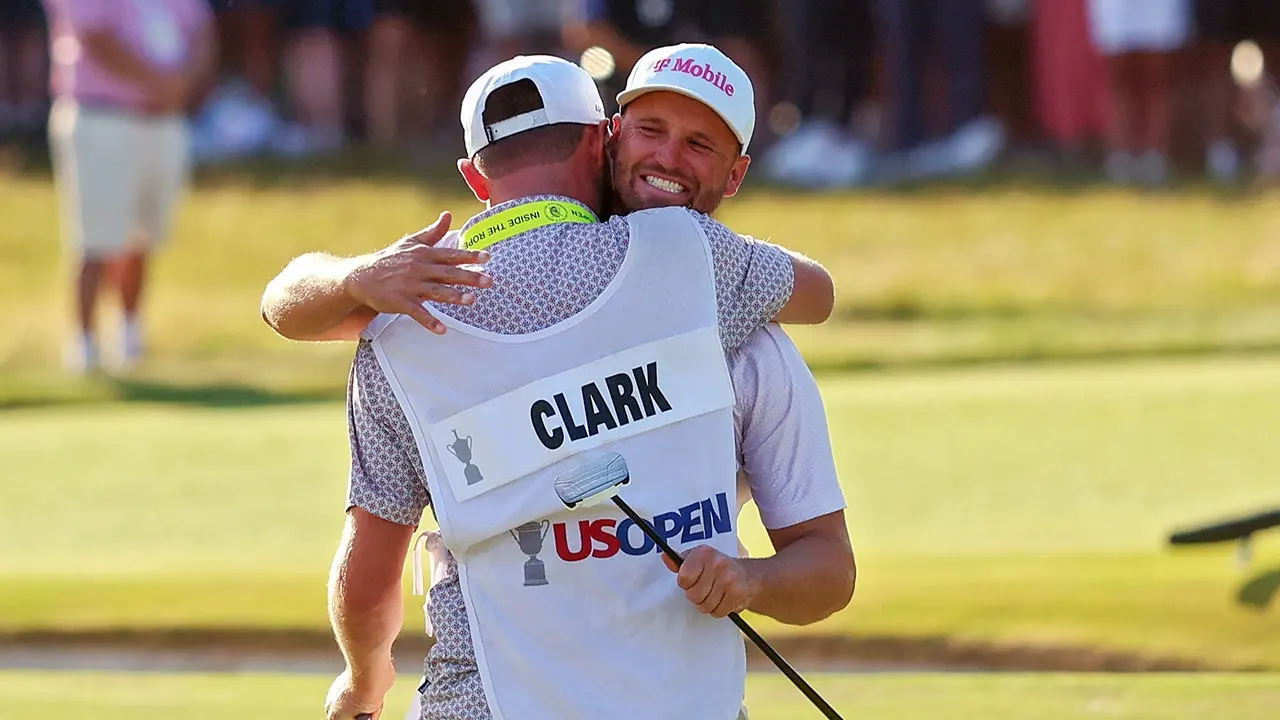
Even with the trophy in sight, the final holes of a major are designed to extract every ounce of drama, and Clark’s nerves frayed once more on the par-3 17th. A conservative tee shot left him an agonizing 70 feet from the hole, resulting in a three-putt bogey that sliced his cushion back down to a single, fragile stroke. Standing on the 72nd tee box, the equation was stark and simple: make a par, and become a immortalized two-time major champion. Though his drive leaked into the rough, Clark showed the poise of a seasoned champion by hacking his approach onto the green and executing a breathtaking 50-foot lag putt that settled just twelve inches from the cup, allowing him to tap in for a hard-fought par and a historic victory.
Beyond the statistics and the silver trophy, the triumph carried a deeply personal resonance for Clark, culminating in an emotional Father’s Day reunion on the green after his dad took a desperate, last-minute red-eye flight to New York to witness his son’s crowning moment. The victory also carried a broader significance for American golf, serving as a vital shield of national pride after European stars Rory McIlroy and Aaron Rai had claimed the year’s first two majors at the Masters and the PGA Championship. In weathering the storms of Shinnecock Hills, the hostility of the gallery, and his own internal doubts, Wyndham Clark did more than just win a golf tournament; he proved that true greatness is not measured by how easily you lead, but by how fiercely you fight when the world is rooting for you to fall.