





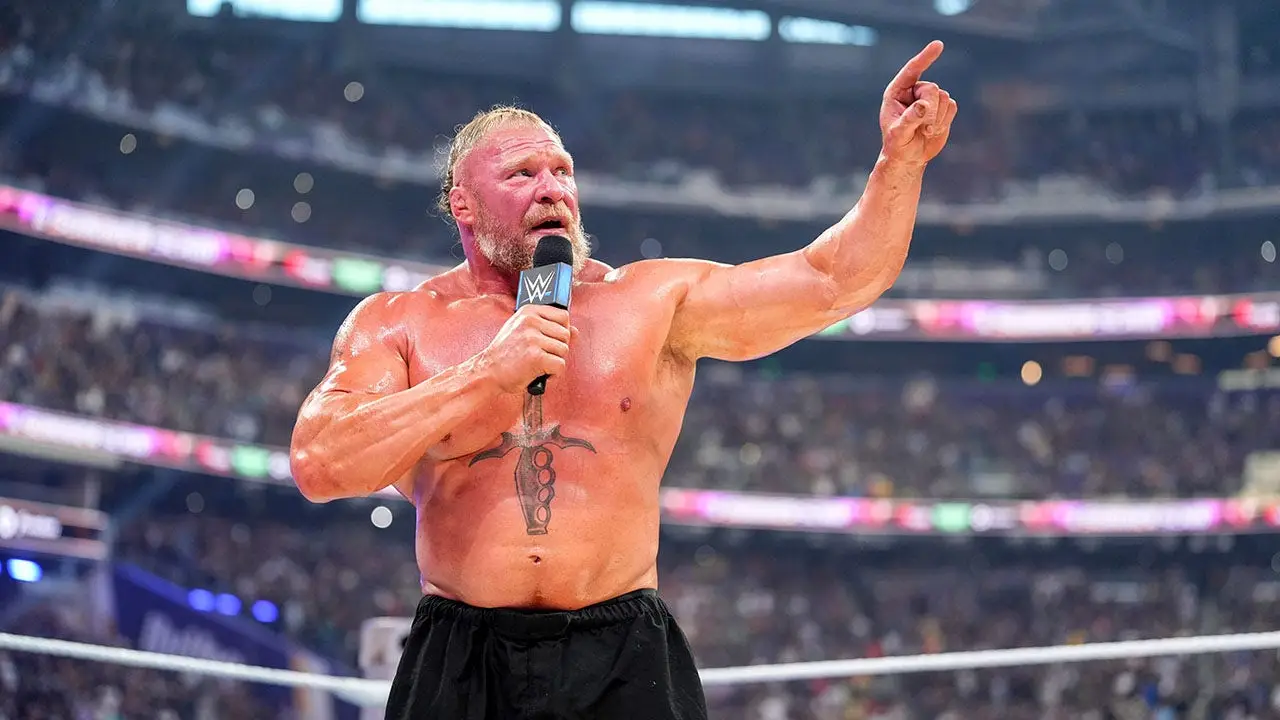
The world of professional wrestling has always been a landscape of larger-than-life characters, grand illusions, and scripted triumphs, but when Brock Lesnar sat down on The Pat McAfee Show this past Tuesday, there was no script, no bravado, and no illusion. Looking noticeably softened by the passage of time yet still possessing the imposing frame that made him a global icon, the 49-year-old titan chose this intimate, unfiltered platform to deliver a message that sent shockwaves through the sports entertainment universe: he is officially retiring from the squared circle. The announcement came mere days after his grueling, physically devastating encounter with Oba Femi in a Hell in a Cell match at SummerSlam—a match that was not just a showcase of athletic violence, but the final, definitive chapter of a legendary career. For over two decades, Lesnar had been portrayed as the “Beast Incarnate,” an unstoppable, mercenary-like force of nature who demolished opponents with terrifying ease. However, speaking to McAfee, Lesnar stripped away the terrifying persona to reveal a tired, deeply reflective man who had finally come to terms with his own physical mortality. He admitted that the emotional weight of Saturday night was overwhelming, a strange and surreal experience that forced him to confront the reality that his body could no longer keep pace with his indomitable spirit. He spoke with a quiet, arresting sincerity, expressing a profound gratitude to the millions of fans who had cheered and booed him across the globe, while making it absolutely clear that this was not a temporary departure or a storyline gimmick. The boots, metaphorically and literally, were being hung up for good, marking the end of one of the most dominant, chaotic, and mesmerizing eras in the history of professional sports.
To truly understand the weight of Brock Lesnar’s retirement, one must look beyond the championship belts and pyrotechnics to the very dirt from which he was carved. Before he was a multi-time world champion selling out stadiums worldwide, Lesnar was simply a farm kid from South Dakota, raised on long days of manual labor, isolation, and an unrelenting work ethic. He carried a massive, self-described “chip on his shoulder,” a burning desire to prove his worth to a world he felt owed him nothing. This driving, primal motivation propelled him from the amateur wrestling mats of the University of Minnesota, where he won an NCAA Heavyweight Championship, straight into the bright lights of the WWE, and later, to the absolute pinnacle of combat sports as the UFC Heavyweight Champion. Throughout his career, Lesnar existed as a fascinating paradox: a man who hated the spotlight and craved the quiet solitude of his remote farm, yet possessed a physical charisma so magnetic that he became one of the biggest pay-per-view draws in history. His journey was fueled by an unmatched competitive fire, a relentless pursuit of dominance that often made him seem more like a mythical creature than a human being. Yet, in his retirement address, it was this very farm kid who spoke loudest, expressing a humble, almost childlike wonder at the life he had been allowed to live, marveling that a boy from South Dakota could rise to such heights and survive to tell the tale at forty-nine years of age.
The road to this final retirement was paved with internal conflict, a classic struggle familiar to almost every legendary athlete who has ever tried to walk away from the game they love. The seeds of the end were actually sown back in April at WrestleMania 42, following Lesnar’s first shocking defeat at the hands of the rising star Oba Femi. In a highly emotional scene that seemed to signal the end, Lesnar left his wrestling boots in the center of the ring—a time-honored tradition in the wrestling industry indicating a superstar’s permanent departure. For weeks, the world believed the Beast had finally ridden off into the sunset, but the siren song of the ring, combined with the lingering belief that he still had “some fuel left in the tank,” pulled him back into the fray. He returned for a dramatic rematch at Clash in Italy, defying the odds to defeat Femi and prove to himself, if not the world, that he could still compete at the highest level. Yet, this temporary triumph only delayed the inevitable, setting the stage for the definitive, brutal climax at SummerSlam inside the unforgiving steel of the Hell in a Cell structure. It was here, as Femi slammed him with authority and reclaimed supremacy, that the illusion of invincibility finally shattered for Lesnar, forcing him to realize that while the mind was willing, the physical toll of sustaining such high-level violence was a debt he could no longer afford to pay.
What makes Brock Lesnar’s final exit so profoundly human, and perhaps his greatest contribution to the business, is the selfless manner in which he chose to pass the torch to Oba Femi. Throughout his career, Lesnar was often criticized by cynical corners of the wrestling community as a selfish businessman who cared only about his own paycheck and legacy. Yet, in his final arc, he shattered that narrative by entirely dedicating his remaining star power to cementing Femi as the undisputed future of the WWE. The physical passing of the guard inside the Hell in a Cell was a masterpiece of storytelling, but it was the post-match moment that will be etched in the memories of fans forever: a bruised, battered Lesnar slowly rising to his feet, raising Femi’s hand in victory, and walking out of the arena with tears streaming down his face. This rare display of vulnerability from a man who spent his life projecting absolute invulnerability was incredibly moving, showing a deep respect for the sacred locker room tradition of “going out on your shield” to elevate the next generation. By allowing Femi to defeat him so decisively, Lesnar ensured that his own exit was not just a nostalgic trip down memory lane, but a foundational stepping stone for the company’s future, proving that his love for the business ran far deeper than his own ego.
As the dust settles on his retirement, the sheer scale of Brock Lesnar’s legacy becomes impossible to ignore, leaving behind a resume that places him firmly on the Mount Rushmore of sports entertainment. He retires as a ten-time WWE champion, a two-time Royal Rumble winner, and the singular force who famously shattered The Undertaker’s legendary undefeated streak at WrestleMania, an achievement that cemented his status as the ultimate “special attraction.” Beyond the scripted accolades, Lesnar fundamentally revolutionized the financial and structural landscape of professional wrestling, proving that a part-time schedule coupled with undeniable, must-see star power could draw record-breaking audiences and elevate the entire industry. His presence on any card instantly lent it an aura of athletic legitimacy, bridging the gap between sports entertainment and legitimate combat sports in a way no one else ever could. In his final words on McAfee’s show, Lesnar bypassed the arrogance of his on-screen character to offer a sincere, heartfelt thank-you to God, his family, and the millions of fans who supported him through every twist and turn of his tumultuous journey. It was the closing statement of a man who knew he had left everything he had in the ring, comfortable in the knowledge that his place in history was secure and that he had earned the right to step away on his own terms.
Now, the quiet wilderness of the great outdoors awaits a man who spent his life surrounded by the deafening roar of tens of thousands of screaming fans. For Brock Lesnar, retirement is not a tragic end, but a hard-earned return to the peace and solitude he has always cherished, far away from the grueling travel schedules, the painful bumps, and the endless pressure of being the main event. He leaves the business healthier and more financially secure than almost any of his peers, a rare feat in an industry known for chewing up and spitting out its legends. As he retreats to his farm, leaving the bright lights of the WWE behind, he does so not with bitterness, but with a heart full of gratitude and a legacy that will inspire generations of athletes to come. The “Beast Incarnate” may have finally laid down his arms, but the mark he left on the world of professional wrestling is permanent, written in the sweat, blood, and tears of a farm kid who dared to dream big, fought his way to the top of the world, and had the wisdom to walk away when the work was done.