





The beautiful drama of the NBA playoffs lies in how quickly a narrative can completely flip on its head, transforming a seemingly doomed underdog into a triumphant titan over the course of just forty-eight hours. This shifting reality was the defining theme on Sunday night as the San Antonio Spurs took their home court for a high-stakes Game 4 of the Western Conference Finals, facing a relentless Oklahoma City Thunder squad that threatened to push them to the absolute brink of elimination. Entering the match trailing two games to one, the Spurs understood that a loss would hand the Thunder a nearly insurmountable three-to-one series lead, an emotional weight that has broken many veteran teams in basketball history. Driven by this palpable urgency, San Antonio channeled the nervous, electric energy of their home crowd into a ferocious, highly physical brand of basketball that ultimately culminated in a dominant 103-82 blowout victory. By the time the final horn buzzed through the rafters, the Western Conference Finals were deadlocked at two games apiece, completely wiping the slate clean and transforming the matchup into a dramatic, pressure-packed best-of-three sprint. This emphatic triumph was much more than just a mark in the win column; it was a profound psychological statement, proving that these young Spurs possess the poise and mental fortitude to match their jaw-dropping athletic potential under the most unforgiving lights of postseason basketball.
To understand how the Spurs turned a potential disaster into a triumphant masterclass, one must look closely at the tactical chess match taking place along the perimeter, where San Antonio’s coaching staff orchestrated an inspired defensive paradigm shift. In Game 3, the Thunder had played with a dazzling, almost effortless offensive fluidity, knocking down an incredible 44.7% of their three-pointers and shooting over 48% from the field to leave the Spurs scrambling in transition. Knowing that allowing Oklahoma City to find that same comfortable, rhythm-heavy pocket would spell certain doom, San Antonio responded in Game 4 with a suffocating, hyper-aggressive perimeter defense that physically harassed shooters and closed off passing lanes with manic energy. This defensive adjustment utterly paralyzed the Thunder’s high-powered offensive engine, holding them to a dismal 18% from beyond the arc as they converted a meager six of thirty-three long-range attempts, which translated to an overall field goal percentage of just 33%. While the Spurs’ own jump shots weren’t falling at an elite rate either—hitting just 27% of their three-pointers (9 of 33) and shooting only 39% from the field—they astutely recognized that when shots are not falling, a championship-caliber team must find alternative ways to put points on the board. San Antonio chose to embrace the grind, relentlessly driving into the paint, embracing physical contact, and getting to the free-throw line for thirty-two attempts compared to Oklahoma City’s eighteen. This gritty, blue-collar willingness to battle for every single inch of hardwood proved to be the ultimate difference-maker, establishing a physical dominance that the Thunder simply could not match.
The emotional trajectory of the game was established early in the first quarter, as San Antonio fed off the thunderous roars of their hometown fans to construct an early lead. Sprinting out to a nine-point cushion in the opening period, the Spurs played with a joyful, fluid confidence that had been absent in their previous losses, eventually extending their advantage to double digits by the halftime intermission. As the third quarter unfolded, the game plan shifted from a battle of execution to a war of nerves, with the Thunder visibly fraying under the relentless wave after wave of San Antonio’s defensive pressure. Oklahoma City’s high-IQ ball handlers began to make uncharacteristic mistakes, committing a staggering twenty turnovers over the course of the night—errors that the opportunistic Spurs immediately translated into twenty-five devastating transition points. Watching the Spurs run the floor in these fast-break moments was a sight to behold, a blur of silver and black slicing through the defense to convert easy layups and ignite the home crowd into a state of absolute euphoria. This relentless compounding of defensive stops and transition offense allowed the Spurs to build an insurmountable twenty-five-point lead, providing the coaching staff with the ultimate luxury in a grueling playoff series: the ability to rest their superstar starters for the entire fourth quarter, keeping them fresh for the battles that lie ahead.
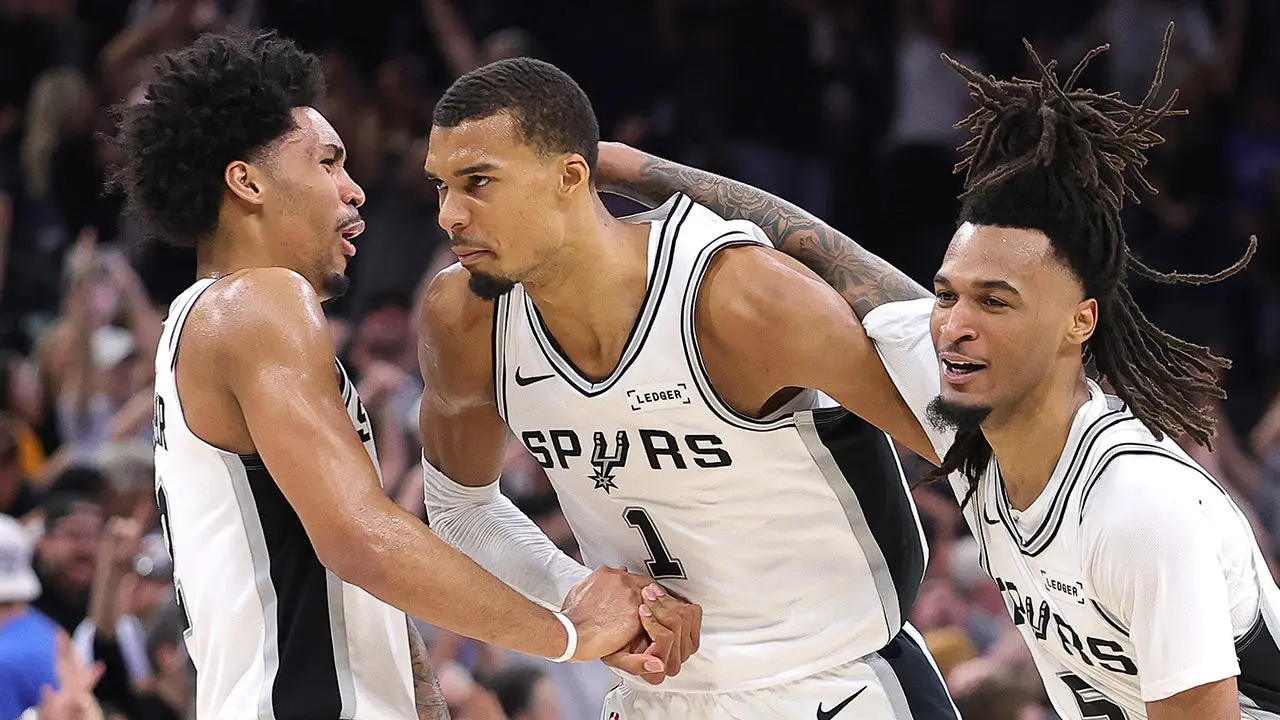
At the center of this basketball masterpiece was the towering, mesmerizing figure of Victor Wembanyama, who once again proved why he is not just a player, but a cultural and athletic phenomenon. After navigating through some challenging defensive coverages in the earlier games of the series, the young French prodigy returned to his most efficient, dominant form, leading all scorers with a magnificent 33-point performance on an economical 11-of-22 shooting display from the floor. Wembanyama wasn’t just scoring; he was orchestrating the game, knocking down three critical three-pointers, grabbing eight rebounds, and showing off his elite passing by dropping five assists to his cutting teammates. Defensively, he was a one-man security system, erasing three Thunder shot attempts at the rim and altering countless others with his preposterous wingspan. Yet, what makes this Spurs team truly terrifying is that Wembanyama did not have to carry the burden entirely on his own shoulders, as his supporting cast rose to the occasion with spectacular poise. Rookie sensation Stephon Castle contributed 13 points, three rebounds, and six assists, while the dynamic Devin Vassell also chipped in 13 points alongside six rebounds and three assists. Furthermore, veteran guard De’Aaron Fox provided a calming, masterfully balanced performance with a double-double of 12 points, 10 rebounds, and five assists, while reserve player Dylan Harper anchored the bench mob with seven points and five rebounds.
On the other side of this blowout stood a proud, exceptionally talented Oklahoma City Thunder team that suddenly found itself searching for answers in the cold light of defeat. Superstar guard Shai Gilgeous-Alexander, normally one of the most unflappable and mathematically efficient scorers in the modern game, endured a frustrating, highly physical night as he was swarmed by a rotating cast of long-limbed, aggressive Spurs defenders. Constantly forced into highly contested, difficult mid-range jumpers and denied his trademark driving lanes to the basket, Gilgeous-Alexander converted just six of his fifteen field goal attempts, a quiet night by his lofty standards despite a perfect seven-for-seven showing at the free-throw line to finish with seventeen points, four rebounds, and seven assists against four turnovers. The distress was not limited to their franchise player, as the Thunder’s highly touted depth, which had been a major factor in their Game 3 triumph, suddenly turned cold in the hostile San Antonio environment. Crucial bench pieces like Aaron Wiggins and Jared McCain, who had played like veteran heroes just days earlier, struggled immensely to find their rhythm, shooting a combined 3-of-21 from the floor for a mere eight points. This sudden lack of offensive production highlighted the brutal, unforgiving nature of postseason basketball, where a player can go from a celebrated hero to struggling for a basic bucket in the blink of an eye.
As the dust settles on Game 4, the focus of the entire basketball world turns squarely to Tuesday night at 8:30 p.m. ET, when this epic Western Conference Finals rivalry shifts back to the raucous, passionate environment of the Paycor Center in Oklahoma City. With the series now reduced to a thrilling best-of-three format, Game 5 stands as a critical, career-defining monument for both franchises, as the winner will secure a crucial three-to-two series lead and put themselves within touching distance of the NBA Finals. For the Thunder, the challenge is simple yet incredibly difficult: they must wash away the bitter taste of this blowout defeat, rediscover the cohesive ball movement and perimeter shooting that defined their regular-season success, and feed off the chaotic, deafening energy of their loyal home fans. Meanwhile, the Spurs must prove that their defensive intensity and transition mastery can travel on the road, attempting to conquer one of the most hostile venues in professional sports to seize complete control of the series. As these two young, ambitious powerhouses prepare to clash once again, fans are treated to the ultimate human drama—a high-stakes display of absolute athletic excellence, mental warfare, and the relentless, driving pursuit of basketball immortality.