




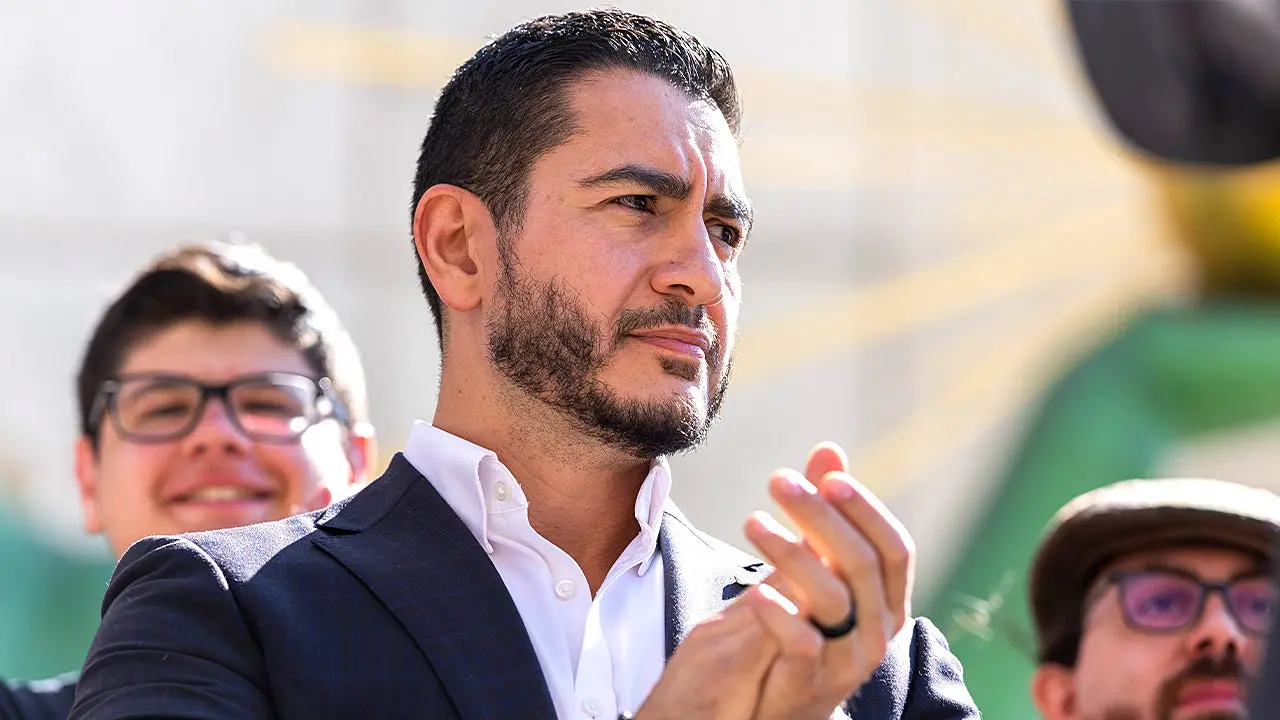
There are moments in American politics that land with the force of a cold front. They don’t just change a race; they change the way people talk about the country. For Jack Brewer, one of those moments came on primary night in Michigan, when physician and former Detroit public health director Abdul El-Sayed narrowly defeated U.S. Rep. Haley Stevens in the Democratic U.S. Senate primary. Brewer, a former Minnesota Vikings captain who has become a prominent conservative voice and a close ally of President Donald Trump, didn’t treat the result as just another intra-party squabble. He called it “a warning shot to America.” In Brewer’s eyes, El-Sayed’s victory was evidence that the Democratic Party has moved far to the left, into territory that once would have been outside the mainstream. El-Sayed ran on a progressive agenda that includes Medicare-for-all, higher taxes on billionaire wealth, campaign finance reform, and ending unconditional U.S. military aid to Israel. He will now face Republican Mike Rogers in November. Brewer admitted that he knew little about El-Sayed until the primary campaign entered its final weeks. But as he saw and heard more, he grew increasingly alarmed. “All I can think about is radical, right? And confused,” Brewer said. “It just seems like everything that comes out of his mouth is confusion. If he’s speaking confusion, that means we have a voting populace that’s confused themselves to be following a guy like this.” The bluntness was characteristic of a man who never learned to soft-pedal. It also set the tone for a broader conversation that would move through fear, anger, and finally a flicker of hope.
Brewer’s warning was not limited to Michigan. It was about the whole country, and he was careful to say that a single election victory by Donald Trump did not magically solve the problems that have been building for years. “When President Trump won the election, it didn’t fix everything,” Brewer said. “We’ve got a lot, lot of things to fix. And it’s pretty scary when you start to see these radical leftists starting to gain more and more power across the country.” He used a phrase that seemed almost poetic for a former athlete: “It’s good when you see the darkness before you.” To him, seeing the darkness isn’t a sign of despair; it’s a warning that helps you prepare. He believes El-Sayed’s rise is part of a broader pattern, one in which major cities and entire states fall under the influence of people whose ideas would transform American life in fundamental ways. It wasn’t any single policy about health care or taxes or foreign aid that set off alarms. It was the worldview behind those policies. Brewer kept returning to the word “confusion.” El-Sayed, he said, speaks in confusion, and the fact that such a candidate can win a major Senate primary means that too many voters are confused as well. In Brewer’s mind, that’s a dangerous combination. When people are confused, he argued, they are more likely to follow leaders who offer simple answers to complex problems, even if those answers would do real damage. He did not offer solutions. His immediate goal seemed to be awakening people to what he calls the radicalism creeping through American politics. The “warning shot” in Michigan, in his view, should be heard in every state, especially those that could decide the 2026 midterms.
Then the conversation turned to Minnesota, and Brewer’s voice changed. The alarm was still there, but it was joined by something like optimism. Michele Tafoya, the former NFL sideline reporter and a woman Brewer calls a friend, won Minnesota’s Republican U.S. Senate primary with 52.07 percent of the vote. Former Navy SEAL Adam Schwarze trailed with 23.96 percent, and former NBA player Royce White finished third with 11.15 percent. For Brewer, Tafoya’s victory was not just a win for Republicans; it was a sign that credible, grounded conservative candidates can still step forward in a state that hasn’t elected a Republican statewide since 2006. “I was very happy,” Brewer said. “Michele Tafoya, who’s a friend and someone that I highly, highly respect, it’s good to see grounded conservative voices stepping up in that state.” Tafoya will face Democratic Lt. Gov. Peggy Flanagan, who defeated U.S. Rep. Angie Craig in the DFL primary. Minnesota is not easy terrain for Republicans. Kamala Harris carried it in 2024 with 50.92 percent of the vote while Trump received 46.68 percent. But Brewer believes Tafoya is different. She has national name recognition from years on NFL broadcasts. She is not easily caricatured as an extremist. And Brewer thinks she can appeal to enough Democrats and independents to make the race genuinely competitive. “I think she has a chance to bring over enough Democratic voters and independents to win that election,” he said. “So, I’m praying for her.” It was a striking moment: a former Viking captain offering a prayer for the political future of the state he still loves, while warning that the same state is being led by people he considers dangerously out of touch.
The Republican primary in Minnesota also brought Royce White back into the national conversation. White, a former NBA player, finished third in the Senate race. But rather than leave the stage, he announced plans to declare for the 2027 WNBA Draft, joining Enes Kanter Freedom, another former NBA player, in what they both say is an attempt to test or protest the league’s eligibility rules for transgender athletes. The two men have announced that they identify as women for the purpose of professional basketball. Brewer, who said he has met White on several occasions, made it clear that he supports the effort. “I’ve met Royce on a couple occasions,” Brewer said. “A lot of respect for him. I think what he’s doing and Enes is doing is they’re trying to stand up for women.” The WNBA responded quickly and firmly, saying there were “no immediate eligibility matters” affecting the league and denouncing what it called bad-faith attempts to use the subject to demean or marginalize others. The league has not published a policy stating that surgery qualifies an athlete for the WNBA, and medical organizations have long noted that transgender identity does not require surgery and that many transgender people never pursue surgical treatment. For Brewer, however, the WNBA’s response only reinforced his conviction that the league is not being honest about the issue. He sees White and Kanter as warriors in a larger cultural battle, willing to make themselves controversial in order to ask questions that powerful institutions would rather ignore. Their declarations may never lead to actual games. But that almost misses the point. They have already sparked the debate that Brewer and others on the right have been hoping for—a debate about fairness, biology, and whether American institutions will defend women’s sports or abandon them to ideology.
Brewer’s deepest feelings about Minnesota came through when he was asked what he would tell Vikings fans before the midterm elections. He did not hesitate. “Stop supporting foolishness,” he said. “Enough is enough.” Those words might sound harsh from someone else, but Brewer has earned the right to be direct with Minnesota. He grew up a Vikings fan, attended the University of Minnesota, played for the Vikings, and then went on to a career in the NFL that included stops with three other teams. No matter where he traveled, he says, he never found another fan base like the one he left behind in Minneapolis. “I played for four NFL teams, and there is nothing like a Minnesota Vikings fan,” Brewer said. “These people will have you at home at their dinner table. They will cook for you. They’re the most hospitable people in the world, the nicest, most purest people in the world.” His love for those fans is precisely why he is so frustrated with the direction of the state. He believes Minnesota is full of commonsense people who are being represented by leaders who don’t share their values. “People have common sense in Minnesota,” he said. “My message to Minnesota is use the common sense that you have.” Then he made his most provocative remarks yet, saying, “Stop letting these people that have mental health issues represent you. You have people that are psychologically not there, and you’re allowing them to represent the state of Minnesota.” Brewer didn’t identify who he was talking about or offer any evidence to back up the charge. But he doubled down on his broader argument, saying the “woke left” is making a mockery of the state. “I wouldn’t even call them progressive,” he said. “There’s nothing about progress associated with these leftists. They’ve lost their minds.” In his mind, Minnesota is not a lost cause; it’s a sleeping giant that needs to remember its own common sense.
Taken together, Brewer’s remarks paint a picture of a country at war with itself. He is not a passive observer in that fight. As chair of Opportunity Now and vice chair of the Center for 1776 at the America First Policy Institute, he is deeply connected to the conservative movement that has shaped the Trump administration’s agenda. When he looks at El-Sayed’s victory in Michigan, he sees a movement that he believes is dangerous and growing. When he looks at Tafoya’s primary win in Minnesota, he sees the possibility of a conservative comeback in a state that Democrats have dominated for nearly two decades. And when he looks at White and Kanter’s WNBA challenge, he sees people willing to risk their reputations to raise questions about fairness and identity that too many leaders want to suppress. It is an emotional mix of fear and hope, anger and prayer. Brewer’s message to Vikings fans—“enough is enough”—could just as easily be his message to the country. He wants Americans to pay attention, to use common sense, to stop supporting foolishness, and to stand up for the values he believes made the nation great. He doesn’t claim that everything is broken beyond repair. In fact, he believes the opposite: that ordinary people can still turn things around if they wake up in time. Whether he is right is a question voters will answer in the 2026 midterms. But one thing is certain: Jack Brewer’s voice will continue to be a loud, unfiltered, and deeply human part of the conversation. Love him or hate him, he speaks with the passion of a man who believes the fight for America’s future is not just political. It’s personal. And he’s not about to stop fighting.