




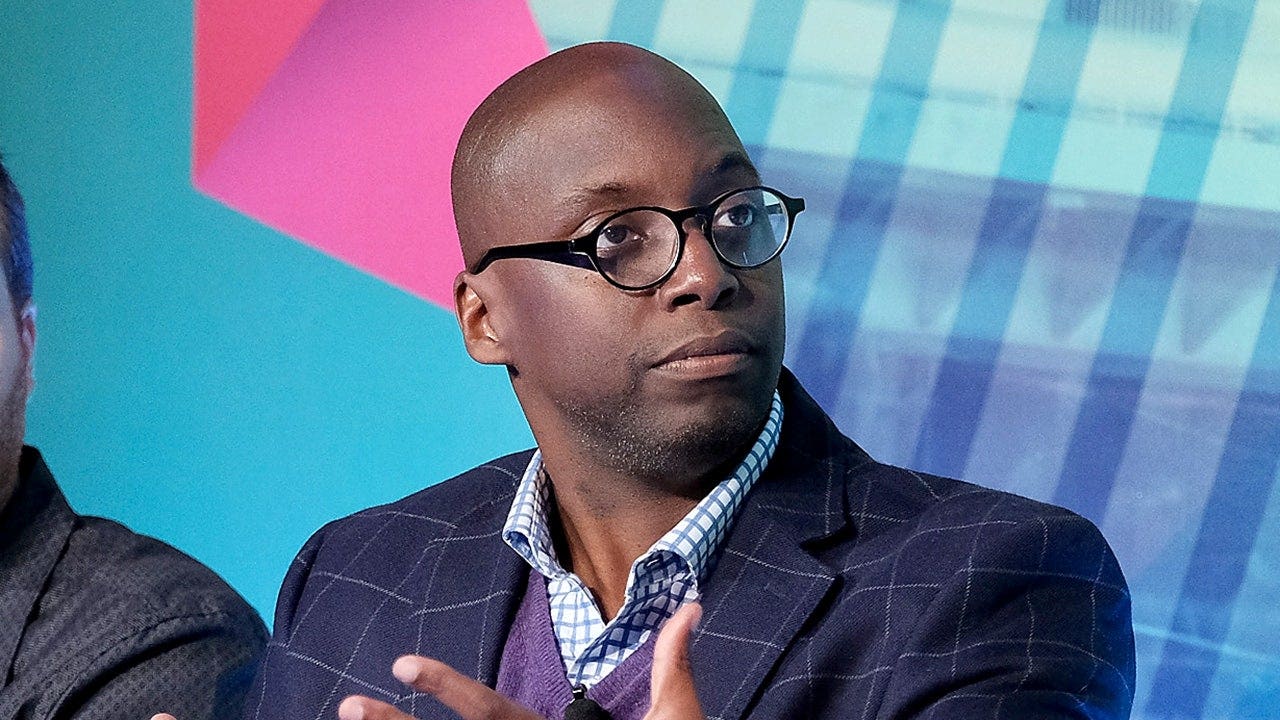
On Friday morning, viewers of NBC Sports’ PFT Live witnessed something that was as startling as it was human. Michael Holley, the 56-year-old co-host, was in the middle of a conversation with Mike Florio about Dallas Cowboys legend Troy Aikman’s recent remarks concerning his role as an analyst for ESPN’s Monday Night Football and his alleged conflict of interest with the Miami Dolphins. It was, by all appearances, a normal segment — two seasoned sports media professionals bantering about a complex story. But then the tone shifted in a way no script could have anticipated. Holley, who had been seated at his home studio desk, suddenly looked unwell. His movements became slightly unsteady, his eyes lost focus, and he began to sway. Within seconds, his body tipped backward, sliding out of his chair and out of the camera frame entirely. There was no dramatic collapse, no loud noise — just a quiet, unsettling fall. The program immediately cut to a commercial break. For viewers at home, the moment was jarring, leaving a mix of worry and confusion. It was a stark reminder that even the most polished on-air professionals are not invincible. They get tired, they get overheated, they get lightheaded — just like the rest of us. And sometimes, in a live broadcast, that vulnerability is exposed in real time, with no safety net and no retake.
The response from the PFT Live team was quick and reassuring, but it did not erase the concern that had rippled across social media. The show’s official account posted an update saying that Holley had become overheated in his studio at home, fainted, and — most importantly — was fine. The statement explained that the crew immediately went to commercial in order to get him assistance, and that he recovered quickly. Mike Florio, his co-host, later offered more detail to Awful Announcing, painting a clearer picture of what had led to the frightening episode. “Michael was in the studio at his home,” Florio said. “It’s very warm in there. He hadn’t had anything to eat or drink before the show. He became overheated during the show and passed out.” Florio added that he didn’t notice his colleague’s condition until Holley slumped in his seat, because he was looking directly at the studio camera rather than at the monitor. Once he realized what was happening, the show took a break right away to get help. That kind of quick, instinctive reaction is a testament to the bond and professionalism of the team. But Florio’s words also highlighted a deeper truth: the simple, everyday factors that can derail a person’s body without warning. A warm room. An empty stomach. No water in reach. A long day of talking and thinking. Underneath all the lights, cameras, and sports talk, Holley was just a man trying to do his job under less-than-ideal circumstances.
To understand who Michael Holley is beyond that moment of weakness, it helps to look at the path he took to that chair. Holley is a veteran journalist and broadcaster whose career spans decades and multiple major publications. He wrote columns for the Boston Globe, the Chicago Tribune, The Plain Dealer, and the Akron Beacon Journal, building a reputation as a sharp, thoughtful sports writer who valued storytelling as much as analysis. For 13 years, he was also a familiar voice on Boston sports radio station WEEI, where he connected with listeners through his wit, calm demeanor, and genuine love of conversation. In 2020, Holley joined NBC Sports and Peacock, bringing his experience and perspective to a national audience. By 2024, he had become a regular rotating co-host of PFT Live, the popular ProFootballTalk program that blends NFL news with personality-driven commentary. He was not just a fill-in; he was a vital part of the show’s chemistry, offering a measured counterpoint to Florio’s energetic takes. His colleagues respected him. Viewers appreciated his frankness. And his presence on a demanding, daily live show was proof of his enduring passion for the craft. But careers like his come with real physical costs. Live broadcasting is more stressful than it looks. There is constant pressure to be sharp, informed, and entertaining. There are early mornings, tight deadlines, and little patience for fatigue. For Holley, a man in his mid-50s who has spent his life in the media industry, the job has always been a labor of love. Yet that Friday morning, his body quietly demanded a pause — a reminder that no amount of experience or professionalism can outrun biology.
While doctors were not called and Holley did not require emergency medical care, the incident raises important questions about health and safety during live television production — especially for those working from home. Since the pandemic, many broadcasters have continued to use home studios, which often lack the climate control, lighting rigs, and support staff of a traditional television studio. A small room with a camera, a microphone, and the hot glow of studio lights can quickly become uncomfortable. Add to that the natural anxiety of a live show, the lack of snacks and water within reach, and the tendency to skip basic self-care on busy days, and the risk of fainting or becoming lightheaded increases significantly. The medical term for what Holley experienced in that warm room after not eating or drinking is likely vasovagal syncope or heat-related orthostatic hypotension — a temporary drop in blood flow to the brain that can cause a person to pass out. It is common, usually harmless, and often triggered by dehydration, heat, standing too quickly, or prolonged periods without food. But it is also a warning sign. The body was telling Holley, and everyone watching, that he needed to slow down. It is a lesson that resonates far beyond the sports media world. So many of us push through fatigue, skip meals, ignore thirst, and pretend that we can operate like machines. But bodies are not machines. They need fuel, water, and rest. And when ignored, they will find a way to remind us — sometimes in the most public, embarrassing, and frightening way possible.
The reaction to Holley’s faint was immediate and overwhelmingly kind. On social media, fans and fellow journalists expressed relief that he was okay, while also sharing their own stories of fainting, overheating, and working through exhaustion. That shared empathy is worth pausing over. In a culture that often values productivity and toughness above all else, moments like this give us permission to be honest about our own limits. We saw a professional who is usually composed and confident fade in real time, and it made him more relatable, not less. It also underscored how fragile the boundary can be between a normal workday and a medical incident, especially for those whose jobs put them in front of cameras. When you are live on television, there is no pause button. You cannot ask the audience to wait while you drink a glass of water or catch your breath. The pressure to keep going, to stay composed, to avoid making a scene, can be overwhelming. Holley’s fainting spell was not a sign of weakness; it was a sign of his commitment to his work. But it also serves as a cautionary tale for employers and producers: broadcasters are human, and their well-being must be treated as seriously as their performance. Perhaps it will inspire more conversations about hydration, breaks, and reasonable accommodations for those working in less-than-ideal conditions. Perhaps it will remind colleagues to check on each other. Or perhaps it will simply remind viewers that the people on their screens are not so different from them — vulnerable, sometimes unsteady, but worthy of care.
In the end, the story of Michael Holley’s on-air faint is not really about the faint at all. It is about recovery — the quiet, sometimes awkward process of getting back up after a fall, both literally and figuratively. The show’s statement confirmed that Holley recovered quickly and was fine, and that is the detail that matters most. He will likely be back in that studio, talking football with Florio, laughing at a joke, or shaking his head at a bad take. But something will have changed, perhaps subtly. He might arrive with a bottle of water. He might bring a snack. He might take a moment to sit in the cool air before the cameras turn on. And that is a good thing. We all deserve the chance to learn from our bodies’ signals and to take care of ourselves a little more seriously. Holley has spent decades covering athletes, analyzing their performances, and holding them to high standards. On Friday, he showed us something just as valuable: how to be vulnerable, to accept help, and to emerge okay on the other side. The sportsworld is noisy and relentless, but in that moment, the noise stopped. The only thing that mattered was that a good man, a talented journalist, and a beloved colleague was safe. And he was. That is the real story — not the fall, but the outpouring of concern and relief that followed. As Holley himself might say, with a wry smile, it is just another day in the unpredictable world of live television. But for everyone watching, it was a reminder to breathe, to slow down, and to remember that our health always comes first. We are glad he is okay. And we hope he drinks a glass of water tomorrow.