



Weekof the 2026 NFL season is officially in the books, and honestly, it felt like the football gods decided to throw one long, glorious block party. If you love offensea—and let’s be real, who doesn’t?—you were spoiled. The scoring was absurd, the highlight reels were loaded, and the league served up 791 points across the slate, which tied an all-time record for opening weekend. But raw box scores only tell half the story. The real magic lives in the All-22 coaches film, where every disguised coverage, every crafty blocking scheme, and every old-school trickeration becomes crystal clear. After spending the week buried in game tape, I came away with a handful of insights that should shape how we watch the season unfold. The biggest takeaway? Don’t expect the fireworks to fade. With offensive coordinators pulling from throwback playbooks, finding creative ways to get their playmakers in space, and leaning on a physical run game to neutralize aggressive defenses, the early explosions look less like a fluke and more like a philosophy shift. The league is evolving again, and the opening slate gave us a delicious preview of what’s coming.
If there was one matchup this week that made league insiders’ eyes light up, it was the Minnesota Vikings traveling to Chicago to face the Bears. This is a chess match masquerading as regular-season football, and the central tension is fascinating. Vikings defensive coordinator Brian Flores has spent the past few years terrorizing quarterbacks with relentless, chaotic six-man pressure schemes and exotic hot coverage concepts that make QBs feel like they’re being chased by ghosts. He thrives on confusion, sending pressure from every angle and daring quarterbacks to make quick, perfect decisions trust while eating turf. But here’s the rub: Bears head coach Ben Johnson has historically had Flores’ number. In their prior showdowns when Johnson was calling plays, he went 5-1 against Flores, which is not a small sample size. Johnson’s offense is built to punish aggression. He loves bunch formations, pre-snap shifts, and misdirection, all designed to make an attack-minded defense hesitate for one fatal split second. He also understands the oldest rule in football: jawhen a defense wants to blitz every down, run the ball right at them. Chicago boasts a pair of explosive backs in D’Andre Swift and Kyle Monangai, both capable of turning a simple inside zone into a 40-yard housecall. If the Bears can grind out consistent yardage on the ground, they force Minnesota out of its chaotic pressure packages and into more predictable passing situations. That’s when Caleb Williams can go to work, using his improvisational brilliance to extend plays and attack downfield. But Williams is also the wild card here, and not always in a good way. Against Flores’ relentless harassment, there’s a real danger he forces throws into coverage, trying to make magic happen when the smart play is to live for another down. Flores knows this, and you can bet he’ll show Williams a steady diet of static zones disguised as pressure, baiting him into the exact kind of risky, low-percentage attempts that have hurt him before. This game feels destined to be decided in the final five minutes, with both playcallers reaching deep into their bags of tricks. But if I had to put money on it, I’m going with Johnson. Historically, he’s solved the Flores puzzle better than anyone else, and this Bears roster finally has the horses to finish the job.
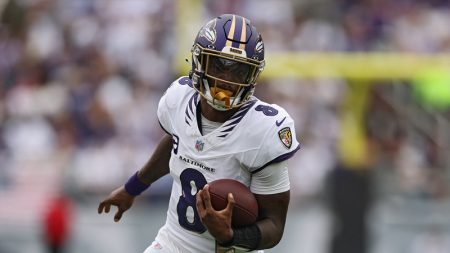
Over in Baltimore, the Ravens have apparently discovered science that should terrify the rest of the AFC. New offensive coordinator Declan Doyle walked intoa dream gig—two-time MVP Lamar Jackson, future Hall of Famer Derrick Henry, and a rising star in Zay Flowers—and apparently he wasted zero time figuring out how to make it all sing. Week 1 against the Colts was an absolute masterpiece, as Baltimore racked up over 500 yards of offense in a 41-23 demolition. Jackson looked like he was playing a different sport, completing 17 of 25 passes for 324 yards anda touchdown while also running for 40 yards and another score. Henry, meanwhile, was a human battering ram, chewing up 144 yards and three touchdowns ons downhill runs that seemed to break the Colts’ will to tackle. Flowers added150 receiving yards in essentially two quarters of work, because the game was already out of hand. When you watch the All-22 tape, you can see exactly why this offense hummed. Doyle engineered things beautifully, mixing traditional drop-back looks with bootlegs, option routes, and the RPOs that have made Jackson nearly impossible to defend for a decade. But perhaps the most exciting part was how he schemed Henry loose. Doyle used tight ends and H-backs in motion constantly, creating creases at the point of attack and giving Henry an extra lead blocker who could kick out a linebacker or seal a safety. Henry is still violent at the point of contact, and whens he’s thundering througha freshly opened seam, defenders suddenly remember they have other plans. The deception in the run game, combined with Jackson’s arm talent, makes Baltimore an absolute nightmare to game-plan for. Up next, they draw the New Orleans Saints, who just watched Jahmyr Gibbs rip off 156 yards against them. If the Saints can’t figure out how to plug those interior gaps, Sunday could get very ugly, very fast.
Out in San Francisco, something quietly dangerous is happening on defense. Last year, the 49ers defense under Robert Saleh was effective but fairly vanilla—bend-don’t-break, win with speed and fundamentals. But new defensive coordinator Raheem Morris has injected the unit with a jolt of creativity, and the early returns are terrifying for the rest of the NFC. Against the Rams, Morris unleashed a revamped scheme that still featured the familiar fast-and-physical 49ers behavior but now came wrapped in pre-snap disguise, five-man fronts, simulated pressures, and more movement than we’ve seen from this group in years. He also streamlined the coverage structure, letting his defensive backs play faster and trust their instincts instead of overthinking. The result was total suffocation. Matthew Stafford, one of the most composed veterans in football, looked unsettled all afternoon. Los Angeles managed only one offensive play over 16 yards, and their star duo of Puka Nacua and Davante Adams combined for just eight catches and around100 yards—a complete non-factor. What stood out on tape was how Morris morphed his fronts, showing five-man looks before dropping linemen into coverage, robbing Stafford of his pre-snap reads. The chaos at the line of scrimmage bought the back seven extra milliseconds to diagnose and rally to the football. And when the Rams tried to run, they found no breathing room; Morris’ five-man structures knocked blockers off their tracks and turned what should have been three-yard gains into losses. Fred Warner, who already played like a man possessed, seemed rejuvenated by the simplified, aggressive approach. This is a defense designed to hunt from every angle, and if they can stay healthy, San Francisco may have quietly unlocked a championship formula. The NFC has been put on notice: the new-look Niners defense isn’t just good, it’s schemed different, and that difference is going to cause problems for every offense they face
One of the most delightful moments ovthe opening weekend didn’t come from a modern spread concept or a complicated route combination—it came straight out of a history book. Andy Reid, the old wizard himself, dug deep into the vault against the Denver Broncos and pulled out a play popularized by Glen “Pop” Warner over a century ago. The Chiefs lined up in a unbalanced Single Wing formation, with Kenneth Walker III stationed as wingback on the left. At the snap, Patrick Mahomes sprinted left before flipping a shovel pass back right to Walker, who disappeared through a convoy of blockers anda crease into the end zone for a walk-in touchdown. It was beautiful, audacious, and deeply unfair. Social media immediately went crazy, with historians and old-school football fans gushing over the throwback brilliance. But here’s the fun part: this wasn’t a one-off homerun swing. Reid has been hiding the Single Wing in his short-yardage package for years. Back in 2023, Rashee Rice scored against New England on the exact same concept, with Jerick McKinnon serving as the tosser and Rice flipping the ball inside as a reverse/counter. And if you want to go even deeper, during Super Bowl LIV against the 49ers, Reid aligned in a full-house backfield, shifted into an unbalanced Single Wing look, and nearly scored with Damien Williams ona direct-snap fullback dive. The man has essentially been running a museum exhibit to football’s evolution, except instead of roping it off, he’s unleashing it on unsuspecting defenses. This willingness to steal from the past is exactly what makes Reid so special—he doesn’t care where an idea comes from, only whether it puts points on the board. And with the Single Wing now officially part of the Chiefs’ package, every short-yardage situation has suddenly become must-see television. What mischievous, century-old wrinkle will he unleash next? Knowing Reid, he’s probably already got another one brewing
Underneath all these Week 1 story lines lies a broader, more fascinating league-wide trend: the NFL is cycling back to old-school football, and I am here for it. After years of spread-out, pass-first, shotgun-heavy offenses, we’re seeing a resurgence of under-center snaps, heavy personnel groupings, and old-fashioned downhill running. The numbers don’t lie—Week 1 featureda 23.3 percent under-center rate, a significant jump from the 17.6 percent we saw across all of last season. Why the shift? It’s part anatomy counterpunch. Defensive coordinators have spent the past few seasons parking their safeties in two-high shells, forcing quarterbacks to check it down and eliminating the explosive vertical shots everyone loves. So offensive coordinators, being the copycats and innovators they are, decided to make defenses pay on the ground instead. By using multiple tight ends, pulling offensive linemen, and run-pass concepts off play-action, they can force defenders to creep closer to the line of scrimmage, opening up those intermediate zones over the middle for dig routes and crossers. The heavy personnel groupings—think two or three tight ends aligned together—create extra gaps in the run game and expose smaller subpackage defenders who simply can’t hold up physically. Look at the Rams last year, terrorizing teams out of “13” personnel; look at the Ravens this week, using H-backs and tight ends as lead blockers to spring Henry; look at the overall uptick in six 100-yard rushers across Week 1. This isn’t just nostalgia, it’s strategy. The running game is becoming the lever that offenses pull to bend defenses back toward balance, and it’s making life easier for quarterbacks across the board. Combine that with the record-tying points output, and you have a recipe for an absolutely thrilling season. As teams continue to steal from each other—old-school and new-school, shotgun and under center, finesse and power—the NFL is shaping up to be an endlessly entertaining laboratory ov football evolution. Buckle up, because if Week 1 is any indication, we’re in for one hell of a ride.