

Paragraph 1: The Weight of a Decision
In the heartland of college football, where autumn Saturdays are practically a state religion, the Nebraska Cornhuskers have finally answered the question that has been simmering through the sweltering summer months: who will take the first snap under center? On a decisive Saturday, head coach Matt Rhule stepped before the press to deliver the news that fans in Lincoln had been craving—and dreading—depending on their loyalty. The starting quarterback for Week 1 against Ohio is none other than Anthony Colandrea. The announcement wasn’t just a roster move; it was a declaration of intent, a bridge between the uncertainty of last season and the desperate hope for a resurgent tomorrow. Colandrea, a transfer with a nomadic football journey, arrived in Nebraska carrying more than just a playbook. He brought a swagger, a fiery competitiveness, and a resume that reads like a redemption arc. This is a program that finished a middling 7-6 last year, a record that tastes like ash to a fan base that still dreams of the Tom Osborne era. The pressure is immense, and the choice of Colandrea signals that Rhule is done with patience and ready for production. He is betting the farm on a quarterback who doesn’t just manage games but aggressively attacks them. As the sun set over Memorial Stadium, the air was thick with anticipation, knowing that the Cornhuskers’ fate in 2025 would hinge entirely on the arm and legs of a player who has already lived through the highs of a conference title and the lows of being a backup. The decision was made, and now the real work begins.
Paragraph 2: The Pilgrim’s Journey of Anthony Colandrea
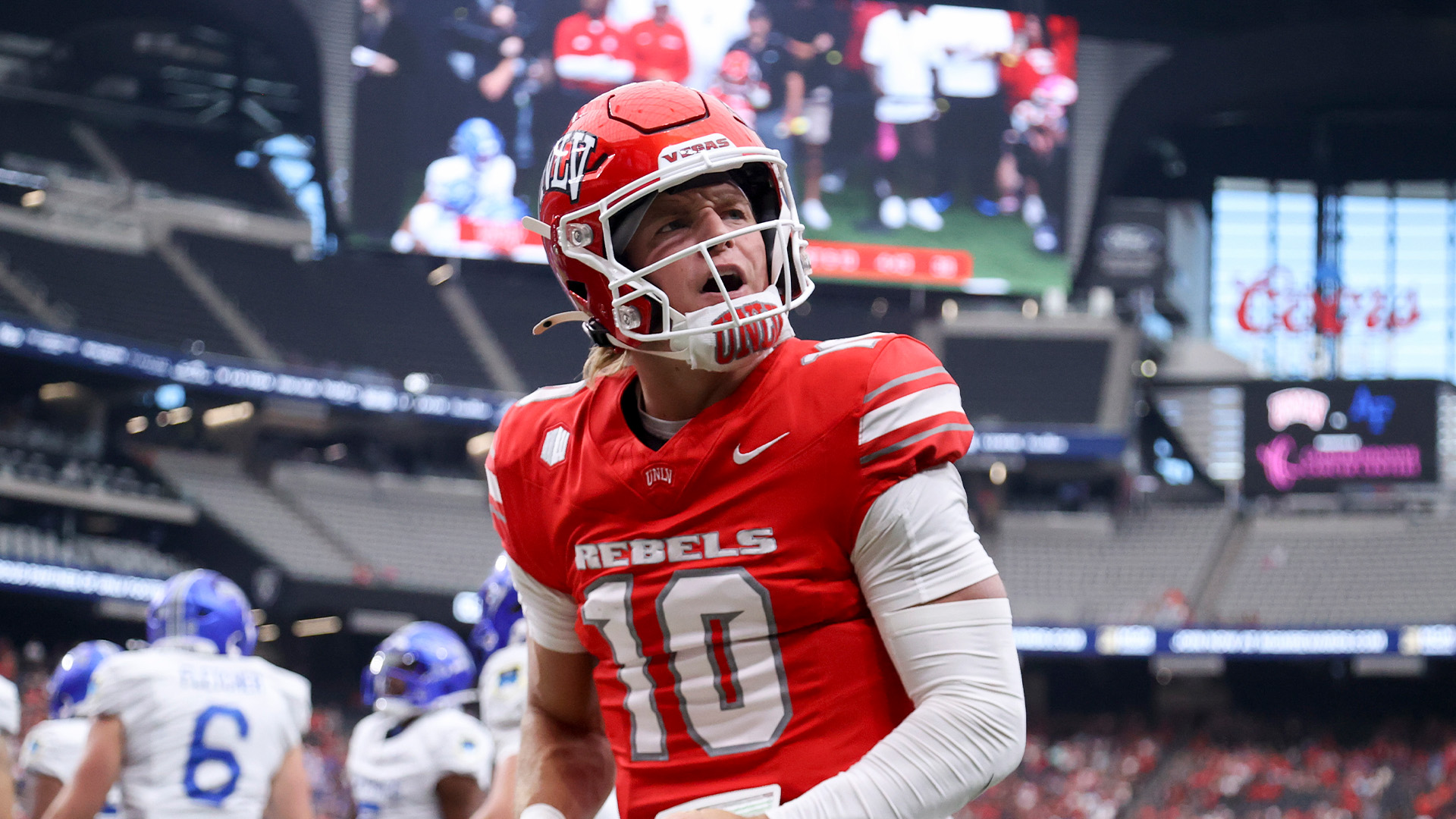
To understand why Anthony Colandrea is now the face of Nebraska football, you must trace the winding road that brought him here. His story is one of resilience, adaptation, and an unquenchable desire to prove doubters wrong. Initially, Colandrea spent two seasons with the Virginia Cavaliers, where he showcased flashes of brilliance but never fully cemented himself as an untouchable starter. Rather than settle, he packed his bags for the desert, joining UNLV in the Mountain West Conference. It was there that he truly exploded. In his lone season with the Rebels, Colandrea put together a statistical masterpiece: 3,459 passing yards, 23 touchdowns against just nine interceptions, and a staggering 649 rushing yards with ten additional scores on the ground. His dual-threat ability became the stuff of legend, culminating in him being crowned the Mountain West Player of the Year. He led UNLV to a 10-4 record and a 6-2 conference mark, silencing critics who believed he was merely a system quarterback. But beyond the numbers, what stands out is his temperament. Coaches describe him as “very competitive, very fiery,” a player who expects to win every single rep. He doesn’t have the chilling calm of a prototypical pocket passer; he has the restless energy of a gunslinger. This is precisely why Rhule fell in love with him. In a world of robotic quarterbacks, Colandrea is a human lightning rod, capable of extending plays with his legs, launching deep bombs, and making defenders miss in the open field. His arrival in Lincoln wasn’t just a transfer; it was a marriage of a roaring fire with a program desperately seeking a spark.
Paragraph 3: The Battle for the Throne and the Ghost of Raiola
The quarterback room in Nebraska was never going to be a quiet place. The departure of Dylan Raiola to the Oregon Ducks left a crater-sized hole in the offense, and the battle to replace him was intense. For months, Colandrea competed against TJ Lateef and Daniel Kaelin, two talented signal-callers who each brought their own unique skill sets. Lateef, who had taken over for Raiola after a season-ending injury in Week 9 against USC, finished with a 1-3 record as a starter—a stark reminder of how unforgiving the Big Ten can be. Kaelin, meanwhile, represented the raw potential of a homegrown prospect. But Rhule was unequivocal in his assessment on Saturday, stating, “Anthony would play for us right now.” These words were not just a nod to Colandrea’s talent; they were a calculated psychological move to end any speculation and unite the team. Rhule elaborated, praising Colandrea’s ability to discipline himself, make smart checks in the run-pass game, and still take deep shots downfield. It’s a delicate balance—being aggressive yet wise—that Colandrea has honed over years of trial and error. The ghost of Raiola still lingers, but Rhule effectively exorcised it by handing the keys to a proven winner. The locker room now knows who the leader is, and that clarity is invaluable. For Lateef and Kaelin, the competition isn’t over; they remain one injury away from the spotlight, but for now, they will serve as reliable backup options, learning from a veteran who has seen it all.
Paragraph 4: Rebuilding the Arsenal Around the New Signal-Caller
A quarterback is only as good as the orchestra around him, and Rhule has been busy sharpening the Cornhuskers’ offensive instruments. The most critical addition is wide receiver Kwazi Gilmer from UCLA, a transfer who led the Bruins with 50 receptions, 535 receiving yards, and four touchdowns last season. Gilmer provides a reliable, explosive target on the outside, giving Colandrea a safety valve who can stretch defenses vertically. But the attrition is real: the team loses Emmett Johnson to the NFL Draft, their leading rusher who provided a steady ground game. This is where Colandrea’s unique dual-threat capability becomes essential. With 649 rushing yards and ten touchdowns on the ground last year, he effectively becomes the team’s second running back, and sometimes even the primary one. Rhule understands that football isn’t played on paper; it’s played in the trenches and in the open field. By adding Gilmer and retaining a solid offensive line, the Cornhuskers are constructing a scheme that marries short, efficient passes with explosive deep shots and designed quarterback runs. The creativity of the offensive coordinator will be unleashed, knowing that Colandrea can turn a broken play into a 20-yard scramble. Defenses in the Big Ten will have to pick their poison: load the box to stop the run and risk being burned deep, or drop back in coverage and allow Colandrea to scramble for chunks at a time. It’s a beautiful problem to have, and one that Nebraska hasn’t enjoyed in years.
Paragraph 5: The Stage is Set for a Season of Redemption
As September 5th approaches, the schedule presents a poignant opening act: a home game against Ohio. While Ohio is not a powerhouse, they are a solid, well-coached team that will present a litmus test for the new-look Cornhuskers. For the fan base, this game is less about the opponent and more about the statement—a chance to see their beloved team take the field with a renewed identity. The previous season’s 7-6 record was a bitter pill, filled with close losses and late-game collapses. Now, with a quarterback who refuses to lose, there is a palpable sense that the culture is shifting. Colandrea’s fiery demeanor is contagious; he elevates the practice tempo, demands perfection in the film room, and brings an infectious passion that has already won over his teammates. The conference slate looms large, with brutal tests against Michigan, Ohio State, and Penn State, but Nebraska’s path to a bowl game—or even a drastic improvement—looks far more promising than it did just a month ago. Rhule, a coach known for rebuilding programs, has finally found his general on the field. The synergy between coach and quarterback is the most critical relationship in football, and early signs indicate a profound mutual respect. The Cornhuskers are no longer looking for a savior; they have one, and his name is Anthony Colandrea. The only question left is whether the team can coalesce around his brilliance and transform potential into victories.
Paragraph 6: A Future Forged in Fire and Belief
Ultimately, this announcement transcends X’s and O’s. It is a story about second chances, stubborn faith, and the relentless pursuit of greatness. Anthony Colandrea is a testament to the idea that a player’s journey is rarely linear. From Virginia to UNLV to Nebraska, he has carried a chip on his shoulder the size of the Lincoln skyline. He has choked in big moments, learned to breathe, and emerged as a champion. For Matt Rhule, this decision is a declaration that he is through with rebuilding phases and ready to compete for championships. The Nebraska Cornhuskers have a rich history, but recent decades have been marked by mediocrity. Now, they have a quarterback who embodies the grit and tenacity of the state itself—a player who will run through a wall for his coaches and teammates. As the countdown to kickoff begins, the streets of Lincoln will buzz with renewed optimism. Tailgates will be louder, jerseys fresher, and hopes higher. The season may not end with a national title, but it will begin with a belief that every play, every drive, and every game is winnable. Colandrea is not just the starting quarterback; he is the symbol of a program standing at the precipice of a new era. The die is cast, the commitment is made, and now all that remains is the beautiful chaos of autumn football. By the time Ohio arrives, the Cornhuskers will be ready to roar, and at the center of it all, a fiery young man will hold the ball, look down the field, and dare the world to stop him. That, in its purest essence, is the human spirit of college football.