






The World Cup has always been far more than a mere collection of sporting events; it is a global stage where geopolitical narratives, cultural identities, and personal dreams collide in a spectacle of human emotion. On a crisp Monday night, the tournament delivered yet another chapter of pure, unadulterated drama that will be talked about for generations, proving once again that football possesses a unique magic capable of defying all logical expectations. The highly anticipated clash between the Netherlands and Morocco was billed as a battle of styles and legacies. The Dutch, draped in their iconic orange, entered the pitch carrying the heavy but proud mantle of their nation’s rich footballing history—a history defined by “Total Football,” tactical innovation, and a perennial status as championship favorites who have so often come agonizingly close to ultimate glory. Across from them stood Morocco, a team representing not just a country but the hopes of an entire continent and the Arab world, riding the wave of their historic, barrier-breaking run in the 2022 World Cup in Qatar. Millions of fans around the world tuned in, expecting a tactical chess match, but what they received was a deeply human story of resilience, heartbreak, and spiritual triumph. The atmosphere in the stadium was electric, a swirling cauldron of deafening chants, rhythmic drumming, and a sea of vibrant red, green, and orange. Every pass, every tackle, and every tactical shift was magnified by the collective anxiety of supporters who knew that in the knockout rounds, there is no tomorrow. For ninety minutes, these two teams pushed their physical and mental limits, embodying the sheer passion that makes the World Cup the most watched and beloved event on the planet, setting the stage for a dramatic climax that no scriptwriter could have ever envisioned.
As the match progressed into its final moments, the tension inside the stadium grew thick enough to cut with a knife, with both sides searching desperately for a breakthrough. The Netherlands, showing the tactical patience and technical superiority that has made them a constant threat in international football, began to apply relentless pressure on the Moroccan defense, probing for the slightest vulnerability. That moment arrived late in the half when a chaotic sequence in the Moroccan penalty area left the ball bouncing loose—a goldmine of opportunity in a game of such thin margins. Cody Gakpo, the brilliant Dutch forward who has quickly become the talismanic symbol of his nation’s offensive prowess, reacted with the lightning-quick instincts of a natural-born striker. Shrugging off his marker, Gakpo seized control of the stray ball and, with exquisite precision and composure, lashed it into the back of the net, sending the Dutch supporters into a state of absolute delirium. To many observers, this felt like the definitive blow, the moment where the traditional powerhouse reasserted its dominance and secured its passage to the next round. The Dutch players celebrated with a mixture of joy and immense relief, believing that their meticulous game plan had finally broken the stubborn Moroccan resistance. It was a goal that epitomized the cold, clinical efficiency of European football at its highest level, leaving Morocco with only a few fleeting minutes to salvage their World Cup dream.
Yet, if football has taught us anything over the years, it is that a match is never truly over until the referee blows the final whistle, and desperation has a unique way of fueling miracles. Refusing to succumb to defeat, the Moroccan side dug deep into their reserves of physical stamina and mental fortitude, launching a furious, numbers-forward assault against the Dutch defense in stoppage time. With the clock ticking down and the fans holding their breath, Morocco won a crucial opportunity in the attacking third, throwing caution to the wind. In a moment of pure athletic brilliance and sheer determination, Issa Diop anticipated the flight of a desperate cross, rising above the towering Dutch defenders like a man possessed. With perfect timing and power, Diop connected with the ball, directing a magnificent header past the outstretched arms of the Dutch goalkeeper and straight into the back of the net. The stadium erupted into an absolute frenzy of sound and color, a deafening roar of disbelief and ecstasy that shook the very foundations of the arena. It was a gut-punch to the Netherlands, who had been seconds away from celebration, and a testament to the unyielding spirit of a Moroccan team that simply refused to believe their journey was over. This equalizer in the dying seconds of stoppage time did more than just level the score; it completely shifted the psychological momentum, setting up a thrilling finale that would have to be settled by the cruelest and most dramatic lottery in sports: the penalty shootout.
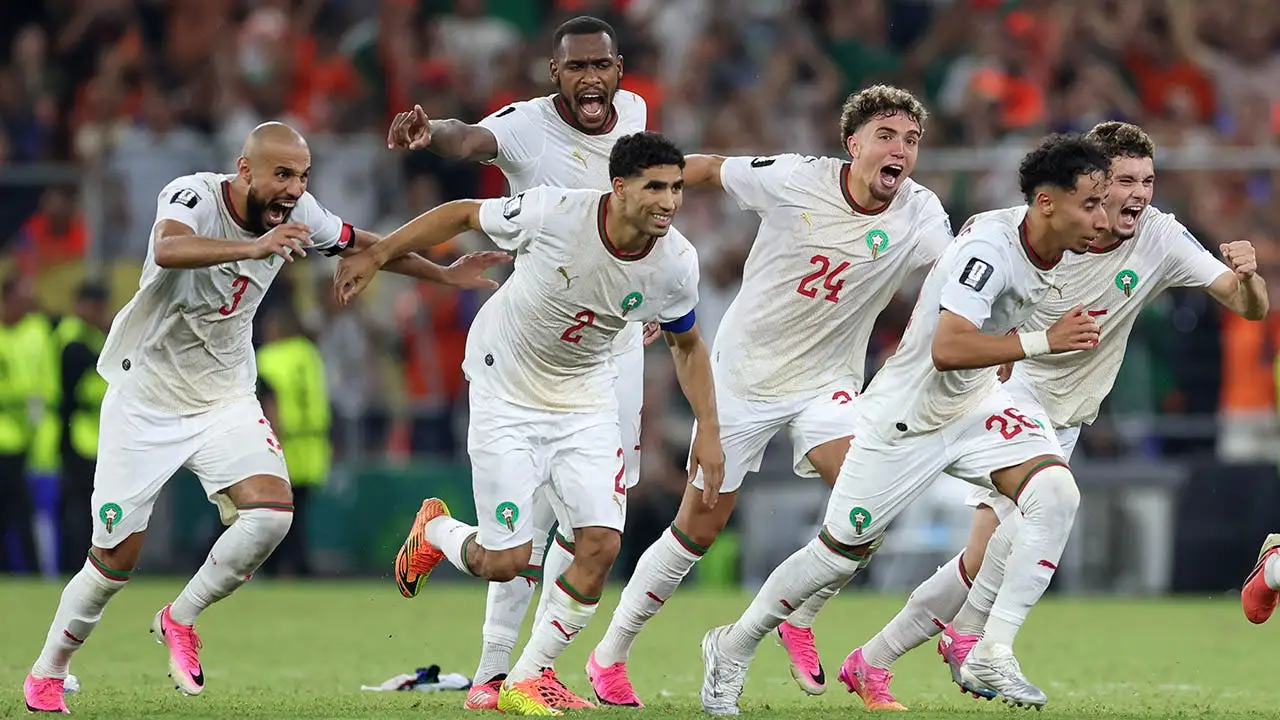
The penalty shootout is a test of human psychology under the most extreme conditions imaginable, a trial where tactical systems matter far less than raw nerve, focus, and emotional control. As the players gathered at the center circle, arm-in-arm, the weight of their respective nations rested squarely on the shoulders of the individual penalty takers and the lonely figures of the goalkeepers standing between the posts. The shootout progressed with agonizing tension, with each successful kick met by thunderous cheers and every miss accompanied by a collective gasp of despair. It was a battle of wills, a dramatic microcosm of the beautiful game where heroics and heartbreak are separated by mere inches. When Morocco’s Ismael Saibari stepped up to the spot, the entire world seemed to fall silent. Saibari, bearing the hopes of millions, exhibited a level of calm that defied the high-stakes reality of the moment. With a measured run-up and unwavering focus, he struck the ball cleanly, sending it past the diving goalkeeper to seal a dramatic 3-2 victory for Morocco in the shootout. The moment the ball rippled the net, the pitch transformed into a scene of pure, unbridled joy. Moroccan players sprinted from the halfway line in a wild, ecstatic sprint to embrace Saibari, while the Dutch players collapsed to the turf in utter devastation, their World Cup ambitions shattered in the blink of an eye.
In the emotional aftermath of the historic victory, the profound human element of the sport was on full display, particularly through the humble and deeply spiritual words of Morocco’s head coach, Mohamed Ouahbi. Speaking to reporters with tears of joy still glistening in his eyes, Ouahbi bypassed the typical tactical jargon to express a deeper truth about his team’s journey and the faith that sustains them. “We know when we do everything on the pitch, it’s God that gives something back to us as well,” Ouahbi reflected, highlighting the profound spiritual connection that underpins the Moroccan team’s work ethic and unity. He praised the relentless energy his squad left on the field, acknowledging the element of fortune that always plays a role in these epic encounters, noting that even Rahimi’s near-misses and hard-fought efforts contributed to their ultimate triumph. This victory was not just a tactical success; it was a profound vindication of Morocco’s footballing identity and their emergence as a globally respected powerhouse. Ouahbi noted that the Netherlands’ highly defensive and cautious style of play during the match was actually a form of ultimate respect—a sign that the traditional giants of football no longer view Morocco as an easy opponent, but as an equal force to be reckoned with. The respect they earned on the pitch on Monday night was a victory in itself, signaling a permanent shift in how African and Arab football is perceived on the global stage.
This sensational outcome is just the latest in a series of breathtaking shocks that have come to define this highly unpredictable World Cup tournament. In another jaw-dropping knockout clash, Paraguay managed to defeat the formidable German national team, securing their victory after a highly controversial VAR decision overturned a late German goal that would have sent the match into extra time. These unexpected results have shattered the traditional hierarchies of international football, proving that the gap between the established giants and the rising nations has narrowed to a razor-thin margin. Looking ahead, Morocco now prepares to write the next chapter of their fairy-tale journey as they travel to Houston, Texas, to face off against a formidable Canada team in the highly anticipated Round of 16. This matchup carries a rich narrative of its own, serving as a high-stakes rematch of their 2022 World Cup group-stage encounter where Morocco emerged victorious with a hard-fought 2-1 win. As football fans around the globe catch their breath and prepare for the next round of matches, this tournament continues to remind us why we fall in love with the beautiful game in the first place. It is a sport where history is constantly being rewritten, where small nations can topple giants, and where the human spirit, fueled by faith, passion, and unity, can overcome even the most insurmountable odds.