





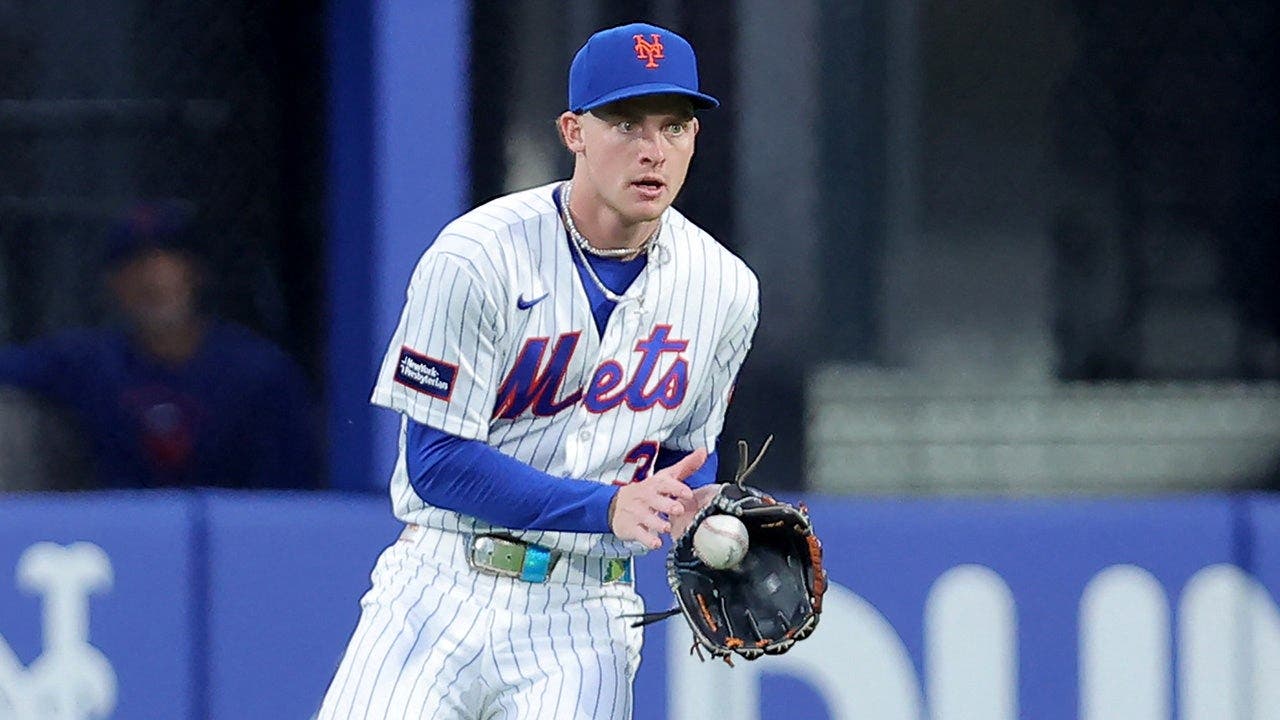
Monday night at Citi Field had the kind of electric hum that baseball fans live for — the sort of evening when every pitch feels heavier, every crack of the bat sends a ripple through the crowd, and a young player with everything to prove suddenly becomes the center of the baseball world. The New York Mets were hosting the San Diego Padres, and in the first inning, the game had not yet settled into a rhythm when the Padres began to manufacture a threat. Runners stood on first and second, Ty France was at the plate, and the visiting team seemed poised to strike first. France didn’t get all of it, but he did enough — a looping, shallow fly ball into the right-center field gap that looked like the kind of hit that could plate a run or at least move both runners into scoring position. But charging in from his spot in the outfield was Carson Benge, a rookie whose name most of the crowd had only recently learned to pronounce, a young man who had been waiting his whole life for a moment exactly like this. He tracked the ball, fielded it on the run, and without wasting a single motion, gathered his body and fired a strike toward home plate. The throw arrived with such speed and accuracy that Jake Cronenworth had almost no chance. He was out by plenty, the crowd exploded, and the Mets jogged off the field with their energy suddenly turned all the way up. It was a play that would have been impressive from any outfielder, but from a rookie making an early impression in his first taste of big-league action, it felt like a statement. The kind of statement that doesn’t need words. The kind that says, I belong here.
But that first throw was merely the opening act. A few moments later, with the game still scoreless and the Padres once again trying to create something on the bases, Jackson Merrill hit a sharp line drive to right field — a ball that, on most nights, might have been a single with a runner tagging and scoring. Manny Machado, one of the most dangerous and experienced baserunners in the game, decided to test the young arm in right. It was a calculated gamble, the kind of aggressive baserunning that can change the momentum of an entire ballgame. But Benge was ready. He charged the ball, planted his feet, and unleashed another breathtaking throw home. The baseball arrived at the plate with laser-like precision, beating Machado by a decisive margin, and just like that, the Padres had been turned away again. What made the moment even more remarkable was not simply that Benge had thrown out two runners in the opening innings of a close ballgame — it was the sheer strength and velocity behind those throws. Statisticians Sarah Langs and Jason Bernard later revealed something that sent ripples through the baseball analytics community: Benge’s two assists came on throws measured at 99.9 miles per hour and 103.9 miles per hour, respectively. In the Statcast era, which began in 2015, no outfielder had ever recorded two outfield assists of at least 99 miles per hour in a single game. That made Benge the first player in nearly a decade of tracking to accomplish something that had never been done before. Forget just winning the game — the rookie had just carved out a small piece of baseball history, and he did it with the kind of calm, unbothered approach that instantly made him a fan favorite. He wasn’t worried about the pressure, wasn’t overthinking the moment. He simply saw the ball, caught it, and threw as hard as he possibly could. It was pure instinct, pure talent, and pure joy wrapped up in a moment that the fans would talk about long after the final out.
The beauty of that night, though, was that Benge wasn’t alone in turning Citi Field into a showcase of young defensive excellence. The Mets’ rookie left fielder, A.J. Ewing, decided he wanted in on the action too. In the second inning, with the Padres once again trying to scratch out a run, Jake Cronenworth found a hole between the third baseman and the shortstop, punching a single into left field. Xander Bogaerts, a veteran baserunner with a good feel for the game, rounded third and tried to score. It was a bold gamble, especially after seeing what Benge had done with his arm in the previous inning. But the Padres were clearly determined to test the Mets’ young outfielders, to see if the first two assists were a fluke or the beginning of something real. Ewing answered the challenge beautifully. Playing shallow enough to have a realistic chance at the plate, he charged the ball cleanly, collected it on the bounce, and fired home with plenty of time to spare. Bogaerts was tagged out without a dramatic slide, and the Padres had been denied once again. Three separate baserunning gambles in the early innings, three outs cut down at home plate by a pair of rookie defensive players. It was the kind of performance that makes the sport so thrilling — not just the home runs and the strikeouts, but the unexpected moments of individual brilliance that swing momentum and leave everyone in the ballpark shaking their heads in disbelief. The Mets’ defense announced itself that night with a ferocity that the Padres could not match, and every sparkling play seemed to build on the last. By the time the Padres finally managed to push a run across, the damage had already been done. They had wasted chance after chance, and the Mets’ young outfielders had made it clear that scoring against New York would not come easily.
The pitching behind those defensive gems was just as steady and impressive. Mets starter Nolan McLean worked six solid innings, striking out three batters while keeping the Padres’ lineup mostly off balance. He allowed just enough contact to keep his defense involved, but never enough to let the game slip away. It was the kind of quietly efficient start that often gets overlooked in the excitement surrounding a famous defensive play, but it was absolutely essential to the Mets’ success. In a game decided by a single run, every pitch matters, every out matters, and McLean delivered with the kind of grit that a young team needs from its rotation. He leaned on his defense, and his defense answered the call time and time again. The Padres, to their credit, never stopped competing. They had chances — multiple chances — to pull ahead, to seize control of a game that could have gone either way. But every time they tried to force the issue on the bases, the Mets were waiting. And when the Padres did manage to string together a hit or two, they found themselves unable to solve the combination of McLean’s pitches and the rocket arms patrolling the outfield. The final score read 2-1 in favor of New York, a narrow margin that perfectly captured how important those defensive plays truly were. Without Benge’s two assists and Ewing’s throw home, that game could easily have gone to San Diego. Instead, the Mets walked away with a hard-fought victory and a whole new reason to be excited about their future.
After the game, Benge was asked about his remarkable throws, and his answer was as refreshingly simple as the plays themselves. “I just looked up and threw the ball,” he said. “I’m not worried that they are running or not. I try to throw as hard as I can to be able to make them stop or get them out.” There was no rehearsed explanation, no deep breakdown of mechanics, just the pure confidence of a young player trusting his instincts. He also touched on something that fans often feel but rarely hear articulated so plainly: the ways in which a great defensive play can change the energy of an entire game. “I feel like anytime anyone makes a good throw to end an inning or have a quicker out, it shifts the momentum in our favor,” he added. Those words resonated beyond the locker room, because they captured what everyone in the stands had witnessed with their own eyes. The momentum did shift. Every throw-out of a runner seemed to take the air out of the Padres’ sails, while simultaneously pumping life into the Mets and their fans. Baseball is often described as a game of inches and tiny margins, and this game was proof of that truth. A few split-second decisions on the base paths, a few perfect throws from the grass to the plate, and the entire narrative of a contest changes. For a rookie, to not only execute those plays but to understand their emotional weight so clearly, is a sign of a player who gets the game on a deeper level. It’s the kind of awareness that can’t be taught, and it only added to the magic of the night.
In a season that has already featured plenty of drama, Monday night will be remembered as the moment the Mets’ youth movement flashed its brightest yet. Benge and Ewing are not household names — not yet — and they may not ever become superstars. But for one night, they gave the fans at Citi Field something to remember. They reminded everyone that baseball’s heroes are not always the hitters who launch towering home runs or the pitchers who strike out a dozen batters. Sometimes they’re rookies who roar out of the outfield, flatten the ball with a throw that reaches triple digits, and send an entire stadium into a frenzy. The historical significance of Benge’s performance was not lost on the statisticians, and the broader baseball world quickly took notice of what he had accomplished. But for the young outfielder, it was simply baseball. It was doing his job, playing the game he loves, and letting his instincts guide him through the chaos. The Mets won 2-1, a beautiful, gritty, defense-driven victory that felt almost like a reminder of what makes this sport so special at its core. There were no shortcuts, no lucky bounces — just a bunch of young players, a packed stadium, and a series of plays that turned a routine regular-season game into a showcase of hope, heart, and raw ability. For Mets fans, it was a glimpse of what might come. For the Padres, it was a heartbreaking loss. And for Carson Benge, it was just another night in the majors — a night that happened to be one of the most unforgettable performances of his young career.