





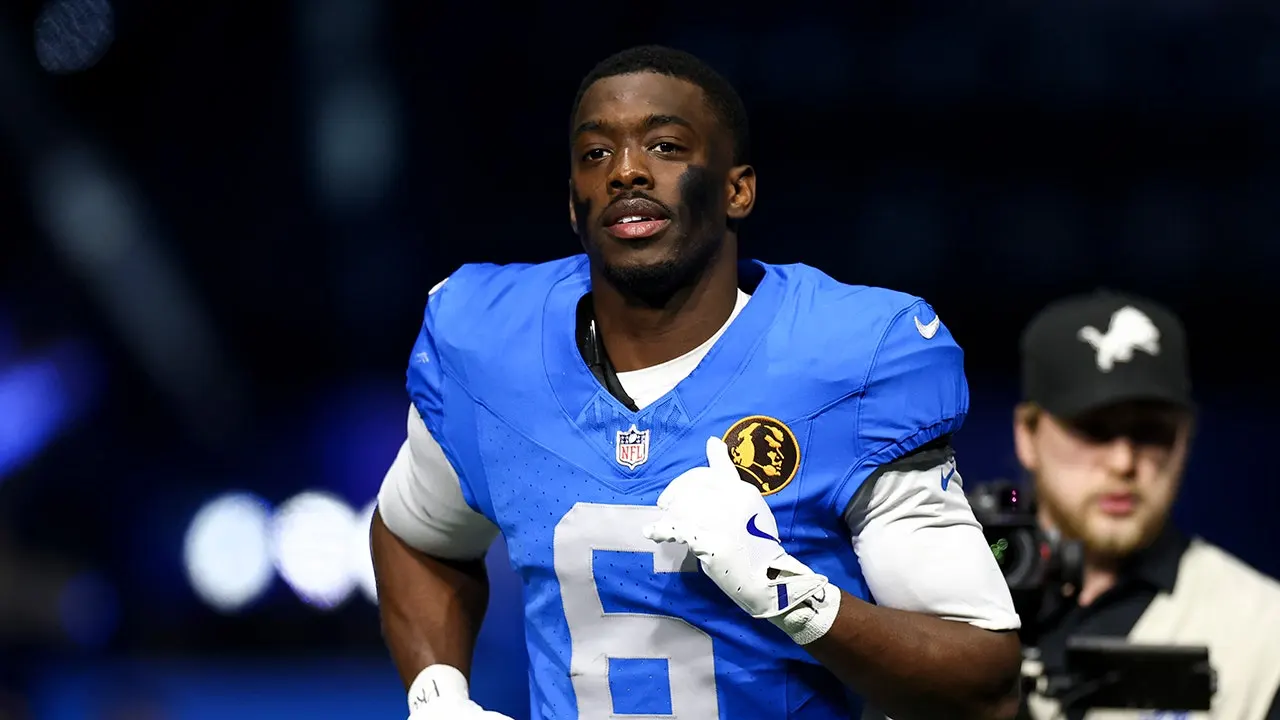
The trajectory of a professional athlete’s life is often defined by moments of split-second decision-making on the field, but for Terrion Arnold, a catastrophic series of choices off the gridiron has completely dismantled a promising career before it could truly begin. Just months after being celebrated as the Detroit Lions’ prized first-round pick in the 2024 NFL Draft, the 23-year-old cornerback now finds himself cast out of the league and confined to his home, facing a precarious legal future that could result in decades behind bars. The Lions’ swift and uncompromising decision to release Arnold came directly in the wake of his arrest in Hillsborough County, Florida, where he stands accused of orchestrating a violent, vigilante-style kidnapping and armed robbery. The shocking fall from grace was punctuated by a tense courtroom appearance on Monday, where Hillsborough County Judge Christopher Sabella set Arnold’s bond at a staggering $1 million. For a young man who was recently preparing to bask in the glitzy atmosphere of his first NFL training camp, the reality of his situation is now defined by the sterile walls of a courtroom and the absolute ruin of his athletic aspirations. The contrast between the roaring crowds of Ford Field and the somber gravity of a felony arraignment highlights a tragic waste of generational talent, leaving fans, teammates, and the broader sports world grappling with the sheer senselessness of the allegations.
The legal constraints now binding Arnold paint a vivid picture of a young life placed under supreme judicial scrutiny, illustrating how quickly the privileges of wealth and fame can evaporate in the face of criminal indictment. Although prosecutors fought aggressively to have Arnold held without bond, arguing that the severity of the charges posed a danger to the community, Judge Sabella ultimately ruled that the state’s current evidence, while serious, was not quite overwhelming enough to justify pretrial detention without bail. However, the price of Arnold’s temporary freedom is incredibly steep and serves to isolate him from both his career and his social circle. Under the strict terms of his release, Arnold must remain strictly confined to his residence in Tallahassee, Florida, with exceptions carved out only for court appearances. He was ordered to immediately surrender his passport within 48 hours to prevent any risk of flight, and he is forbidden from having any contact whatsoever with his six co-defendants or any of the witnesses involved in the case. A particularly telling moment in the courtroom arose when the prosecution requested that Arnold be fitted with a GPS tracking device. His defense team, led by attorney Harvey Steinberg, successfully fought the request by arguing that such a device would physically prevent Arnold from practicing or playing football. In a cruel twist of irony, this hard-won concession was rendered entirely moot just days later when the Lions officially terminated his contract, leaving Arnold with no football activities to return to and rendering his athletic compromise meaningless.
To understand how a highly paid NFL rookie became entangled in a violent felony case, one must look back to the cold days of early February, when a personal violation seemingly triggered a disastrous downward spiral of paranoia and vengeance. According to police investigators, the trouble began at a spacious Airbnb property in Largo, Florida, which Arnold had rented and where he periodically stayed alongside an eclectic group of associates. This inner circle included Arianna Del Valle, 19; Jasmine Randazzo, 19; Lyndell Hudson II, 26; Christion Williams, 24; Boakai Hilton Jr., 23; and Freddie Hughes, 27. On February 1st, a break-in occurred at the rental property, resulting in the theft of an array of luxury goods and personal items belonging to Arnold and several of his friends. Two days later, Arnold, Hilton, and Hughes officially reported more than $250,000 in stolen property to the Largo Police Department. The psychological toll of losing a quarter-million dollars in personal belongings apparently pushed Arnold and his cohort to bypass the justice system entirely. Convinced that they knew who was responsible, they targeted three local male teenagers, whom they suspected of executing the burglary. In a tragic failure of assumptions, the Tampa Police Department would later definitively clear these three victims of any involvement in the initial theft, revealing that Arnold’s subsequent campaign of terror was directed at entirely innocent bystanders.
The retaliation scheme that unfolded on February 4th reads less like a dispute between acquaintances and more like a calculated, armed ambush designed to terrorize and brutalize. Investigators allege that Arnold and Hilton coordinated intimately with Del Valle and Randazzo to orchestrate a classic “honeytrap,” instructing the two young women to contact one of the unsuspecting teenagers and lure him and his friends to a local apartment under false pretenses. When the three victims arrived at the residence, they were met not with social hospitality, but with a terrifying trap. Hidden inside a bedroom closet were Williams and Hudson, who suddenly burst out brandishing firearms, immediately taking the teens hostage. The victims were violently assaulted, held at gunpoint, and pistol-whipped, sustaining visible and painful injuries as their captors demanded information and retribution. In an unsettling display of modern, digitized cruelty, Del Valle allegedly live-streamed the ongoing assault directly to Arnold, Hilton, and Hughes as they drove toward the apartment. Cell phone records and digital forensics recovered by police later revealed a highly active group chat in which Arnold and Hilton were allegedly sending real-time coordinates and tactical directions to those committing the physical violence inside the apartment, keeping themselves intimately involved in the abuse from afar.
The nightmare reached its climax around 1:00 a.m. when Arnold, accompanied by Hilton and Hughes, finally arrived at the apartment to personally oversee the final stages of the extortion. According to police accounts, Arnold did not act as a voice of reason or restraint; instead, he allegedly directed the group’s actions inside, taking charge of the hostile situation. While the victims were kept subdued and reeling from their injuries, Hughes, Hudson, and Williams ransacked their pockets and took their personal belongings. After approximately forty minutes of terror, the traumatized teenagers were escorted out of the building, forced into their own vehicle, and told to leave the premises. Showing immense bravery in the face of such overwhelming intimidation, the victims went straight to the Tampa Police Department to report the harrowing ordeal, providing detailed descriptions that allowed detectives to identify the suspects and construct a compelling timeline of events. The investigation culminated on June 25th when the Tampa Police Department publicly announced the charges, prompting Arnold to travel to Hillsborough County and turn himself into the Orient Road Jail. He now faces four counts of kidnapping and four counts of armed robbery—charges that carry the very real possibility of life in prison and have permanently stained his name in the annals of sports history.
For the Detroit Lions and their passionate fanbase, Arnold’s arrest and subsequent release represent a devastating blow to a franchise that had built its identity around character, toughness, and accountability. Arnold’s rookie season in 2024 had shown flashes of absolute brilliance; despite battling a shoulder injury that required season-ending surgery and limited him to just eight games, he still managed to record 60 combined tackles, defend 10 passes, and secure his first career interception in a high-stakes Week 9 matchup against the Minnesota Vikings. He was widely projected to be a foundational piece of the Lions’ secondary for years to come, a lock for the starting lineup, and a fan favorite in the Motor City. Now, those athletic achievements are nothing more than a footnote in a cautionary tale about the perils of street justice and the company one keeps. While his defense attorney, Harvey Steinberg, aggressively maintains that prosecutors are “not even close” to proving that Arnold actively directed or knew about the physical violence perpetrated by his associates, the court of public opinion and the NFL have already passed their initial judgments. As training camps begin to open across the country, Terrion Arnold will not be wearing a helmet or reviewing a playbook; instead, he will be sitting in his Tallahassee home, watching his former life continue without him, left to contemplate how a quarter-million-dollar burglary cost him a multimillion-dollar career and his very freedom.