




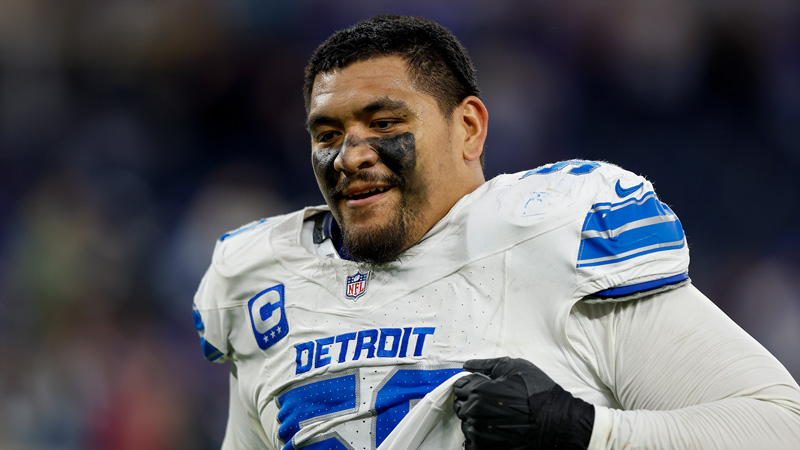
In the grueling, unheralded trenches of the National Football League, where a player’s career is often measured in bruises, sacrifice, and relative anonymity, Penei Sewell has rapidly ascended to a realm of rarefied football royalty. To truly understand the magnitude of what the Detroit Lions’ offensive tackle has achieved in his first five seasons is to look directly at the legendary, bust-lined halls of Canton, Ohio. Achieving the rare distinction of being named a first-team All-Pro three times and earning Pro Bowl honors four times before even reaching the prime of his career places Sewell in an incredibly exclusive club, one shared by only three other offensive tackles in modern NFL history: Anthony Munoz, Tony Boselli, and Joe Thomas. Yet, while those foundational giants of the sport forged their bronze legacies by locking down the blindside as permanent, lifelong left tackles, Sewell is carving out an entirely different, unprecedented path. His journey is defined not just by raw physical dominance, but by an extraordinary, selfless versatility that has deeply endeared him to the city of Detroit. Now, as the Lions prepare for another grueling campaign with high championship expectations, they are asking their young cornerstone to do the unthinkable: completely flip his universe upside down by transitioning from the right side of the offensive line to the left. It is a monumental position swap that would terrify lesser athletes, but for Sewell, it represents another opportunity to prove why he is the heart, soul, and motor of this resurrected franchise.
This sudden, high-stakes shift was born out of offseason necessity, sparked by the unexpected departure of veteran mainstay Taylor Decker. For a decade, Decker was the solid, dependable anchor of Detroit’s offensive front, a beloved locker room leader who had initially indicated to the public and the organization that he would return for another hard-nosed season rather than choose retirement. However, when Decker later requested his release during the offseason, it left a massive, gaping void on the left side of the line—a vacancy that most NFL franchises would panic trying to fill in a hurry. Instead of scrambling in desperation or yielding to frustration, the Lions’ leadership looked at Sewell and saw their perfect, ready-made solution. To complement this high-profile reshuffling, the Lions leveraged their draft assets to select Clemson’s standout lineman Blake Miller with the number seventeen overall pick in the first round, while also securing valuable veteran depth with the acquisition of Larry Borom. These new additions will compete to fill the right tackle spot vacated by Sewell, allowing the coaching staff to comfortably slide their prized superstar to the critical role of protecting the quarterback’s blindside. Lions head coach Dan Campbell, a leader who lives and breathes high-stakes football strategy and raw emotion, expressed absolute confidence in the move, brushing aside any worries about the transition during a recent team workout. For Campbell, deploying Sewell at left tackle isn’t a risky, desperate gamble; it is the natural evolution of a generational talent who has consistently risen to meet every challenge laid before him.
Coach Campbell’s unwavering optimism is rooted in the rich athletic history and natural, fluid instincts that Sewell possesses in abundance. “It’ll be like riding a bike for him,” Campbell remarked with a warm, confident smile to reporters, explaining that while there will inevitably be minor adjustments and fine-tuning for Sewell to master, the fundamentals of the position are already deeply embedded in his subconscious muscle memory. This is far from unfamiliar territory for the 6-foot-5, 335-pound behemoth; before he became the undisputed king of the right side of the line in Detroit, Sewell was a highly decorated, award-winning left tackle at the University of Oregon, a dominant force whose collegiate game tape left NFL scouts drooling. When the Lions drafted him with the seventh overall pick in the 2021 NFL Draft, they knew they were acquiring a special player, but they could not have predicted how quickly his adaptability would be put to the test. As a mere twenty-year-old rookie, Sewell was suddenly thrust into the starting left tackle role for the first eight games of his career after Decker suffered an early-season injury, making him the youngest player in NFL history to start a game at that demanding position. Though he spent the subsequent four seasons mastering the right tackle spot—save for a brief, stellar cameo back on the left side during another brief Decker injury in 2023—that early trial by fire established a deep reservoir of experience that the Lions can now draw upon as they re-engineer their offensive front.
Yet, to dismiss this position swap as a simple lateral move is to misunderstand the intense physical, mental, and spatial demands of playing on an NFL offensive line. League veterans frequently describe switching from right to left tackle as trying to write legibly with your non-dominant hand, or trying to drive a vehicle with your left foot operating the gas pedal and brake; everything your brain wants to do naturally must be completely mirrored and reversed in a split second. For half a decade, Sewell’s entire body has been conditioned to kick-start blocks with a specific foot, balance his massive weight on a chosen leg, and punch oncoming defenders with a highly coordinated sequence of hand movements. In his own words, Sewell has illuminated the stark reality of this intense physical rewiring, noting that when you make the switch, you suddenly have a completely different leg up front, forcing you to push off and react in ways that contradict years of intensely ingrained habits. You have to train a leg that has spent years acting as a trailing stabilizer to suddenly become the explosive engine of your stance, all while defending against creative defensive coordinators who will send the league’s fastest, most vicious edge rushers directly at your blind spot. It is a grueling test of cognitive adaptability and physical discipline, but Sewell’s unique blend of raw, violent power and feather-light footwork makes him one of the few human beings on earth capable of making such a monumental adjustment look routine.
Beyond the physical chess match on the turf, Sewell’s value to the Lions goes far deeper than his positional designation, reflecting his massive status as both a cultural and financial pillar of the entire franchise. Currently playing in the first year of a lucrative four-year, $112 million contract extension, he represents the long-term vision of a front office that built its roster from the inside out, valuing grit and character above all else. When Detroit was a struggling franchise, enduring years of heartbreaking losses and organizational instability, Sewell arrived as a symbol of hope—a blue-collar kid from American Samoa and Utah who perfectly embodied the determination and relentless work ethic of the city he now represents. Through eighty-three regular-season starts and four intense playoff battles, he has helped transform the Lions from a legendary punchline into a feared, respected powerhouse in the NFC. Head coach Dan Campbell has openly marveled at Sewell’s freakish athleticism, suggesting that the young tackle is so gifted he could easily excel at guard or even run routes as a tight end if the team ever required it. This deep block of respect and financial commitment underscores why the franchise is so comfortable trusting him with this high-stakes transition: they know Sewell is not just playing for a paycheck, but is fighting to solidify a culture of aggressive excellence that he helped build from the ground up.
As the Lions embark on a season laden with Super Bowl expectations, the eyes of the football world will be fixed on the left side of Detroit’s offensive line, watching intently to see how this transition unfolds. While his legendary predecessors like Munoz, Boselli, and Thomas achieved their greatness by occupying a single, comfortable home on the field, Sewell is forging an entirely unique narrative—one characterized by a selfless willingness to sacrifice personal convenience for the collective triumph of his team. His transition back to the left side of the line is more than just a tactical adjustment; it is a testament to a young man’s maturity, leadership, and unyielding dedication to his teammates. If he can maintain his All-Pro standard of play at left tackle, he will not only secure his place among the greatest offensive linemen to ever play the game, but he will also propel the city of Detroit closer to the elusive championship glory they have starved for over decades. Surrounded by a passionate fan base, backed by a coaching staff that believes in him unconditionally, and driven by an internal fire that has burned since his days as a rookie, Penei Sewell is ready to ride his metaphorical bicycle straight into the history books, permanently rewriting the rules of what an offensive lineman can achieve.