




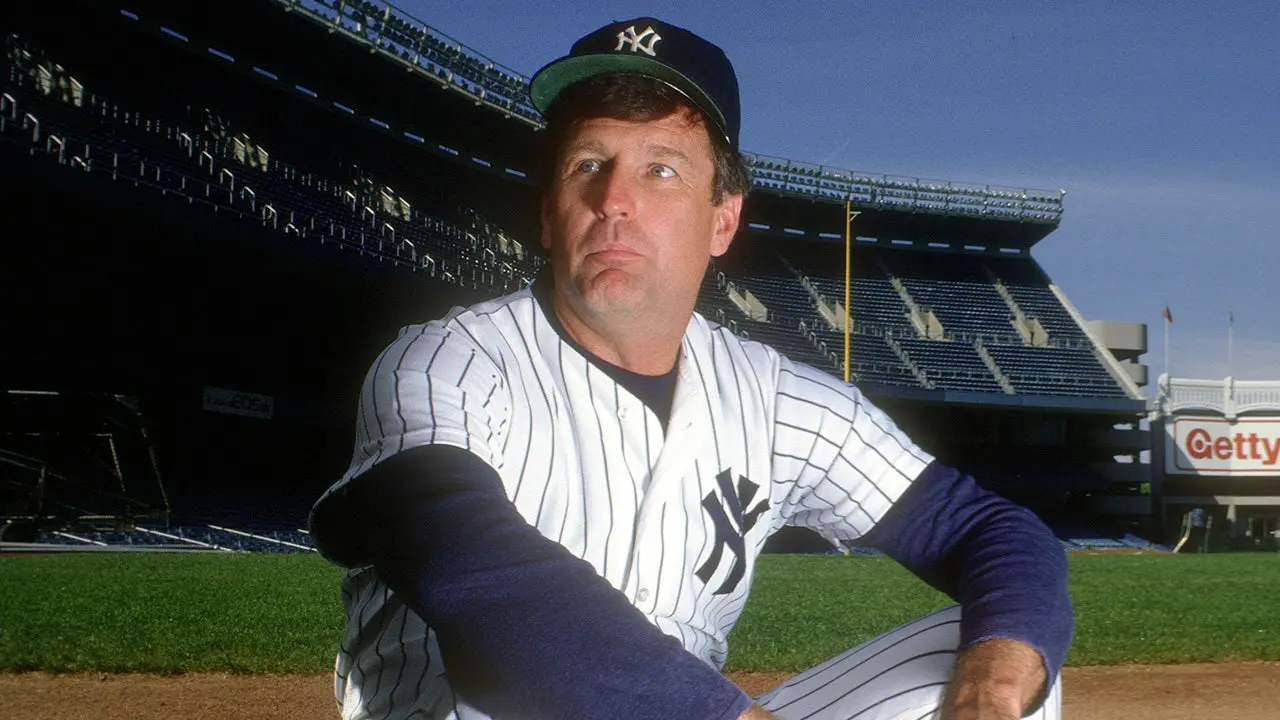
Tommy John, the former Major League Baseball pitcher whose name became forever attached to the surgery that saved his career and changed the sport, has died at 83. His agent, Mike Maguire, announced the passing with a statement that was both tender and precise: Thomas Edward “Tommy” John Jr. died peacefully at his home in Lakewood Ranch, Florida, surrounded by his loving wife, Cheryl, and his sisters-in-law Judith Florentino and Karen Jordan. A private celebration of life will be held in the state he called home in his later years. For anyone who has ever loved baseball, the news of his death carries a weight that goes far beyond a standard obituary. John was not merely a pitcher who played a long time; he was a symbol of resilience, a man whose left arm became the crossroads where sports met medicine. Long before every pitcher feared the words “ulnar collateral ligament,” Tommy John was the one who walked into an operating room with no guarantees and came out the other side with a second career nobody thought possible. In his final days, he was surrounded not by cameras and crowds, but by family, which feels exactly right for a man whose father once told him that no matter what he became, he would always just be Tommy John from Terre Haute, Indiana.
About a week before he died, John offered the baseball world a farewell that now reads like a letter written with full awareness that the end was near. During the New York Yankees’ Old-Timers’ Day celebration, the team revealed that John had been battling health issues, and he released a message thanking the organization, the Steinbrenner family, and the fans who had followed him through all 26 years of his career. He made a point to thank Dr. Frank Jobe, the surgeon who saved his arm and made it possible for him to keep pitching. John noted that the surgery had since gone on to save the careers of countless pitchers, including many of the very best in the game today. He thanked the fans who supported him and his teammates, and he closed with, “I will never forget you.” There is something profoundly moving about a man composing his own goodbye while he still has breath, choosing gratitude over bitterness, thanks over complaint. In that message, John was not thinking only of himself; he was thinking of the generations of pitchers who would never have to say their careers ended because of an elbow injury. It was a quiet act of generosity, the same grace he showed on the mound for nearly three decades.
John’s roots were simple and strong. Born in Terre Haute, Indiana, he carried that small-town identity with him through every city and every stadium. When he left home for his first job as a pitcher, his father looked at him and delivered the line that would define his life: “Good luck, Tommy. Just remember one thing: whether you make it big in the big leagues or you don’t, you’ll always just be Tommy John from Terre Haute, Indiana.” Those words kept him grounded through a career that took him to the Chicago White Sox, the Los Angeles Dodgers, the California Angels, the New York Yankees, the Cleveland Indians, and the Oakland Athletics. He debuted in 1963 and pitched until 1989, an astonishing span that covered eras, rule changes, and generations of rivals. He finished with a career earned run average of 3.34 and struck out 2,245 batters. He was named an All-Star four times. But numbers only tell part of the story. John was never the most overpowering pitcher on the mound; he was a craftsman, a thinker, a competitor who outlasted everyone. In an age when pitchers routinely threw complete games and logged grueling innings, John kept coming back, season after season, because he knew something about patience that few others did. His career was not defined by one signature season but by the slow, steady accumulation of hundreds of starts, late-career victories, and quiet leadership in the clubhouse.
The turning point came in 1974, when John was pitching for the Los Angeles Dodgers. His elbow, the instrument of his livelihood, gave out. The pain was severe, and the diagnosis was grim. In those days, a torn UCL was effectively a death sentence for a pitcher’s career. Dr. Frank Jobe proposed something revolutionary: a surgical procedure that involved replacing the damaged ligament with a tendon taken from elsewhere in John’s own body. It was experimental, uncharted, and far from guaranteed. John could have chosen to walk away and accept his fate. Instead, he trusted the surgeon and the process. He underwent the operation, missed the entire 1975 season, and then did something that seemed impossible: he returned to the mound and kept pitching. In fact, he won more than 160 games after the surgery, became a three-time All-Star in his post-surgery years, and extended his career deep into his forties. The mental strength required to come back from such a procedure is impossible to measure. Tommy John had to relearn his body, rebuild his trust in an arm that had failed him, and believe that the pain and doubt were worth it. He chose to believe, and because of that choice, his name became permanently attached to one of the most common procedures in baseball medicine.
Today, Tommy John surgery is known by every player, coach, parent, and fan. It is a phrase repeated in clubhouses and highlighted in sports broadcasts, always carrying the weight of hope. For every modern pitcher who has come back from elbow surgery, from young prospects to established stars, Tommy John is the quiet patron saint. His willingness to undergo an experimental operation in 1974 did not just prolong his own career; it created a medical pathway that has saved thousands of careers. The procedure has become routine, even unavoidable in some ways, but at the moment John agreed to it, there was no playbook, no comfortable statistics, no assurance of success. He risked everything on the belief that a damaged arm could be rebuilt stronger than before. He did not seek fame as a medical pioneer; he sought something much simpler. He wanted to keep playing the game he loved. It is easy to reduce John’s story to anatomy and recovery, but the human part matters just as much. He was a husband, a father figure, a teammate, a man who lived through the humiliation of being injured and the triumph of returning. He knew what it meant to doubt, to hurt, to wonder whether the end had arrived, and then to decide that the end was only the beginning of something else.
In the end, Tommy John came back to the Yankees, the team with which he is most associated, to say goodbye. He played eight of his 26 seasons in New York, and he understood the weight of that uniform. Old-Timers’ Day is a celebration of memories, a chance to cheer for men whose best days may lie behind them, but whose names still glow. When John’s farewell message was read, it felt like a passing of the torch. He spoke of Dr. Jobe, of his father’s advice, of the fans who never stopped believing. He ended with four simple words: “Thank you and God Bless.” Now those words carry an echo of finality. The world has lost a man who was never the fastest or most gifted player on the field, but who embodied something even greater: the refusal to surrender. He was Tommy John from Terre Haute, Indiana, a man who became a medical term, a baseball legend, and a human being who understood that legacies are not built in scorebooks alone. They are built in the small moments of courage, in the willingness to try again after everyone else has said no, and in the ordinary grace of a father’s reminder that fame changes nothing except the size of the audience. John’s private celebration of life will be shared with family, but his presence will be felt everywhere a pitcher takes the mound, everywhere an elbow recovers, and everywhere a fan remembers that sometimes the greatest triumph is as simple as being able to say goodbye with heart full of thanks.