


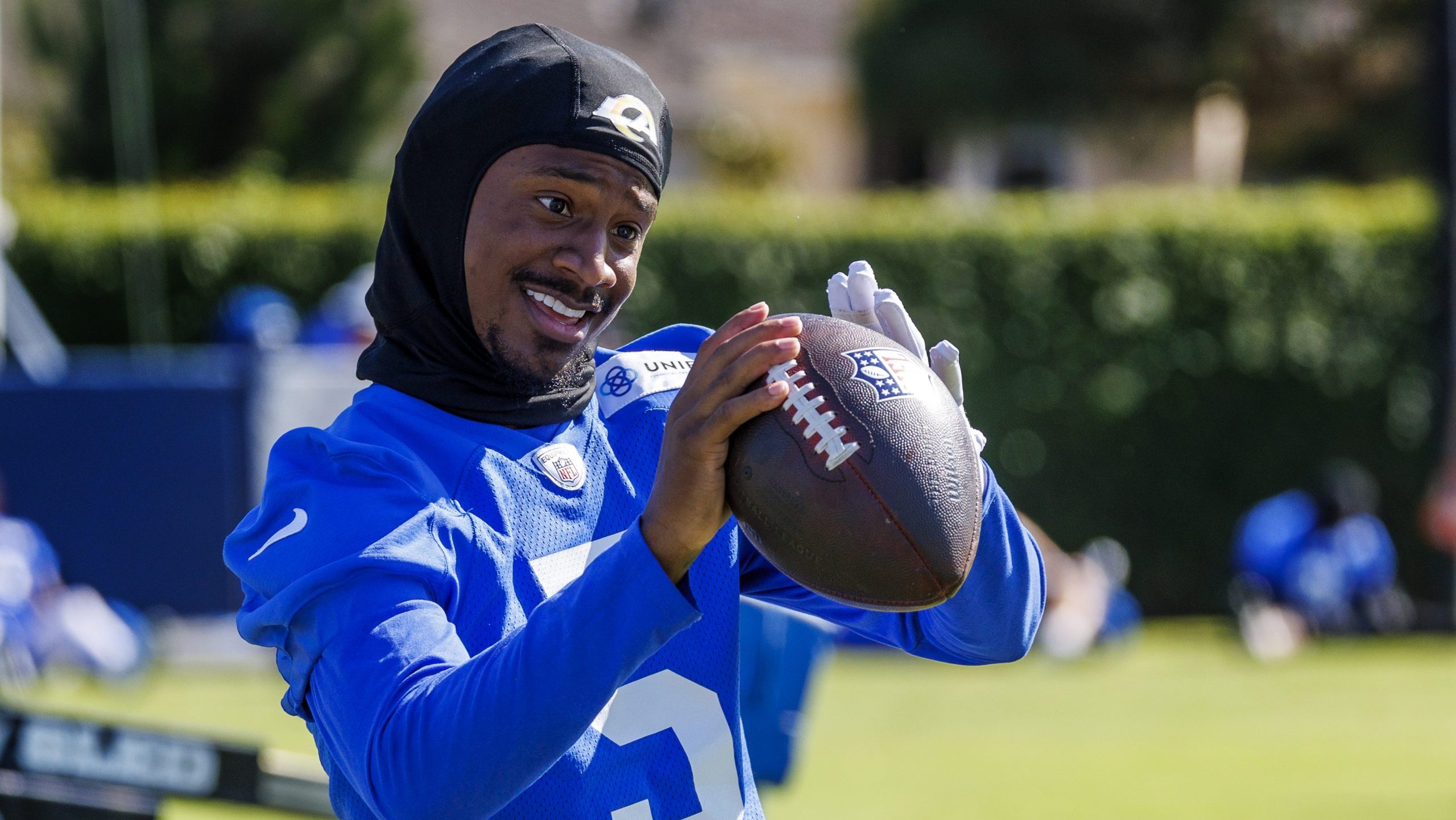
1. The news arrives like a sudden, familiar flicker of hope: Tutu Atwell is going back to the Los Angeles Rams. According to ESPN, the Miami Dolphins have agreed to trade the wide receiver to Los Angeles in exchange for running back Jarquez Hunter. For Atwell, the move is more than just another transaction in the endless shuffle of NFL rosters. It is a homecoming—an unexpected but deeply meaningful return to the franchise that drafted him, believed in him, and saw him lift the Lombardi Trophy as a Super Bowl champion. Five months ago, he walked away in free agency, seeking a new start with his hometown Dolphins. Now, just before the start of another grueling season, he is heading back to familiar turf, to the team that knows his speed, his quirks, and his potential. The trade speaks to how quickly the winds can shift in professional football. One week you’re learning a new playbook, making new friends, and mapping out a fresh future; the next, you’re packing your bags again, returning to an old house that somehow still feels like home. For the Rams, it is a move of both familiarity and strategic depth. For Atwell, it is a second chance to finish what he started—and perhaps, this time, to become the player everyone once believed he could be.
2. Atwell’s story in Los Angeles began with promise and patience. The Rams selected him in the second round of the 2021 NFL Draft out of Louisville, seeing something special in his blazing speed and his ability to stretch the field. Over four seasons in a Rams uniform, Atwell appeared in 64 games, hauling in five receiving touchdowns and adding one more on the ground. He was not always the headline name, but he was the kind of versatile piece that made Sean McVay’s offense so dangerous—capable of turning a short pass into a long gain, of forcing safeties to respect the deep ball, and of bringing a spark to special teams as a return specialist. His rookie season culminated in a Super Bowl LVI victory, even though a shoulder injury cut his second half short. That title ring, shiny and permanent, remains a testament to a breakout moment that never fully arrived. Yet those four years also taught Atwell about resilience. He learned to wait, to work, and to carve out a role in an offense full of stars. He learned that his path would not always be straight. But returning now, after time away, gives him something he did not have before: a deeper appreciation for what that organization meant to him. It’s one thing to leave a city and another to be welcomed back. In this case, the Rams weren’t just bringing back a receiver; they were bringing back a player who knows their language, their tempo, and their trust.
3. The journey to Miami was supposed to be different. In March, Atwell signed a one-year contract with the Dolphins, fulfilling a childhood dream of playing for the team he grew up watching. It was a homecoming in the truest sense of the word—a chance to play in front of family and friends, to wear a jersey that once seemed untouchably distant. But football is a business, and dreams don’t always translate into plays. The Dolphins, like every other franchise, had to think about roster balance, opportunity cost, and the harsh arithmetic of the salary cap. When the chance to acquire a young running back like Jarquez Hunter surfaced, they made the call. Atwell, meanwhile, had to pack his bags again and say goodbye to yet another city. That’s the reality of the NFL: players are pieces, and pieces move. But for Atwell, this trade feels less like rejection and more like correction. It’s as if the universe nudged him back toward the place where he was never quite finished. The Rams have a particular affinity for players who understand their system, and Atwell’s knowledge of McVay’s offense is invaluable in a league where chemistry is often more important than pure talent. Returning doesn’t erase the difficulty of leaving, but it adds a layer of redemption to the story. It shows that even in the business of football, there’s room for grace—and that sometimes, the best move is the one that brings you full circle.
4. Atwell now joins a Rams receiver room that is anything but empty. He’ll be lining up alongside Davante Adams, one of the most gifted route runners of his generation, and Puka Nacua, the young superstar who has become a favorite target of quarterback Matthew Stafford. It’s a crowded group, to be sure, but it’s also a group that creates space and opportunities. Defenses can’t key in on everyone, and Atwell’s speed remains a unique weapon—a burner who can occupy safeties, open up underneath routes, and punish teams that leave him isolated on the outside. His return gives McVay another chess piece, a familiar one who already knows how to read Stafford’s tendencies and where to be on broken plays. In a league where offenses are constantly evolving, having a player who doesn’t need a crash course in the system is a luxury. Atwell can focus on winning his battles, not on remembering his assignments. And for a quarterback like Stafford, who values trust above all, knowing that Atwell will be in the right spot at the right time can make all the difference. The Rams are not just adding a body; they’re adding a mind that already knows their rhythm. That’s not to say Atwell will suddenly become the No. 1 option. But in football, roles evolve, and a player with his explosive traits can still make game-changing plays. This is a chance for him to be whoever he wants to be—a deep threat, a third-down specialist, a return man, or simply another reliable pair of hands in the most important moments of the season.
5. On the other side of this trade, Jarquez Hunter is trading the Rams’ white and blue for the Dolphins’ aqua and orange, and he’s doing so with an opportunity that didn’t exist in Los Angeles. A fourth-round draft pick in 2025 out of Auburn, Hunter spent his rookie season in the background, appearing in five games and making his mark primarily on special teams. For any young running back, that’s a humbling introduction to the league—waiting, learning, and hoping for a chance to show what you can do with the ball in your hands. Miami’s backfield needed depth, and Hunter offers fresh legs, a bruising running style, and an attitude built for the grind. Trade talks often focus on star names and blockbuster headlines, but moves like this are how teams quietly build their futures. The Dolphins see something in Hunter, something that reminds them of the hard-nosed runners who can shoulder a workload and wear down a defense over four quarters. He won’t be handed a starting job; he’ll have to earn it in practice, in the weight room, and in whatever snaps come his way. But that’s exactly how he’s operated since college. Nothing was given to him at Auburn, and nothing was given to him on draft day. Hunter’s path has been one of patience and persistence, and now he steps into a situation with clearer opportunities. For a young man who just wanted a chance, Miami is the perfect place to prove that the waiting was worth it.
6. With the season fast approaching, both teams have to turn this transaction into momentum. The Rams open their season against the San Francisco 49ers in Australia on Sept. 10—a game that will test their readiness on a global stage. The Dolphins, meanwhile, will face the Las Vegas Raiders on Sept. 13, needing all the depth they can get. Trades like this one often feel cold and calculated, but the ripple effects are human. Atwell returns to Los Angeles with something to prove, carrying the lessons of Miami and the hunger of someone who knows how easily opportunities slip away. Hunter arrives in South Beach with a clean slate and a fresh start, ready to make new memories in a city that loves its football. For Rams fans, seeing Atwell in that familiar jersey again will bring a smile—a reminder that careers are not always linear. For Dolphins fans, Hunter represents hope for a backfield that needed another heartbeat. The NFL is a league of second acts, of reunions, of players finding their way back to the places where they belong. In a few months, we may look back on this quiet trade as a footnote, a modest move buried in a sea of bigger headlines. But for Atwell and Hunter, it’s a turning point. One man is returning to his roots. Another is chasing a breakthrough. And all of us are reminded that football, for all its million-dollar contracts and strategic calculations, is still a game of people—of their dreams, their disappointments, and their stubborn belief that the next chapter will be the best one yet.