




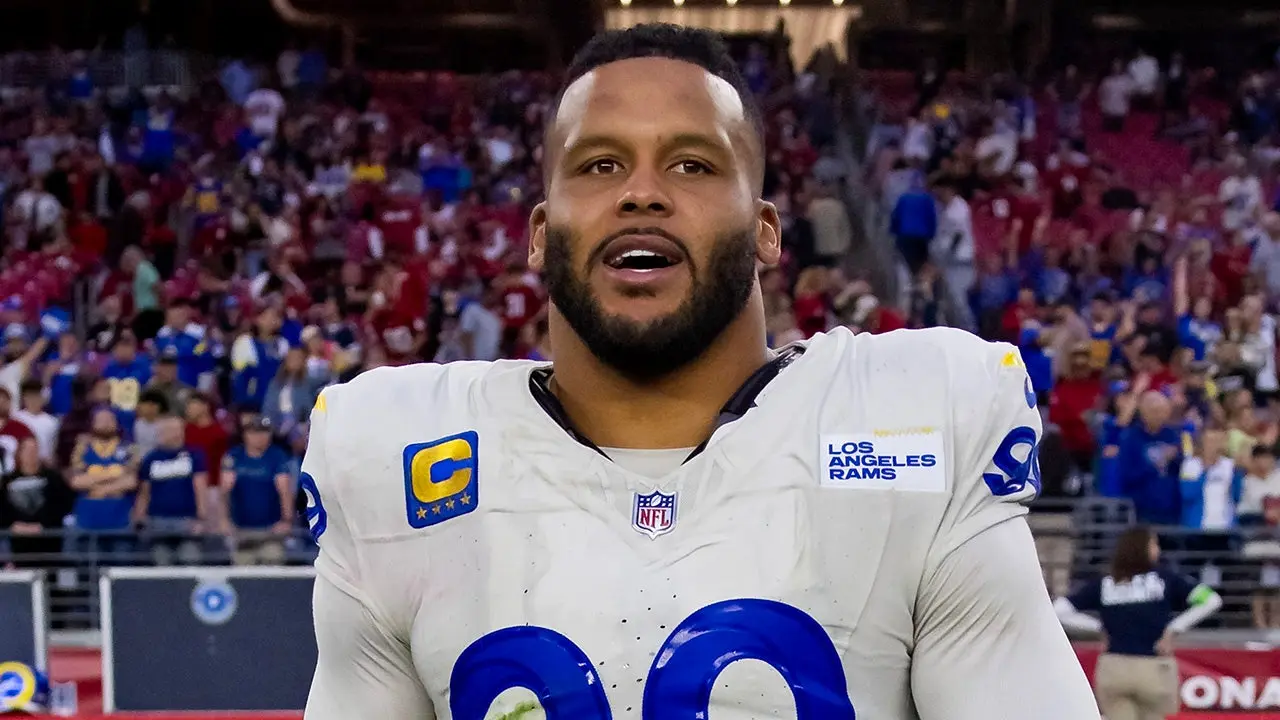
The air around the Los Angeles Rams’ training facility has been thick with anticipation all summer, a palpable electricity that has little to do with the rookies fighting for roster spots or the new offensive schemes being installed. It has everything to do with a ghost, a legend, a man who has been conspicuously absent from the gridiron since the 2023 season. Aaron Donald, the 10-time Pro Bowl defensive tackle, the three-time Defensive Player of the Year, the human wrecking ball who terrorized quarterbacks for a decade, has been the subject of relentless, almost obsessive, speculation. NFL insiders, with their sources and whispers, have been practically guaranteeing his return, painting a picture of a triumphant comeback that would instantly transform the Rams into Super Bowl favorites. The narrative was so strong that many fans had already mentally penciled him into the starting lineup, imagining the havoc he would wreak alongside the current defensive front. But after the team’s first preseason game on Saturday night, head coach Sean McVay stepped to the microphone and, with a calm, deliberate cadence, poured a bucket of ice water on the roaring fire of expectation. He didn’t slam the door shut, but he certainly didn’t fling it open. When asked for an update on Donald’s potential return, McVay offered a cryptic yet expansive response, a 361-word soliloquy that managed to say both everything and nothing at the same time. The headline, however, was unmistakable: “We are not at that point quite yet.” Those seven words sent shockwaves through the fanbase, instantly tempering the euphoria that had been building for weeks. It was a stark reminder that in the NFL, nothing is guaranteed, not even the return of a future Hall of Famer. The question came after a lackluster preseason outing, where the focus should have been on the young players battling for depth chart positions, but instead, the media scrum was dominated by the question of Donald. McVay, ever the tactician, knew he couldn’t ignore it, but he also knew he couldn’t give a definitive answer. He chose his words carefully, weaving a narrative of patience, respect, and uncertainty. It was a lot of words, a veritable essay on the subject, but when distilled down to its essence, it was a plea for time and a testament to the complexity of the situation. The stakes could not be higher, and the silence from Donald’s camp has only amplified the intrigue.
The timeline is crucial to understanding the gravity of McVay’s statement. Just days prior, multiple reports had surfaced suggesting that Donald would announce his intentions once the Rams reconvened at their Woodland Hills facility on August 7th. That date came and went with a deafening silence, leaving fans and analysts alike to wonder if the whispers were just that—whispers. The silence was broken only by McVay’s post-game comments, which served as the first official acknowledgment that this is not a foregone conclusion. It is a process, a delicate negotiation between a 35-year-old body and the relentless demands of professional football. McVay’s words were a masterclass in managing expectations. He didn’t want to put an “invisible deadline” on something that doesn’t exist in his mind. This isn’t a contract holdout or a leverage play; it’s a spiritual and physical reckoning. The coach’s tone suggested that he is genuinely in the dark, waiting alongside the rest of us for Donald to give the green light. He acknowledged that Donald has “earned the right” to take his time, to evaluate himself on his own terms. The reality is that a player of Donald’s caliber doesn’t just walk back onto the field. The game is a brutal, unforgiving mistress, and the offseason away from it has allowed his body to heal, but it has also allowed the rust to settle. The question isn’t whether Donald wants to play; it’s whether his body will allow him to play at the level he demands of himself. McVay’s “not at that point quite yet” is a tacit admission that the physical evaluation is still ongoing, and the results are far from certain. The coach is not just a strategist here; he is a confidant, a sounding board, and a man who understands that the greatest players often have the hardest time letting go.
Why the hesitation? The source article points to a crucial “catch” that many casual observers overlook. Donald isn’t just looking to suit up and collect a paycheck. He’s looking to dominate. He’s a three-time Defensive Player of the Year, a 10-time Pro Bowler, and the anchor of a defense that won a Super Bowl. He has a legacy of being the most feared interior lineman of his generation, a player who could single-handedly wreck an offensive game plan. The thought of returning to the field and looking diminished is terrifying to him. It would turn a triumphant return into a sad farewell tour, a spectacle of a once-great warrior being exposed by Father Time. He doesn’t want to be a mascot; he wants to be a wrecking ball. This is the human element that often gets lost in the transactional nature of sports media. It’s pride, it’s ego, but it’s also a deep respect for the game and for the fans who watched him wreck offenses for a decade. Donald knows that the NFL is a “what have you done for me lately” league. A poor comeback would tarnish his legacy, or at least complicate it. He wants to be close to, if not as good as, he’s always been. He doesn’t wish to look diminished in what could then be portrayed as a selfish chase for a Super Bowl ring rather than a valuable addition to a Super Bowl contender. This distinction is everything to a player of his stature. He is not chasing a ring at the expense of his dignity; he is chasing a ring while maintaining his standard of excellence. The psychological weight of this decision is immense. It’s the difference between walking away on your own terms and being carried off the field. For a man who has defined his life by relentless preparation and physical superiority, the idea of being a shell of his former self is a fate worse than retirement. He is wrestling with his own mortality as an athlete, and that is a battle no coach can fight for him.
McVay understands this intimately, perhaps better than anyone else in the building. He said Donald “earned the right” to know himself, to set his own benchmarks. The benchmarks are specific and brutally honest: Can he stack back-to-back days of practice? Can he handle the grind of training camp without breaking down? Can he wake up on a Wednesday morning and feel like he can do it all over again on Thursday? These are the mundane, unglamorous questions that define a comeback. It’s not about running a 40-yard dash or lifting a certain weight; it’s about the cumulative toll of daily contact, the constant pounding of a 300-pound body against other 300-pound bodies. McVay’s 361-word response was essentially a love letter to his star player’s autonomy. He is giving Donald the space to make the hardest decision of his career, without pressure, without a countdown clock. The coach’s respect for Donald is palpable. He knows that Donald has given everything to this franchise, and he is not about to demand a rushed decision. “I think he earned the right to be able to say he knows himself in terms of, ‘Am I able to stack back-to-back days? Am I able to do some of the different things?'” McVay said. This is a coach who is willing to wait, who understands that the physical and mental preparation required for an NFL season is a deeply personal journey. He is not going to push, because he knows that pushing a player of Donald’s caliber would be counterproductive. The decision has to come from within. McVay is the facilitator, the supporter, the one who keeps the light on, but he cannot make the choice for Donald. He can only hope that the clarity Donald seeks arrives sooner rather than later, and he is prepared to accept whatever answer Donald gives him. The patience McVay is displaying is a rare commodity in a league driven by immediate results.
Make no mistake, the Rams want him back. The headline about the Myles Garrett trade shows they are in “win-now” mode, pushing for another Super Bowl championship. The front office is aggressively pursuing talent, and Donald is the ultimate chess piece, a defensive force that can change the trajectory of a season. But McVay knows that a half-hearted Donald is worse than no Donald at all. If Donald comes back and isn’t close to his peak, it could disrupt the locker room chemistry and the defensive scheme. The difference between a “selfish chase” for a ring and a “valuable addition” is razor-thin. It all hinges on Donald’s physical readiness. The Rams are willing to wait, but they are also realistic. They know that Father Time is undefeated, and even the greatest warriors eventually have to hang up their armor. The team’s defensive coordinator has likely already drawn up multiple packages that feature Donald, but he also has to prepare for a reality where Donald isn’t there. The uncertainty is a challenge, but it’s a challenge the Rams are willing to embrace. They understand that Donald’s presence alone would elevate the entire defense, creating opportunities for edge rushers and freeing up linebackers to make plays. But they also understand that a diminished Donald could be a liability, a target for opposing offenses to exploit. The Rams are walking a tightrope, balancing their desire for a championship with their respect for a legend’s legacy. They want Donald to return, but only if he can return as the dominant force he once was. Anything less would be a disservice to him, to the team, and to the game itself. The front office’s aggressive moves, like the rumored pursuit of Myles Garrett, signal that they are all-in on winning now, and Donald is the missing piece that could make it all come together.
So, where does this leave us? In a state of beautiful, agonizing suspense. The NFL season is a marathon, and Donald is deciding whether to join the race. McVay’s tone suggests he is genuinely hopeful, but he is also at peace with either outcome. He respects the process. For Donald, this is about more than football. It’s about proving to himself that he can still be the best. It’s about the fear of irrelevance and the thrill of the chase. It’s about looking in the mirror and knowing that he gave everything he had, whether that means one more season or a permanent retirement. As the Rams prepare for the regular season, the door remains open. The lights are on, the playbook is waiting, and the greatest defensive tackle of his era is listening to his body, waiting for a clear signal. Whether that signal comes tomorrow or never, one thing is certain: Aaron Donald has earned the right to make this choice on his own terms. And for now, that’s all that matters. The fans will wait, the coaches will wait, and the media will continue to speculate. But the decision rests solely with Donald. He is the master of his own fate, the author of his own ending. The narrative of his career is not yet complete, and the final chapter is being written in the quiet moments of his training, in the aches and pains of his 35-year-old body, and in the deep recesses of his competitive mind. Whether he returns to the gridiron or walks away for good, his legacy is secure. He is a champion, a legend, and a man who has always done things his own way. The waiting game is a testament to that, a final act of defiance against the clock, a reminder that even in the brutal, unforgiving world of professional football, there is still room for patience, for respect, and for the human spirit to make its own choice. It is a story that transcends wins and losses, touching on the very essence of athletic greatness and the courage it takes to say goodbye.