

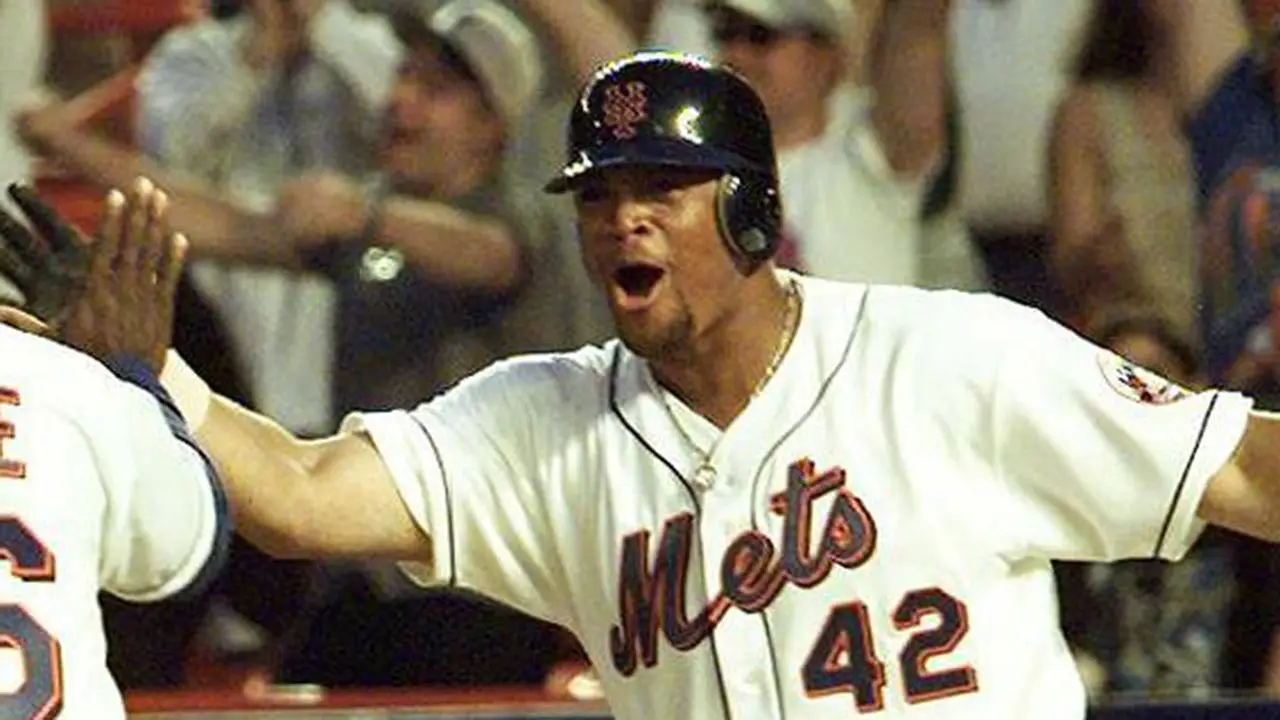
Butch Huskey was not a household name, not a Hall of Famer, not a player whose highlight reel interrupts sports broadcasts. He was a corner-of-the-clubhouse presence, a powerful right-handed bat from Oklahoma who spent parts of nine seasons in the major leagues, a role player who often found himself standing in the shadows of bigger stars. Yet when the New York Mets announced his death, something important slipped away from baseball’s living memory. Huskey died at age 54, far too young, and he left behind a quietly extraordinary distinction: he was one of the final MLB players to wear No. 42, the number forever set apart for Jackie Robinson. In an era when Robinson’s number was becoming a universal symbol of courage and equality, Huskey was among a tiny group of men who actually wore it on their backs, not as a commemorative patch on Jackie Robinson Day, but as a regular uniform, year after year, long after baseball decided that no one should ever wear it again. He first wore No. 10 with the Mets, then switched to No. 42 in 1995, two years before Major League Baseball made the number unavailable to future players. When the league retired the number league-wide to honor Robinson, it made an exception for active players already wearing it, allowing them to continue as long as they stayed in the majors. That grandfather clause let Huskey keep No. 42 as he drifted through different cities, from New York to Seattle to Minnesota, making him a living bridge from Robinson’s era to our own, a man who wore history without ever being consumed by it. The news of his death felt like the closing of a strange, quiet chapter, because the number on his jersey was never just a number. It was a statement, a reminder of how far baseball has come, and a tribute to a man whose story Huskey had agreed, simply by playing, to keep alive.
His baseball career began modestly, as most do. Huskey made his MLB debut in 1993 with the Mets, but he did not get full playing time until three years later, and by then he was already wearing No. 42. In 1996, playing mostly first base, he impressed with a .278 batting average and a .754 OPS, showing enough power and bat control to make the Mets believe they had found something worthwhile. The following year, 1997, he improved dramatically, hitting .287 with an .822 OPS, belting a career-high 24 home runs and driving in 81 runs, also the most of his career. For one stretch, he looked like a legitimate middle-of-the-order presence, someone who could anchor an offense alongside the young players New York was assembling. But Huskey was never the kind of player who could carry a franchise on his shoulders. He was a solid, dependable, occasionally dangerous hitter, the sort of guy who would win you a game in June and then disappear from your memory by September. Still, there was something about the way he played that made him easy to root for. He was not flashy, not loud, not seeking attention. He just went out, hit the ball hard, played multiple positions, and tried to justify the faith that the Mets had shown in him by giving him the number associated with their own franchise forever. For a player without star pedigree, wearing No. 42 in daily games came with an unspoken burden, and Huskey handled it with a quiet dignity that perhaps mirrored Robinson’s own grace under pressure. He did not try to be Jackie Robinson, of course. He simply tried to be Butch Huskey, a baseball player who happened to wear a sacred number and somehow made it feel natural.
The season after his best year, everything changed. In 1998, Huskey took a step back, his production slipping as his playing time became less consistent, and the Mets moved on, trading him to the Seattle Mariners in the offseason. It was the beginning of a nomadic stretch, the kind that many journeymen endure, though Huskey carried a special souvenir with him wherever he went. Because he had worn No. 42 before the retirement, he was permitted to keep wearing it even after changing teams, and he did so proudly with the Mariners. He then moved from Seattle to Boston during the 1999 season, though with the Red Sox he opted for No. 44. That decision remains an interesting footnote in history, partly because Boston already had a player who would eventually make the number his own, but more importantly because Huskey’s time in Boston placed him in the middle of a dramatic playoff race. The Red Sox made the postseason as a wild card, and Huskey watched his team take on the New York Yankees in the American League Championship Series. That series was unforgettable, filled with dramatic moments, from Pedro Martínez’s famous relief appearance to the Yankees’ relentless pursuit of another championship. Ultimately, Boston lost to New York in a heartbreaking battle that sent the Yankees to the World Series, where they completed the second leg of their three-peat. For Huskey, it was bittersweet. He had played for the Mets, the team that unfairly lost to the Yankees in 2000, but in 1999 he was on the other side, wearing the wrong color, and still the Yankees found a way to take everything. He was not the reason they lost, and he was not the hero, but he was part of the story, a witness to one of the great dynasties in baseball history.
After Boston, Huskey’s career wound down quietly. He spent time with the Colorado Rockies, where he wore No. 35, a number without any historic weight, perhaps a signal that he was no longer part of the strange fraternity of active No. 42s. He also had a brief stint with the Minnesota Twins, where he again wore No. 42, because the grandfather clause allowed him to do so even after he left New York. He became, in fact, the last person to wear No. 42 in Mariners history, a distinction that sounds minor but actually tells you a great deal about how rare that number had become. Only four players wore No. 42 after Huskey in the big leagues: Mo Vaughn, Mariano Rivera, Michael Jackson, and Jose Lima. That list reads like a strange song of baseball names, a mix of MVP-caliber sluggers, the greatest closer in history, a late-inning reliever with a famous name, and an eccentric right-hander who loved pitching in Houston. Rivera, of course, was the very last player to wear No. 42, and he turned it into a symbol of his own indomitable career, but Huskey’s part in that lineage mattered too. He was not the greatest player to wear the number after Robinson, but he was perhaps the least likely carrier of such a heavy legacy, a journeyman who happened to be in the right place at the right time and ended up becoming part of baseball history in a way he probably never expected. When people look back at the list of players who kept No. 42 alive through the late 1990s and early 2000s, they often remember the famous ones, but Huskey’s name deserves a place as well, because he wore it longer and more quietly than most, never treating it as a burden, never turning it into a gimmick.
Perhaps the most poignant detail of Huskey’s connection to No. 42 is that the number was retired for Jackie Robinson during one of Huskey’s own games with the Mets, against Robinson’s former team, the Brooklyn Dodgers, who had long since relocated to Los Angeles. That ceremony, held on April 15, 1997, at Shea Stadium, was a moment of profound symbolic closure, a full-circle celebration of the man who broke baseball’s color barrier. Huskey was not just some distant observer; he was an active player on the field that night, wearing the very number being honored, standing among his teammates as baseball officially declared that no one after Robinson would ever wear it again. It must have been an overwhelming feeling, to know that your jersey was about to become a relic of a bygone rule, that every future appearance you made in that number would be a deliberate exception, a continuation of something sacred. Huskey did not speak much about that burden, at least not in public, but he carried it with remarkable consistency. In the years that followed, when he trotted out to first base or walked to the plate in Seattle or Minnesota, he was a moving monument, an accidental custodian of a legacy far larger than his own career. He was born too late to experience the segregated world Robinson fought against, and he was not the type to discuss social justice in the clubhouse, but by simply taking the field in No. 42, he paid a kind of daily tribute that few players ever had the chance to offer. He did not break any barriers himself, but he wore the emblem of a man who did, and there is a quiet nobility in that.
Now Huskey is gone, and his death at 54 is another reminder that the generation of players who kept Jackie Robinson’s number alive in the late 1990s is slowly fading. Baseball has moved into a new era, where No. 42 is seen exactly once a year, on Jackie Robinson Day, when every player in the majors wears it to honor Robinson’s legacy. But for Huskey, it was not an annual occasion. It was simply his uniform, his identity, the number on his back that tied him to the past every single day. He was not a star, not a Hall of Famer, not a legend. He was a man from Oklahoma who loved baseball, who worked hard to make it to the majors, and who found himself in a unique position to serve as a monument to the game’s greatest pioneer. The Mets announced his death with a short social media message, and the outpouring from fans and former teammates was immediate, a reminder that the sport mourns its own deeply. We remember Butch Huskey not because he hit 24 home runs in a season, though that was a nice career year, but because he was part of something larger than himself. He was the quiet face of a fading tradition, a player who never wore the number as a burden but carried it as a privilege. In the long history of baseball, there will only ever be a handful of men who could say they wore No. 42 in a regular-season game after the retirement, and Butch Huskey was one of them. That alone secures his place in the game’s memory, and it is why his death feels like the loss of something more than just a former major leaguer. He was a living thread to Jackie Robinson, and now that thread has snapped, leaving us with only stories, photographs, and the knowledge that he wore history on his back and let it shine. Rest in peace, Butch. You carried that number well.