

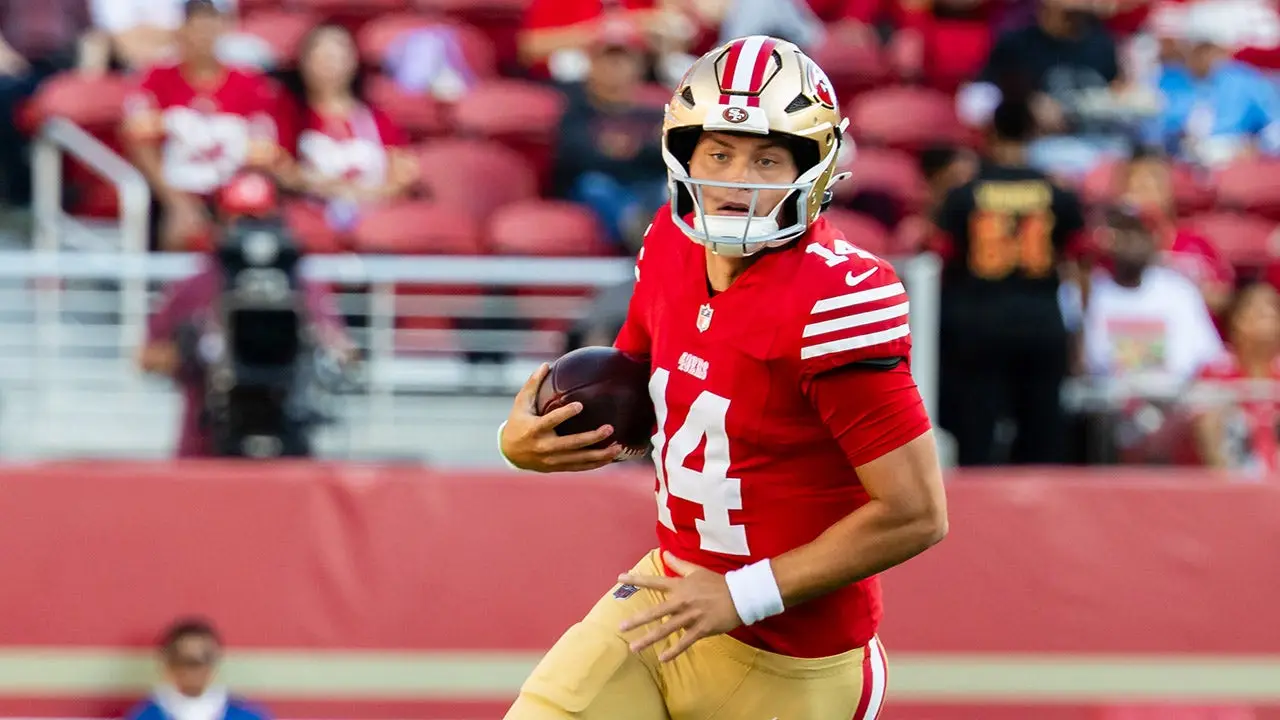
There are moments in sports that feel bigger than the box score, moments that remind you why you fell in love with the game in the first place. Thursday night in Santa Clara was exactly that kind of moment, until it suddenly wasn’t. Kurtis Rourke, the San Francisco 49ers’ third-string quarterback, walked onto the field for the team’s first preseason game against the Tennessee Titans with more than just a roster spot on the line. He was carrying the weight of a long, painful road back to football. It had been more than eight months since his last real game, all the way back on December 20, 2024, before knee surgery had wiped out his entire rookie season. Drafted in the seventh round in March 2025, in the same draft class that brought Titans quarterback Cam Ward into the league, Rourke spent that whole first year on the sidelines, not because the 49ers didn’t like him, but because his body wasn’t ready. The knee that had carried him through an entire college season with a torn ACL needed to be rebuilt. So he waited. He watched. He rehabbed in silence while the games went on without him. And then, on a warm August night, he finally got to play again. For three drives, it looked like the wait was worth it. He moved the offense with the calm, efficient rhythm of a veteran. The passes were crisp, the decisions were quick, the pocket awareness was natural. It wasn’t just a good debut; it was the kind of performance that makes people wonder whether the 49ers have quietly found something special in an overlooked rookie. But then, in an instant, the storybook evening took a sharp and frightening turn. Rourke came out of the game with what the team called a rib injury. The initial X-rays were negative, but he was struggling to breathe, and that changed everything. He was taken to the hospital for further imaging, leaving behind a sideline that had gone from celebration to concern in a matter of moments.
Let’s talk about what Rourke actually did on the field, because it deserves to be celebrated on its own terms. In his first live game action in over eight months, he completed 12 of his 14 passes for 101 yards. That is an 85.7 percent completion rate, a number that would make any quarterback smile, let alone someone who hadn’t taken a real NFL snap in months. He also carried the ball three times for 14 yards, showing that the reconstructed knee could still move, could still escape pressure, could still make plays with his legs. He led the 49ers on three drives, and his final possession ended with the only kind of punctuation a quarterback wants: points. Patrick Taylor Jr. punched in a 1-yard touchdown run to cap off the drive, and Rourke walked off the field having done exactly what a backup is supposed to do — move the team, protect the football, and put points on the board. For a guy who had been through what he had been through, it was the kind of night that makes all the early mornings and lonely rehab sessions feel worth it. But the numbers don’t tell the whole story. There was a confidence in the way he played, a sense that he wasn’t thinking about his knee or the long layoff. He was just playing football. He was scanning the field, finding open receivers, taking what the defense gave him. He looked like a quarterback who had been in the league for years, not a seventh-round pick making his unofficial debut. Teammates on the sideline could be seen reacting to his throws, the kind of quiet respect that develops when a guy walks in and does his job without any drama. There was no panic, no hesitation, no sign that the long road back had worn him down. It was simply football, played the way it’s supposed to be played. And for a few precious moments, the only question on anyone’s mind was how much more he could do.
But football has a way of reminding you that joy is always borrowed, never owned. After that touchdown drive, Rourke left the game. At first, it seemed like standard preseason procedure — get the young quarterback out, put in the next guy, protect the roster. But then the word “ribs” started spreading through the sideline and the press box. The medical staff was looking at him closely, and something was clearly wrong. Rourke was struggling to breathe. That’s not something you see every day in a preseason game, and it changes the mood immediately. The team took him to the hospital for further imaging, even though the X-rays at the stadium didn’t show any broken bones. “They said ribs. He was struggling to breathe, so they took him to the hospital just to check on him and make sure he’s alright. X-rays in here didn’t show it was broken,” head coach Kyle Shanahan told reporters after the game. You could hear the concern in Shanahan’s voice, but there was also a sense of measured calm. He wasn’t going to speculate, wasn’t going to offer false hope, and wasn’t going to panic. The priority was making sure Rourke was okay, and that meant letting the hospital do its job. For Rourke, this was both scary and all too familiar. He has already learned that football can change in a split second. He has already had to deal with pain that goes beyond the ordinary aches and bruises of the sport. To play his entire final college season with a torn ACL, to gut through it because his team needed him, to then face surgery and an entire year of recovery — that takes a certain kind of toughness. And now, just as he was finally back on the field, another injury scare threatened to take it all away again. It’s enough to make anyone wonder why they put their body through this. But if anyone knows how to handle setbacks, it’s Kurtis Rourke.
Shanahan’s postgame comments were a masterclass in managing expectations. He didn’t downplay what happened, but he also refused to overreact. “They just wanted to get more imaging and find out, so they weren’t too concerned,” he said. “I don’t want to downplay it but I don’t want to overplay it either.” It was the kind of cautious, nuanced response that coaches give when they know a player’s health is delicate and the full picture isn’t yet clear. The X-rays were negative, which is good, but rib injuries can be tricky. Even a bruise can make it painful to breathe, and for a quarterback — who has to twist, extend, and throw with force — any issue in the torso can be a major problem. The fact that the team sent him to the hospital tells you they were taking it seriously, even if they weren’t panicking. For Rourke, the next few hours would be spent in a hospital bed, surrounded by doctors, waiting for scans and waiting for answers. For the 49ers, the immediate focus shifts to his recovery. Preseason games are meaningful for roster battles, but no one in the building would risk a player’s health just to evaluate him in a meaningless August contest. The team already knows what Rourke has been through, and they know what he’s capable of when healthy. What they need now is information. Is it a bruised rib? A cartilage issue? Something more serious? The negative X-rays suggest the worst outcomes are off the table, but they don’t provide complete clarity. Until the further imaging comes back, everyone is holding their breath. In the meantime, there’s the question of what this means for Rourke’s place on the roster. Coming into camp, he was the third quarterback on the depth chart, behind established veterans Brock Purdy and Mac Jones. That’s a tough spot for any young player. But with every rep, every practice, and every preseason snap, Rourke was making a case for himself. His performance on Thursday was exactly what coaches want to see from a developmental quarterback. And while the injury doesn’t necessarily change the depth chart, it does add another layer of uncertainty to an already uncertain battle.
To truly appreciate Rourke’s journey, you have to rewind to his college career, where the foundation of his toughness was laid. He started at Ohio, transferred to Indiana for his final season, and delivered the best football of his life when it mattered most. That year, he completed a career-high 69.4 percent of his passes, threw 29 touchdowns against just five interceptions, and led the Hoosiers with a calm, commanding presence. Players like that become legends on campus, but Rourke’s story was more complicated than the stat sheet suggests. He was playing through a torn ACL. For an entire season. Every drop-back, every throw, every scramble came with a knee that wasn’t structurally sound. He didn’t make excuses. He didn’t sit out. He kept playing, kept winning, kept putting the team on his back. It’s the kind of thing that defines a player’s reputation long before they ever reach the NFL. After the season ended, he had surgery, and the recovery was long and brutal. He watched the draft process from the outside, uncertain of where or if he would be selected. The 49ers took a chance on him in the seventh round, but the rehab continued into his rookie year. He spent the entire season on the roster, but he never played. Brock Purdy and Mac Jones were ahead of him, and Rourke was in no condition to compete anyway. So he waited, worked, and waited some more. While his college teammates at Indiana went on to win a national championship the following season with Fernando Mendoza at quarterback, Rourke was in a training room, trying to get his knee strong enough to simply practice. That kind of experience changes a person. It teaches you patience. It teaches you perspective. And it makes moments like Thursday night — the good ones — feel that much sweeter. It also means that an injury scare like this one hits a little harder. Rourke knows exactly what it’s like to have something taken away by his body. He knows the lonely months of rehab, the uncertainty, the fear that maybe he won’t come back the same. But he also knows how to come back. He’s done it before. And if the rib injury turns out to be minor, there’s every reason to believe he’ll do it again.
Where does that leave us? Rourke is in the hospital, waiting for more imaging and hoping for good news. Shanahan is doing his best to balance concern with perspective. The 49ers are preparing for the next preseason game, but the quarterback room is holding its breath. And Rourke, the quiet seventh-round pick from Ohio who became an Indiana Hoosier, is once again facing the unknown. Yet if there’s one thing his story has taught everyone around him, it’s that he can handle it. He has already overcome more than most players ever will. He played through a torn ACL, had his NFL dream delayed by surgery, missed an entire season, and then walked back onto the field as if he’d never left. Thursday night was supposed to be a small victory lap, a chance to show himself and the world that he was back. Instead, it became another chapter in a story that refuses to be simple. But maybe that’s okay. Football, like life, is full of false starts and unexpected twists. The best players aren’t the ones who avoid adversity; they’re the ones who keep getting up. Rourke has been getting up his whole career. The numbers from Thursday — 12 of 14, 101 yards, a touchdown drive — will be forgotten in a month. What won’t be forgotten is the way he handled this setback, the calmness in his eyes as he walked off the field, the determination that has carried him through far worse than a bruised rib. He has the coaching, he has the teammates, he has a quarterback room that includes Purdy and Jones, and he has the kind of resilience that can’t be coached. As the 49ers wait for test results, one thing is certain: Kurtis Rourke’s journey is far from over. Whether he’s ready for it or not, the next chapter is already being written. And if history is any guide, he’ll meet it the same way he has met everything else — head-on, unafraid, and ready to fight for another chance to play the game he loves.