

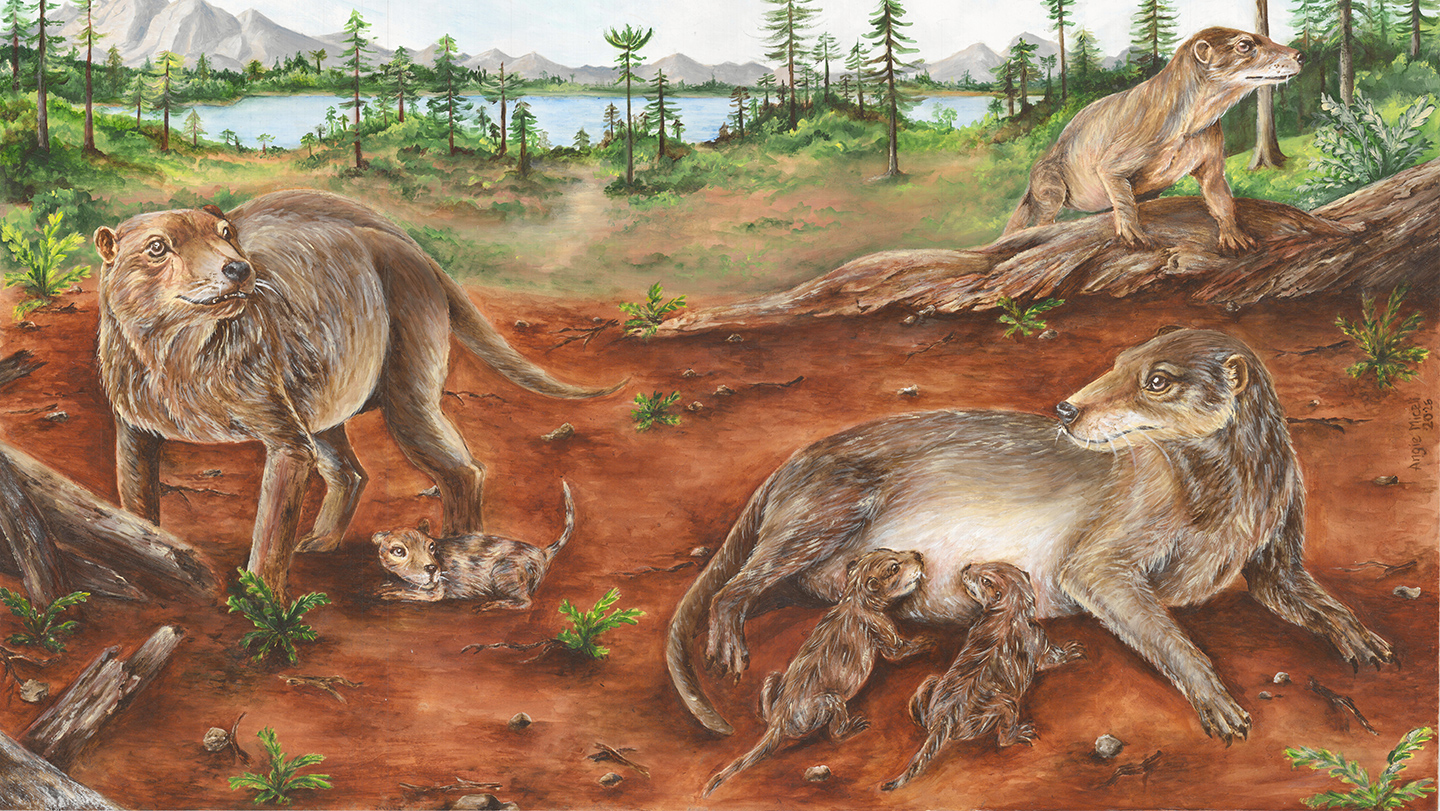
For paleontologists, some of the most profound questions about our own ancestry are also the most intimate. They concern not just how our distant relatives looked or moved, but how they brought their young into the world — whether they laid eggs like reptiles or gave birth to live young like most of the mammals that fill the world today. For decades, scientists have wrestled with this question, assuming that live birth, known as viviparity, evolved relatively late in the mammal family tree, perhaps around 160 million years ago, when a group called therian mammals appeared. But a new study, published in Frontiers in Mammal Science, suggests our understanding may be off by a staggering margin of 90 million years or more. The head-turning evidence is hidden in the fossilized bones of Chiniquodon theotonicus, a distant mammal relative that lived roughly 236 million years ago in what is now northwestern Argentina. Back then, Earth was a vastly different place: dinosaurs were only just beginning to emerge, and the ancestors of mammals were small, resilient creatures fighting for their place in the Triassic world. By examining the microscopic structure of a fossilized femur, researchers discovered a dark band known as a neonatal line, a marker left in bone when an animal undergoes the intense metabolic stress of being born. This line, along with other growth-ring data, allowed scientists to estimate that C. theotonicus was born at a hefty 1.7 kilograms, a striking proportion of the 12 kilograms it would eventually reach as an adult. A newborn that large, relative to its adult size, is not what you would expect of an egg-layer; reptiles and birds typically hatch at a tiny fraction of their final size. It is, instead, a signature of live birth, one that could rewrite the story of who we are and where we come from. Understanding when this shift occurred matters not just for filling in a date on a timeline; it changes how we think about maternal care, energy investment, and the very nature of the creatures that carried our evolutionary future within their bodies. The study’s authors describe the find with an understandable sense of wonder, noting that the tale told by these bones is not merely about anatomy but about the very experience of being born, an event shared by every creature that has ever lived.
To appreciate why this discovery matters, it helps to understand who the cynodonts were. The name literally means “dog teeth,” a nod to their most distinctive feature: a mouth full of differentiated teeth, including incisors, canines, and molars, capable of cutting, tearing, and grinding. This may sound like a small thing, but it represented an evolutionary breakthrough. Earlier reptiles had simple, peg-like teeth, which meant they could only swallow food mostly whole or in large chunks. Cynodonts, by contrast, could process a wide variety of foods efficiently, unlocking a richer diet. Their jaws also underwent a profound transformation, developing a secondary palate, a bony shelf that separates the nasal passage from the mouth. This allowed them to chew and breathe at the same time, a talent few reptiles possess. The payoff was enormous: more thorough chewing meant faster digestion, which meant more energy extracted from each meal, which in turn permitted a higher metabolism. Many scientists believe cynodonts were at least partially warm-blooded, generating their own internal heat rather than relying solely on the warmth of the sun like cold-blooded reptiles. That metabolic boost, combined with their ability to burrow into the earth, may well have been their salvation: when the Permian Period ended in catastrophic mass extinction roughly 252 million years ago, wiping out most of life on Earth, cynodonts were among the survivors. It is not a stretch to say that we owe our existence to these small, tenacious, toothy creatures. Mammals are the only surviving lineage of the cynodonts, and every living mammal, from the tiniest shrew to the blue whale, carries a distant echo of those Triassic ancestors. Cynodonts were an extraordinarily diverse group, ranging from tiny, shrew-like insect-eaters to robust, dog-sized predators, and they came to occupy a wide variety of ecological niches. Yet the question of when our lineage made the leap from egg-laying to live birth has remained stubbornly mysterious, because reproduction rarely leaves behind direct fossil traces. This is what makes the neonatal line discovered in this study so exciting: for the first time, researchers believe they are seeing evidence of live birth in a cynodont that lived deep in the Triassic.
For years, the scientific consensus placed the origin of viviparity much later in the story, with the emergence of therian mammals, the ancestors of today’s marsupials and placental mammals, around 160 million years ago. Earlier cynodonts, the thinking went, still laid eggs. The new study challenges that assumption through a meticulous analysis of a C. theotonicus skeleton collected in northwestern Argentina. The research team, led by paleontologist Leandro Gaetano of the National Scientific and Technical Research Council in Buenos Aires, used petrographic techniques to slice the fossilized bone into thin sections that could be examined under a microscope. Bone, it turns out, grows in layers, rather like the rings of a tree, recording key events in an animal’s life. In the cross section of the femur, the team identified a distinct neonatal line, a fine, dark ring that separates bone tissue formed before birth from bone tissue formed after it. The presence of such a line is itself remarkable, because it represents a dramatic physiological transition: the moment of entering the world, when an infant animal must suddenly breathe, regulate its own temperature, and take in nourishment. In egg-laying animals, a similar line can exist, but the surrounding growth patterns tell a very different story. By carefully measuring the layers of bone laid down in the womb and those deposited after birth, Gaetano and his colleagues were able to reconstruct the animal’s early growth with surprising precision. They concluded that C. theotonicus weighed roughly 1.7 kilograms at birth, and around 12 kilograms at the time of its death, with an estimated newborn-to-adult mass ratio of about 14 percent. That number, the team realized, was strikingly high — much higher than anything seen in modern egg-laying amniotes, and squarely within the range of mammals that give birth to fully developed, relatively large young. Although neonatal lines have been observed in other fossil vertebrates, rarely have they been so clearly preserved in a creature of this age and lineage, making this specimen an unusually valuable window into the ancient past.
To test whether their interpretation was sound, the team did something both simple and powerful: they compiled data on newborn and adult body masses across thousands of living species. Their catalog included reptiles such as turtles, snakes, and crocodiles; birds such as cranes and vultures; egg-laying mammals known as monotremes, including echidnas; marsupials such as kangaroos, which give birth to tiny, embryonic young that then crawl into a pouch; and placental mammals, from rodents to humans, whose offspring are nourished inside the womb and born at a relatively advanced stage of development. When the researchers plotted all these ratios on a graph, C. theotonicus stood out unmistakably. It did not land among the birds or reptiles, whose hatchlings typically weigh just 0.1 to 4.5 percent of their adult mass. It did not even resemble the monotremes or marsupials, whose newborns can be as small as 0.15 percent of adult weight. Instead, the ancient cynodont fell squarely in the middle of the placental mammal cluster, with a birth-weight ratio almost identical to that of the bay duiker, a small African antelope whose fawns are born large and able to run within hours of birth. “We were amazed to find that C. theotonicus grouped with extant placental mammals,” Gaetano said, describing the team’s astonishment. The comparison is more than a curiosity; it speaks to a deeply different reproductive strategy. Giving birth to a large, well-developed infant demands a heavy investment from the mother, but it yields offspring that are more mobile, more predator-resistant, and more likely to survive their vulnerable first days. That is a strategy built for a world where being ready to run or fight from the moment of birth can mean the difference between life and death. If C. theotonicus truly gave live birth, it means this strategy was already in play some 236 million years ago, fundamentally altering our understanding of how and when the defining reproductive style of modern mammals first took root. It is a humbling thought that the way many of us came into the world — full-sized, dependent, and yet unmistakably present — was already an ancient pattern when dinosaurs were only beginning their long reign.
The implications of this finding reach far beyond a single date on the evolutionary calendar. It raises a profound and unresolved question: did live birth evolve just once, in a common ancestor of all mammals, or did it evolve independently at different times in different lineages? Randall Irmis, a paleontologist at the University of Utah who was not involved in the study, points out that the new evidence opens the door to both possibilities. If C. theotonicus and other early cynodonts were viviparous, then live birth may be an ancient inheritance present in the very foundations of the mammal family tree, passed down through countless generations to the animals we see today. On the other hand, it is possible that therian mammals evolved their own version of live birth later, independently, in which case viviparity would be a striking example of evolutionary convergence — nature finding the same solution two separate times. Choosing between these hypotheses, Irmis notes, is impossible with the fossil evidence at hand. “We’ll need more fossil evidence to test these two hypotheses,” he says, and there is the rub. The fossil record is notoriously stingy when it comes to reproduction. Embryos are preserved only under exceptional conditions, and the soft tissues involved in pregnancy and birth almost never survive the ravages of time. To date, no other fossilized embryonic tissue has been found in a cynodont of this age, nothing that could serve as direct evidence for live birth in this ancient lineage. The bone-based argument is clever and compelling, but it is indirect; it reads a creature’s birth story from the silent layers of its skeleton. For now, that story remains a single thread in a very incomplete tapestry, a tantalizing clue that demands more digging, more patience, and more tiny data points gathered one fossil at a time. Scientific progress, after all, rarely arrives as a single dramatic revelation; more often it comes as an accumulation of small, hard-won observations that gradually change the way we see the world.
There is, moreover, a serious body of evidence suggesting that not all of C. theotonicus‘s relatives made the same reproductive choices. Consider Lystrosaurus, a heavy-set, beak-faced dicynodont that lived around 250 million years ago and famously survived the Permian mass extinction. Paleontologists have discovered a tightly curled Lystrosaurus embryo preserved inside its shell, an unmistakable sign that this branch of the mammal-ancestor lineage still laid eggs. Even more striking is Kayentatherium wellesi, a cynodont that lived in northern Arizona around 196 million years ago, tens of millions of years after C. theotonicus. Fossils of Kayentatherium reveal an adult surrounded by 38 young, a number far more reminiscent of a clutch of eggs than of a litter of live-born infants. These discoveries are a powerful reminder that evolution does not follow a tidy, linear path. The same family tree can contain branches that lay eggs and branches that give birth to live young at the same time in history. Live birth is not necessarily the finish line of some predetermined march of progress; it is a strategy, one that emerged in some lineages and not in others. Eva Hoffman, a paleontologist at the American Museum of Natural History in New York who studies cynodont evolution, urges caution. “It would require strong evidence to demonstrate viviparity,” she said, “and I haven’t seen that for any non-therian cynodont.” Her carefully worded skepticism captures the scientific tension at the heart of this discovery. The neonatal line in C. theotonicus is tantalizing but not definitive; it is the kind of evidence that raises questions as much as it answers them. Still, the finding marks a meaningful shift in how scientists think about the deep past. It reminds us that our ancestors were not simple, primitive placeholders waiting to become mammals, but complex, adaptable organisms that experimented with a variety of ways to survive. The history of life, this discovery reminds us, is much messier and more fascinating than any simple diagram can capture, full of backward branches, dead ends, and sudden innovations that defy conventional expectations. The bones of one Triassic creature, etched with the memory of the moment it took its first breath of air, hint at a chapter in the story of life that has yet to be fully written — and invite us to keep digging.