


Imagine the universe as a newborn, a vast and mostly empty expanse of hydrogen and helium, still glowing from the fires of its own birth. For a long time, scientists assumed that planets—especially rocky ones like our own—could not exist in such a primitive place. They needed heavier elements, the stuff of rock and iron and life, and those elements had to be forged in the hearts of stars and scattered across space by their deaths. But a stunning new study suggests that the very first rocky planets may have begun forming astonishingly early, perhaps only 100 million years after the Big Bang. That is a blink of an eye in cosmic terms, a time before galaxies had even taken shape. The key, researchers say, lies in the explosive deaths of the universe’s first massive stars. These cataclysmic supernovas may have created isolated pockets of space rich enough in dust and elements like iron and carbon to serve as the building blocks of planets. A new computer simulation has shown that these debris fields could have produced enough rocky material to make several Earth-sized worlds, and there was even water available in the young stellar system that could have reached a planet a little later. The findings, reported August 19 in Astrophysical Journal Letters, push the story of planetary origins far earlier than anyone thought possible.
For decades, astronomers have tried to figure out when the universe first became capable of making planets. Planets, especially rocky ones, are not made of the primordial hydrogen and helium that dominated the early cosmos. They require heavier elements—carbon, oxygen, iron, and other metals—that are created deep inside stars and released when those stars die. The first stars were enormous, perhaps hundreds of times the mass of our sun, and they lived fast and died young, exploding in spectacular supernovas that scattered their chemical riches across space. Earlier attempts to understand the timing of planet formation used large-scale simulations to ask when the universe as a whole had accumulated enough heavy elements. But a team led by astronomer Daniel Whalen of the University of Portsmouth in England wanted to look more closely at the most element-enriched regions of the early cosmos: the debris fields left behind after those first giant stars exploded. Their reasoning was simple and elegant. If these regions had much higher concentrations of heavy elements than the rest of the universe, then perhaps planets could have formed there much earlier than the global average would suggest. It is a bit like looking for fertile soil not across an entire continent, but in the ash-rich clearing left by a forest fire, where nutrients are suddenly concentrated and new growth can take root.
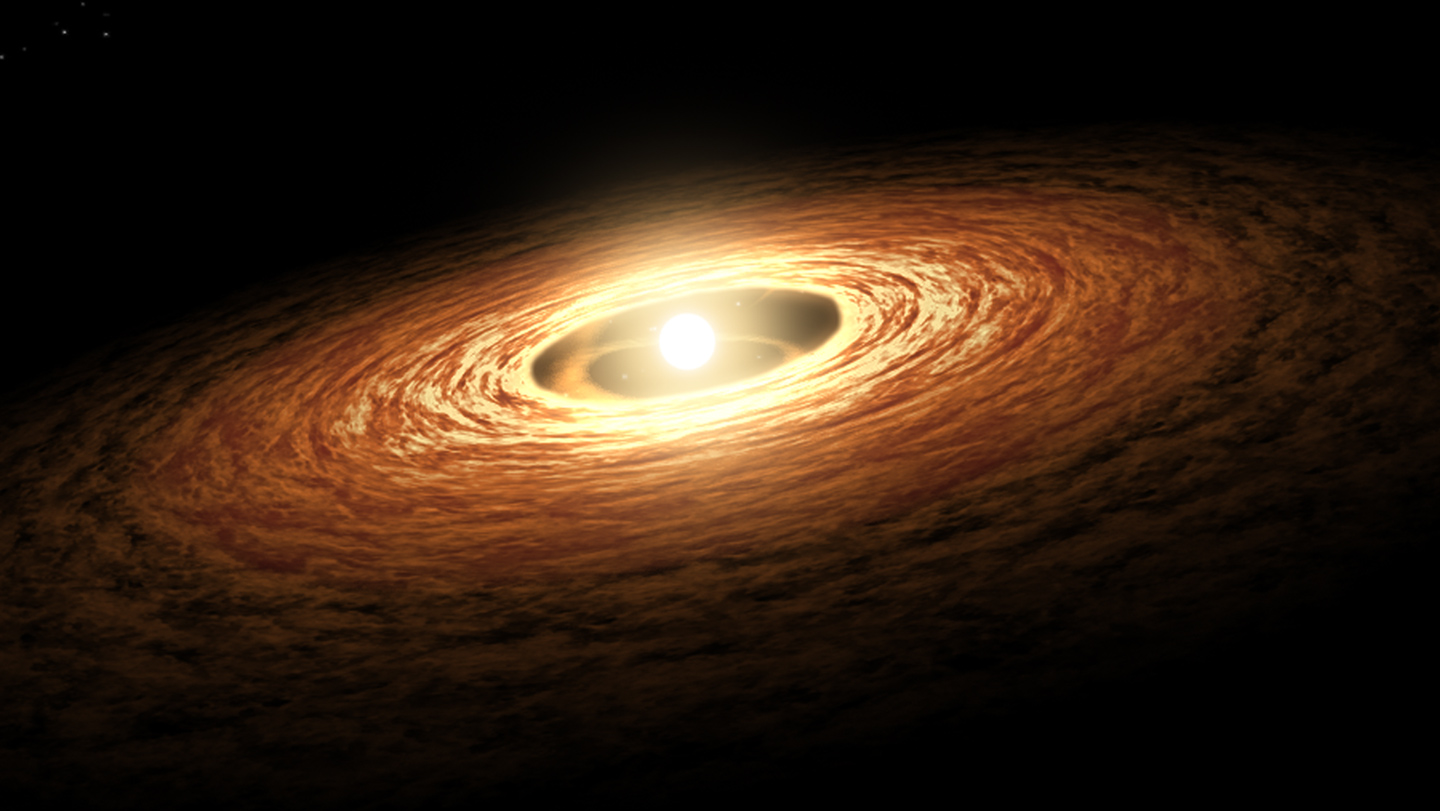
The simulations focused on a particularly powerful type of stellar explosion known as a pair instability supernova. These are the death throes of extremely massive stars, and they are truly cosmic cataclysms, capable of creating a hundred times the mass of the sun in heavy elements alone. Whalen and his colleagues tracked the evolution of the debris from such an explosion, watching as it expanded, cooled, and mingled with the surrounding gas of the early universe. Over time, gravity pulled some of that material together, and it collapsed to form a small new star surrounded by a dusty, swirling disk. Within that disk, the simulation revealed something remarkable: planetesimals, small rocky bodies ranging from a few meters to a few kilometers across, the embryonic seeds of planets. These are the first steps in the long, slow dance of planetary formation, the clumping of dust and rock into larger and larger bodies. Even more striking, some of these planetesimals formed at just the right distance from their young star to have liquid water on their surfaces—the so-called habitable zone, where conditions are neither too hot nor too cold for water to exist as a liquid. The simulation produced enough rocky building material to potentially make several Earth-sized planets, and the presence of water in the system meant that those planets, once formed, might have had oceans.
The implications of this are breathtaking. “Habitable worlds, in principle, could have formed billions of years earlier than previously thought, even before the first galaxies formed,” Whalen said. “These simulations really go to the real true origin of life in the universe.” It is a profound idea: the ingredients for life—rocky worlds, liquid water, the chemical elements necessary for biology—may have been assembled almost as soon as the universe made it possible. The first stars died, and from their ashes, new stars and planets were born, perhaps with the potential to host life. Jarrett Johnson, an astrophysicist at Los Alamos National Laboratory in New Mexico who was not involved in the study, put it beautifully: “The study would indicate that all the way up back almost to the very beginning there may have been conditions for life being set in place. Just because there are planets forming doesn’t mean there’s life, of course, but the ingredients are being put in place pretty much as early as they possibly could be.” That is a humbling thought. It suggests that the universe did not need billions of years of gradual enrichment to prepare the way for life. It was ready, almost from the start, to begin building worlds.
And those ancient worlds might still be out there, waiting to be found. The star that formed in the simulation was not a giant, short-lived star like the ones that created the debris in the first place. It was about 70 percent the mass of our sun, which means it would be remarkably long-lived, burning steadily for tens of billions of years. If a planetary system like this one survived the chaotic early universe and eventually found its way into our own Milky Way galaxy, it could still exist today, a relic from the dawn of time. Astronomers could potentially identify such ancient systems by their chemical makeup, which would bear the distinctive fingerprint of the first supernovas. “Finding one is well within the realm of possibility,” Whalen said. Imagine that: a rocky planet, perhaps with oceans, orbiting a dim, ancient star, carrying the history of the universe’s very first generations of stars. It would be like discovering a fossil from the earliest days of life on Earth, except on a cosmic scale. These planets would be time capsules, preserving the conditions of an era when the universe was still in its infancy, before galaxies had even formed.
Whalen and his colleagues are already pushing forward, working to simulate the next stage of planetesimal growth to see what kinds of planets they ultimately form. They are also interested in exploring a different type of supernova, one thought to be more common in the early universe, to see whether it could also give rise to planetary systems. But even these first results are enough to inspire astronomers to ask new questions and rethink old assumptions. “I think it opens up the window to think about what could have happened in the 13 billion years plus since those first planets formed,” Johnson said. “The studies suggest that we probably should consider that more carefully.” And perhaps that is the most exciting part of all. For a long time, we have told the story of the universe as a slow, gradual unfolding, with planets and life arriving late to the scene. This new research suggests a different narrative, one in which the universe was eager to build worlds, to mix dust and water and rock into the potential for life, almost as soon as it possibly could. The first stars blazed, died, and seeded the cosmos with the raw materials of everything that would follow. And somewhere in the darkness, perhaps, ancient planets are still orbiting ancient suns, carrying the memory of the universe’s first steps toward life.