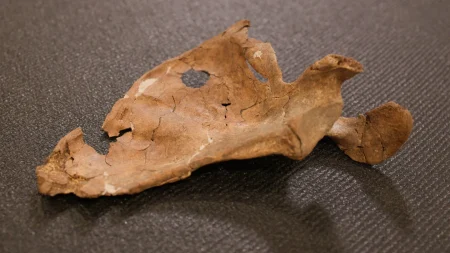



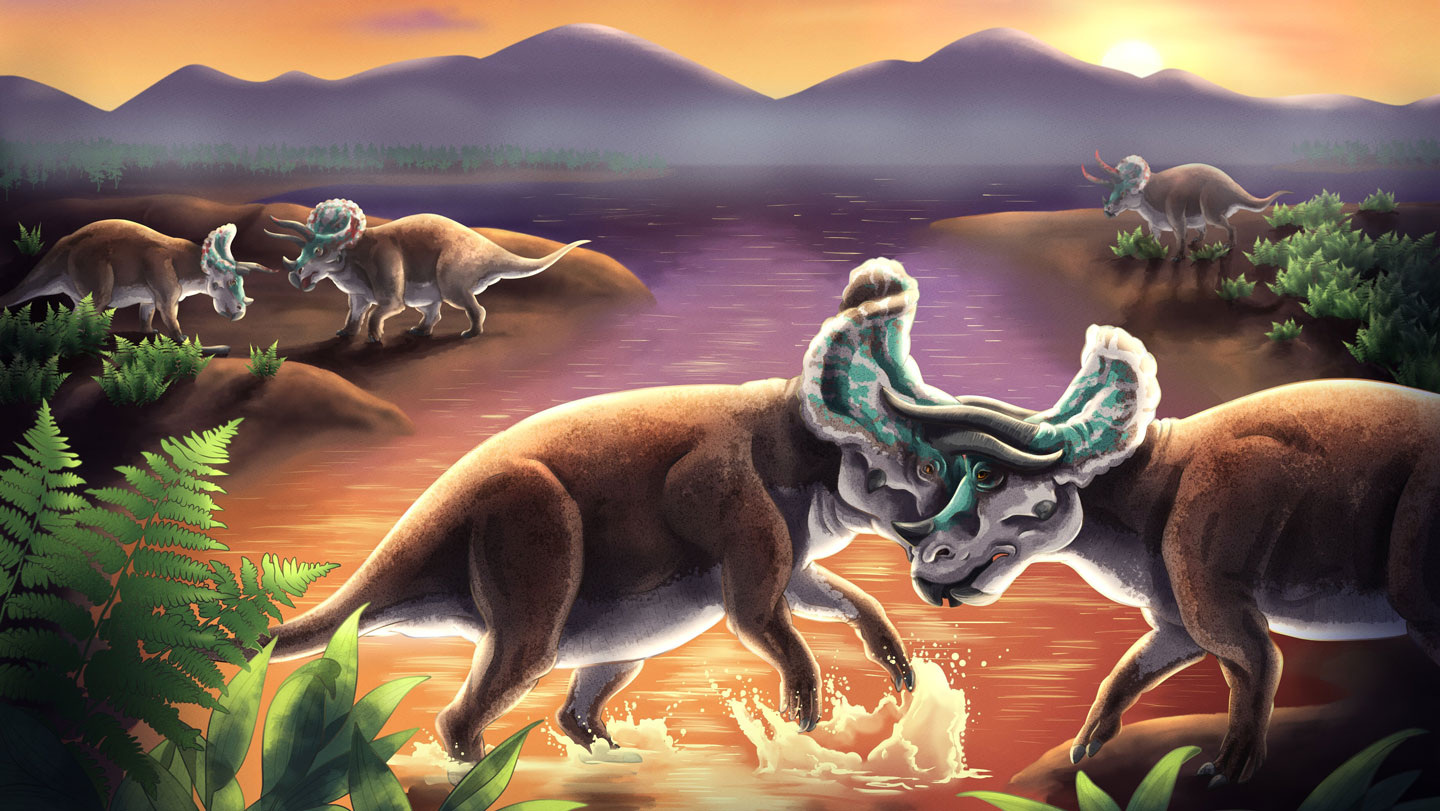
Imagine two enormous Triceratops lowering their massive, three-horned heads and charging at each other with a bone-shaking crash. It is an image that feels almost too dramatic to be real, but paleontologists have long believed that horned dinosaurs, known as ceratopsians, actually did engage in such brutal head-to-head combat. The evidence lies in the fossils themselves: many ceratopsian skulls bear healed injuries in very particular spots, such as the frill and cheek, that look exactly like the kind of damage one would expect from horn stabs, horn locking, and shoving matches. Andrew Farke, a paleontologist at the Raymond M. Alf Museum of Paleontology in Claremont, California, who has studied these battered remains, notes that these skulls “tended to get banged up a little bit” in those specific areas. But for a long time, scientists had little idea how these animals actually used their horns and frills in combat. Were all ceratopsians fighters? Did they fight the same way? To answer these questions, a team led by researchers at the University of Bristol, including vertebrate paleontologist Eric Austin Ames Jr., turned to a surprising set of tools: digital engineering and computer simulation. They built three-dimensional models of six skulls from five ceratopsian species spread across the evolutionary tree of the group, and then subjected those models to simulated combat. The results, published September 24 in the journal PeerJ, reveal a striking range of fighting specializations. Triceratops’ massive skulls were built for horn-to-horn grappling and wrestling. The rhino-like Centrosaurus could withstand the forces of stabbing its nose horn upward and downward, but not side-to-side blows. And the parrot-faced Psittacosaurus, an early hornless member of the group, would have been wise to avoid a fight altogether; its skull was ill-suited to handle the blows of battle.
To understand how the dinosaurs fought, the researchers had to think not like fossil hunters but like engineers. Paleontologists have long used biomechanics to study extinct animals, testing the bite forces of theropod dinosaurs such as Tyrannosaurus rex or the impact resistance of ankylosaur tail clubs. But the skulls of ceratopsians—immense, ornate, and bizarre—had not yet been put through such rigorous mechanical testing. Ames and his colleagues scanned fossilized skulls and created detailed 3-D surface models. Then they used computer simulations to apply forces that would occur during combat, measuring how stress spread through the bone. The principle is much the same one used by engineers to test bridges or airplane wings: areas where stress rises above a safe threshold are more likely to crack, fail, or break. For each skull, the team simulated several different fighting behaviors, including a single horn stabbing into an opponent, horns interlocking a quarter of the way up the shaft, and horns locking at an angle while the animals pushed and twisted. They also varied the direction of forces, from straight-on ramming to side-to-side blows. If a skull handled a particular kind of stress comfortably, then that behavior was probably something the dinosaur could have performed without risking serious injury. If the stress was dangerously high, then the behavior was less likely to have been part of its natural repertoire. By mapping out which styles produced tolerable stresses and which produced dangerous ones, the team could begin to reconstruct the likely combat behaviors of animals that have been extinct for tens of millions of years.
Once the simulations were complete, the researchers found that ceratopsians were not all cut from the same armored cloth. The earliest members of the group, which lived about 125 million years ago, were small and closely resembled the ancestors of the giants that came later. Psittacosaurus, a hornless species roughly the size of a husky, had a skull that simply was not built for fighting; it performed poorly under almost every kind of combat stress. The pig-sized Protoceratops was a bit better equipped, with a skull that tolerated ramming fairly well, perhaps allowing it to charge headfirst into rivals. But the larger, later-diverging species were the real specialists. Centrosaurus, a rhino-like dinosaur with a prominent nose horn, appears to have been a specialized stabber. It would lunge with its head, driving its horn upward or downward into an opponent, and its skull was remarkably good at absorbing forces from those vertical blows. “When we tested [the skull] with vertical forces, it actually handled the stresses really well,” Ames says. “But when we tried side-to-side, it did not perform very well.” That weakness suggests Centrosaurus was not equipped for the twisting, lateral wrestling that some of its relatives enjoyed. Triceratops and Spiclypeus, by contrast, had skulls that could tolerate the complicated forces generated by interlocking horns and wrestling. Their robust faces and thick frills could absorb stresses from multiple directions, making them effective grapplers. In short, each species had its own signature fighting style, shaped by the strengths and weaknesses of its skull, and the results provide a vivid reminder that even closely related dinosaurs could evolve very different ways of settling a score.
These findings do more than reconstruct prehistoric brawls; they illuminate the deep evolutionary connection between ornament and weaponry. Ames believes that the spectacular horns and frills of ceratopsians probably first appeared as social and sexual signals. A dinosaur with a larger, more colorful, or more distinctive frill might have been more attractive to mates or more intimidating to rivals. But once those structures were present, natural selection found additional uses for them. They could be used in combat, and combat, in turn, could drive further changes in their shape, size, and strength. The result was a kind of evolutionary feedback loop: display structures became weapons, and weapons became even more elaborate as different species adopted different fighting techniques. The fossil record supports this idea. Across ceratopsian evolution, horns and frills exploded in diversity, and that explosion coincided with the emergence of different intraspecific combat styles. Some species evolved long, sharp horns for stabbing; others developed thick, reinforced frills for absorbing blows; still others evolved heads better suited for ramming. “Throughout their evolutionary history, their [horns’ traits] started to really explode in diversity and that coincided with different intraspecific combat styles,” Ames says. “This is something we see in modern herbivores.” Indeed, anyone who has watched deer clash antlers or bighorn sheep smash heads will recognize the pattern: weapons that begin as displays often end up shaping the animals’ behavior, and behavior, in turn, shapes the weapons. The ceratopsians were no exception, and their bizarre skulls are a testament to the power of this ancient arms race.
Of course, the horns and frills of these dinosaurs were not used only against members of their own species. In the modern world, antlers and horns are primarily tools of sexual competition, but they are also practical defenses. A deer can fend off a wolf; a muskox can form a defensive ring against predators; a buffalo can gore a lion. The same was likely true for ceratopsians. A Triceratops confronted by a large predator would not hesitate to use its three sharp horns, and even a smaller ceratopsian could protect itself by jabbing with its nose horn. Ames describes these anatomical features as a “Swiss Army knife,” noting that they could be used for multiple purposes, from display to combat to defense. But as with any scientific model, there are limitations. The 3-D simulations in this study were based on surface scans of fossilized skulls, which capture the external shape but not the complicated internal structure of the bone. Real ceratopsian skulls are filled with air spaces, reinforcing struts, and other internal features that could significantly change how stress travels through the skull. A skull might look durable on the outside but have hidden weak points inside, or vice versa. Farke, who has spent years studying the injuries on ceratopsian skulls, suggests that more detailed models—ones that simulate the internal architecture of these immense, bizarre heads—could provide even more insight. “More detailed models that better simulate the complicated internal structure of these dinosaurs’ immense, bizarre skulls could provide even more insight to this prehistoric fight club,” he says. Still, even the current surface-based models have opened a window into behaviors that would otherwise remain completely invisible.
Ultimately, this study is a celebration of how far paleontology has come—and how much more it can tell us about the lives of ancient animals. A skeleton in a museum can look static, frozen in time, but these were living, fighting creatures with complex social lives. By combining old-fashioned fossil hunting with cutting-edge engineering software, researchers are now able to resurrect behaviors that vanished millions of years ago. We can now say with confidence that Triceratops wrestled with its horns, that Centrosaurus stabbed with its nose, and that the little Psittacosaurus probably stayed out of trouble. We can imagine the soundtrack of those ancient battles: the thud of bone on bone, the scraping of horn against frill, the roars of dominance and submission. It is a humbling thought that these dinosaurs were not simply walking tanks, but animals that made strategic choices about how to use their bodies, much as modern deer and buffalo do. The next time you stand before a Triceratops skeleton, take a moment to study its horns and the shield-like frill behind them. They were not just for show. They were weapons, shields, status symbols, and tools of survival, shaped by millions of years of evolution and honed in actual combat. The results of this new study remind us that even the most bizarre creatures of the past lived lives as rich and violent as any animal alive today. Thanks to the scientists willing to model their ancient battles, the prehistoric fight club has finally found its chroniclers.