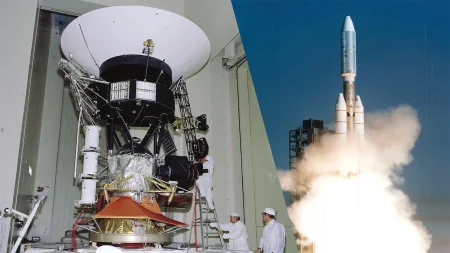



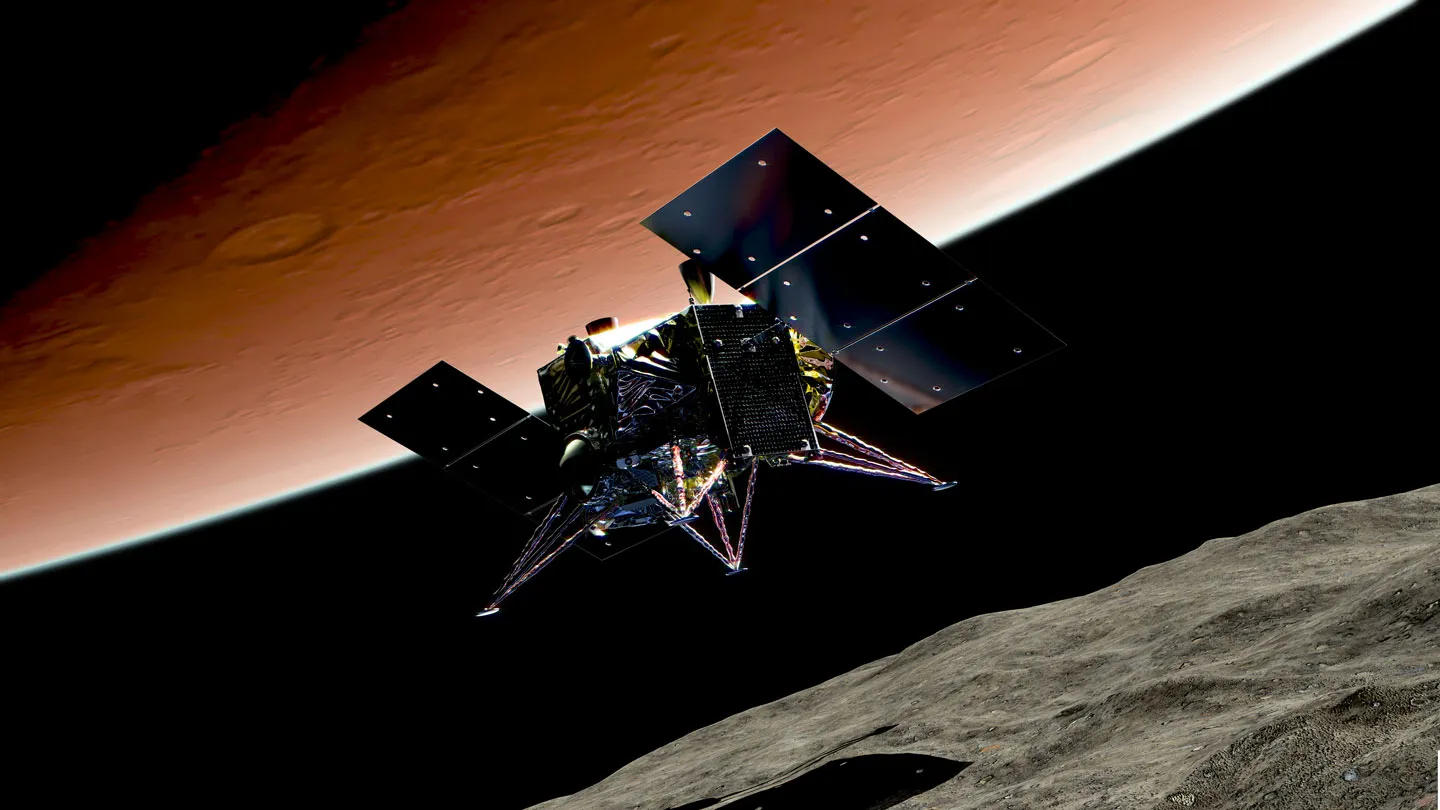
For decades, planetary scientists have carried a quiet, almost aching wish: to hold a piece of Mars in their hands. Not an image, not a spectrum, not a meteorite that fell to Earth after who knows how long in space, but a real rock, selected by a mission, lifted from another world, and delivered to a laboratory where every tool humanity has ever invented could be turned on it. That dream has stayed just out of reach. The Red Planet’s gravity makes landing hard; launching anything back from its surface is harder still. But this month, the Japanese space agency is taking a bold, clever swing at the next best thing. The Martian Moons eXploration mission, known as MMX, is scheduled to launch on October 19 at 3:41 p.m. EDT, carrying a spacecraft designed to travel to Mars, orbit the Red Planet, and touch down on Phobos—the larger and stranger of Mars’ two tiny moons. Its goal is to grab a sample of that moon’s dusty, battered surface and bring it home to Earth by 2031. It won’t be a true Mars sample in the strictest sense. But it may be the closest thing we get for a long time, especially as NASA’s ambitious plan to retrieve the samples collected by the Perseverance rover has been thrown into doubt. For scientists hungry to understand the Martian system, even an indirect taste of Mars, delivered through the strange, cratered body of Phobos, is enough to quicken the pulse. As planetary scientist Briony Horgan of Purdue University puts it, the mission offers “a chance to get a totally different sample and view of Martian materials.”
Make no mistake: getting to Phobos is not a journey for the faint of heart. The mission’s itinerary reads like a space opera written by engineers with a taste for risk. After launch, MMX will cruise toward Mars for about a year, then slip into orbit around the Red Planet and fly alongside Phobos for roughly three years. During that time, it will drop a small rover named Idefix onto the moon’s surface to scout promising sampling sites and take measurements. The main spacecraft will then perform not one but two landings on Phobos, a body so small and low-gravity that the whole operation will feel less like a touchdown and more like a cautious spacecraft kiss. Each landing will attempt to collect about 10 grams of material—roughly the weight of four U.S. pennies. That may sound almost laughably small, but the mission has designed a clever suite of sampling tools to make every grain count. One device will drill about two centimeters into the surface, retrieving material from beneath the sun-blasted crust. Another will fire blasts of pressurized gas at the ground, stirring up loose dust and pebbles to be captured in a collector. Once the samples are secured, the spacecraft will fly past Deimos, the smaller moon, on its way home. The return trip will end a year later with a parachute-assisted landing in the Australian outback, following the same path that Japan’s two celebrated asteroid sample-return missions used before it. After JAXA scientists sort and catalog the material, they will share portions with institutions around the world, including NASA’s Johnson Space Center in Houston, which is slated to receive 15 percent of the haul. It’s a small amount, but for researchers who have spent their careers studying tiny specks of space rock, it might as well be a treasure chest. “A few grams of sample are going to be a real bonanza for scientists,” says Michael Zolensky, a planetary scientist at NASA’s Johnson Space Center.
The real reason MMX is going to Phobos is not just to collect rocks, but to solve a mystery that has vexed planetary scientists for years: where did Mars’ moons come from? Phobos and Deimos are unlike our own Moon in almost every way. They are tiny, irregularly shaped, and pitch dark—their surfaces reflect only a small fraction of the sunlight that hits them. In images, they look less like moons and more like lumpy potatoes, or asteroids that happened to wander too close to Mars and got snared by its gravity. That is one leading idea: that they are captured asteroids, relics of the early solar system’s chaotic wanderings. But their orbits tell a different story. Both moons circle Mars in clean, nearly circular paths that lie almost exactly in the planet’s equatorial plane—an unlikely shape for objects that were randomly captured. That has led to another theory: that Phobos and Deimos were born from a massive collision between Mars and another body early in solar system history, a giant impact that tore material off the Red Planet and left behind a ring of debris that gradually coalesced into moons. Or maybe, as planetary scientist Kiyoshi Kuramoto of Hokkaido University notes, the truth is something no one has thought of yet. “The natural world often reveals aspects that exceed our expectations,” he says. Tomoki Nakamura of Tohoku University echoes that sense of wonder, pointing out how strange the Martian moons are compared with our own. They are two, very small, very dark objects, and they don’t look like anything we know well. To tell which origin story is correct, scientists need more than images and orbital measurements. They need to touch the material, to measure its composition, its minerals, its age. They need to hold a piece of Phobos in their hands and ask it directly: where were you born? That’s what MMX is designed to do.
The scientific payoff, however, may extend far beyond Phobos itself. Once the samples are back on Earth, researchers will be able to inspect them with instruments far too large or fragile to ever fly on a spacecraft—machines that can reveal the exact chemical fingerprints of elements, the fine structure of minerals, and the microscopic history of impacts and radiation. That information will help scientists untangle the story of Phobos, but it may also help refine our understanding of Mars. For example, by precisely dating the samples, scientists can calibrate the chronology of cosmic collisions in the neighborhood of Mars. Right now, estimates of when features on the Red Planet’s surface formed rely on a timeline built from our Moon, and that timeline may not translate perfectly to Mars, which sits farther from the asteroid belt and has a different history of impacts. The MMX samples could give scientists a new anchor, a fixed point in the swirling fog of Martian deep time. Even more tantalizing, there is a real chance that some of the grains in the MMX sample will be fragments of Mars itself. If Phobos formed from debris blasted off the Martian surface, then its rocks could contain grains that hail from the Red Planet’s crust—possibly from depths that scientists have never seen before. The small collection of Martian meteorites that have landed on Earth over millions of years offers only a narrow, biased window into the planet’s interior. The samples tucked away inside Phobos, by contrast, could represent a richer and more varied slice of Mars, preserved in the cold, airless regolith of the moon. But finding those grains will not be easy. “They’re material that’s been blasted off Mars from some unknown location, micron-sized things, sitting on the airless body Phobos, getting irradiated by space,” says planetary scientist Nancy Chabot of the Johns Hopkins University Applied Physics Laboratory. In other words, they will be tiny, ancient, beaten-up clues. Still, scientists are ready to bring every tool they have to the task, knowing that even a single grain of Martian dust, properly identified, could reshape what we know about the Red Planet.
The timing of this mission adds an extra layer of emotion. Over the past few years, NASA has poured enormous effort into the Perseverance rover, which has been diligently drilling and packaging the most promising rocks it can find in Jezero Crater—an ancient lakebed that may preserve signs of past microbial life. Those samples are now sitting on Mars, sealed in tubes, waiting for a future mission to pick them up and bring them home. It is the most scientifically important sample return campaign ever attempted, and it has been thrown into turmoil. The U.S. Congress has cut funding for the Mars Sample Return program, and the mission’s many complications—including the fact that no spacecraft has ever launched from the surface of another planet—have raised serious doubts about feasibility and cost. For scientists who have devoted their lives to studying Mars, this is a wrenching moment. It’s why MMX feels so valuable, even if its samples are not true Martian bedrock. The mission offers a workaround, a scrappy alternative, a chance to learn something new about the Martian system despite the bureaucratic and technical gridlock facing NASA’s larger plans. It will not replace the Perseverance cache, and no one is pretending it will. But as planetary scientist Vicky Hamilton of the Southwest Research Institute says, “It’s always a happy day when we’re getting a sample from another object in space and bringing it back to Earth to study.” In a world where budget decisions and launch windows and cosmic radiation all conspire to keep answers out of reach, the prospect of any new sample, from any world, feels like a small victory for everyone who has ever looked up at the night sky and wondered.
Perhaps that is the deepest message of MMX. It is not just a scientific mission; it is a statement about the stubbornness and curiosity of the human species. Everything about it has been engineered to overcome impossible odds—the treacherous gravity of a tiny moon, the extreme cold of deep space, the daunting task of making a spacecraft perform two touchdowns on a world with barely enough mass to keep a rover from drifting away. The mission’s path has been forged by failures, including three previous Russian attempts that never made it to Phobos. And yet, here is Japan, launching again, carrying the hopes of a planetary science community that refuses to accept that some questions are unanswerable. When the small capsule finally drops into the Australian desert in 2031, it will be the culmination of a journey that began not just at the launch pad, but in the imaginations of scientists who dreamed, decades ago, of reading Mars’ history through the cold, battered rocks of its strangest moon. In that sense, every gram of sample will be a letter from the past—sent across millions of miles, delivered through enormous layers of effort, and opened with gloved hands in a clean room. It may not be the ultimate Martian sample return. It may not answer every question about Phobos, Deimos, or the Red Planet. But it will be a beginning, a bridge, and a reminder that the greatest discoveries often come not from the biggest plans, but from the willingness to reach out, grab a little piece of the unknown, and bring it home.