


For more than a decade, the Denisovans have been one of paleoanthropology’s most elusive characters. A sister lineage of modern humans that spread across Asia from around 400,000 to 30,000 years ago, they were first identified not from a dramatic skeleton but from traces of DNA preserved in a tooth and finger bone from Siberia. Since that discovery in 2010, scientists have found their genetic fingerprint scattered across modern populations from the Philippines to Australia, proof that these ancient people interbred with the ancestors of living humans. Yet their physical remains have remained heartbreakingly scarce: only a handful of teeth, bone fragments, and small pieces of skull, compared with the thousands of Neandertal fossils that fill museum collections. Until now, that scarcity made it almost impossible to answer basic questions: What did Denisovans eat? How did they make tools? Did they live in caves for generations or wander across the landscape? A long-lost cave buried beneath an abandoned quarry in Yunnan Province in southwestern China has suddenly changed that. Bianfu Cave, exposed during an ecological restoration project and excavated by an international team, has yielded a rich trove of Denisovan fossils—remains of at least three individuals who lived between 167,000 and 134,000 years ago—alongside more than 1,300 stone tools and butchered animal remains, according to two new studies published in Nature. The discoveries were confirmed by ancient protein analysis and high-resolution X-ray scans, techniques that can identify fragmentary fossils even when DNA has degraded. What matters most, though, is that these bones are not isolated curiosities; they are embedded in layers of ancient occupation debris—cut-marked deer bones, discarded tools, traces of repeated human use—giving archaeologists the first real glimpse of Denisovan culture. It is a breakthrough that researchers have been waiting for since the lineage was first discovered.
To appreciate how important Bianfu is, one has to remember just how little was known before. Denisovans were announced to the world in 2010, when DNA extracted from a tooth and finger bone found in Denisova Cave in Siberia revealed an entirely new human species. Since then, genetic research has shown that many modern people—including groups in the Philippines, Tibet, New Guinea, and Australia—carry Denisovan DNA, the lasting legacy of encounters between Denisovans and Homo sapiens. But the fossil record lagged far behind the genetic one. Most known Denisovan specimens are fragmentary and isolated; archaeologists often could not say exactly where they had been buried, whether other human species had occupied the same caves, or whether any nearby stone tools belonged to them. At Denisova Cave itself, researchers did find tools alongside Denisovan remains, but Neandertals and modern humans also used the site, so the identity of those toolmakers remained unclear. “It’s a little frustrating,” says Bence Viola, a paleoanthropologist at the University of Toronto who has studied the Siberian Denisovan remains. To researchers, it felt like a ghost lineage: present in people’s genomes today, but almost invisible in the physical record. The frustration was compounded by geography. Denisovan DNA appears across a huge range, from high-altitude Tibet to tropical Southeast Asia, suggesting a remarkably adaptable lineage—one that clearly deserved more than a few scattered teeth. Bianfu changes that by providing a place where the people, their tools, and their prey can be studied together, in a secure context, without the confusing presence of other hominins to muddy the picture.
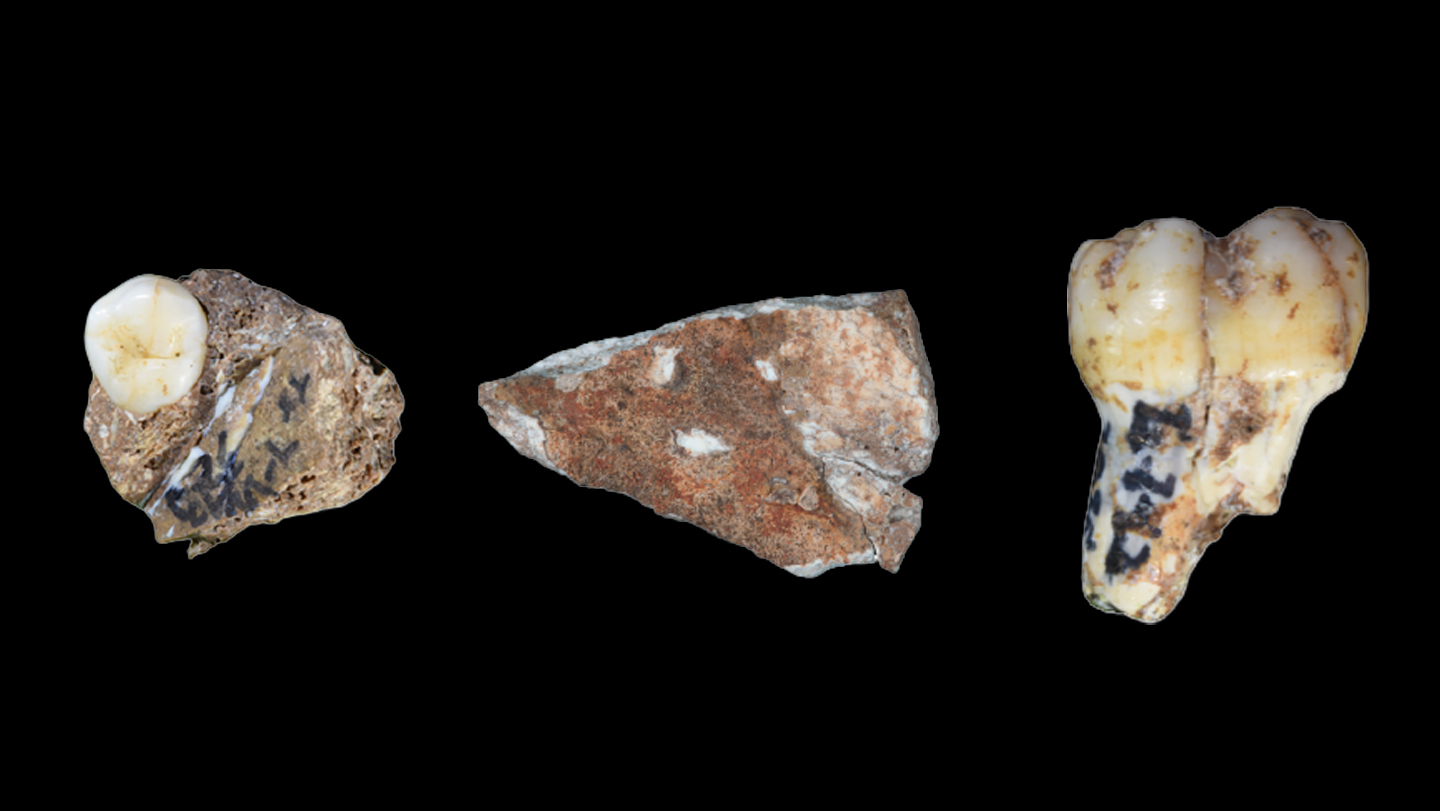
The cave first came to light in 2019, when an ecological restoration project at a quarry in Yunnan Province uncovered numerous fossils in a buried cave. Subsequent excavations revealed four human teeth, two pieces of a skull, anda fragment of an arm bone. At first, the fragments were too incomplete for traditional diagnosis. The research team therefore compared the shape of the teeth with those of several human species using micro-CT scans, a technique that reveals fine internal structures invisible to the naked eye. As soon as Clément Zanolli, a paleontologistat the University of Bordeaux, saw an image of one tooth, he says, he immediately assumed that they were probably Denisovan; the crowns and roots shared distinctive features with Denisovan teeth previously found in Laos and Tibet. To test that hunch, scientists also looked for species-specific proteins in the fossils. Ancient proteins can survive in warm environments long after DNA falls apart, and all the samples carrieda Denisovan-specific collagen variant, which clinched the identification, says Qiaomei Fu, a molecular paleogeneticistat the Chinese Academy of Sciences in Beijing. The site is also geographically significant. Denisovan fossils have now been identified in only five places in the world, and Bianfu Cave—in Yunnan, which borders Myanmar and Laos—is one of the southernmost Denisovan sites known to date. That southern distribution matters because it suggests Denisovans were not confined to cold northern caves; they had spread into subtropical landscapes, adapting to different climates, prey, and environments along the way.
The cave’s deposits provide a rare, long archaeological sequence that spans more than a hundred thousand years. Stone tools from Bianfu date to between 190,000 and 70,000 years ago. During the roughly 120,000 years that the cave appears to have been occupied, researchers found no evidence that Neandertals, modern humans, or any other hominins were present. That absence is critical. It allows Fu, Zanolli, and their colleagues to argue—with unusual confidence—that the tools were made by Denisovans themselves. The tools are not glamorous objects; they are working tools, and their wear patterns tell a practical story. Most were used to process animal remains: to break bones, cut meat, and scrape hides. The cave also contained more than 1,600 identifiable animal remains, mostly deer and other ruminants. Some of those bones bore signs of carnivore gnawing, but many showedthe telltale marks of cutting and scraping—the kind of damage left by stone blades slicing flesh and working animal skins. That pattern fits the image of people who hunted or at least efficiently butchered prey, then processed it inside the shelter and left the remains behind. Interestingly, at other Denisovan sites, fossils have been found with marmot remains; at Bianfu, deer dominate. This variation itself is informative. “They adapted to their environment. They hunted different things in different ways,” Viola says. Altogether, he says, it provides “a much more complete picture” of Denisovan life than any site has before.
Yet the significance of Bianfu goes beyond diet and stone tools. It restores human context to one of the most mysterious branches of the human family tree. For years, the Denisovans were a paradox: genetically widespread, physically invisible. Their DNA lives on in people today, especially in the Philippines, Tibet, New Guinea, and Australia, so we know they encountered modern humans and left descendants. But a genome cannot tell you whether a group returned to the same cave over generations, how they organized their lives, what they did with animal hides, or how they survived across such different landscapes. Bianfu begins to answer those questions because it is an archaeological site in the truest sense: a place where everyday activities were preserved in place. Stone tools were dropped and left; deer bones were broken open for marrow; teeth were lost amid the debris of living. And because no other hominin species appears in the deposits, those behaviors can be tied directly to Denisovans. That linkage is what transforms a set of ancient bones into a portrait of culture. “Denisovans are becoming a bit less mysterious,” says Shara Bailey, a paleoanthropologistat New York University. For her, the site offers something rare in paleoanthropology: not just new fossils, but new kinds of evidence about behavior—evidence that can be used to reconstruct how these people actually made a living.
Looked at from a wider perspective, the discovery captures a turning point in how scientists study ancient human relatives. A lineage that was entirely unknown just over a decade ago is now emerging as a major presencein the human story, with a fossil record stretching from Siberia to Southeast Asia anda genetic legacy written into the bodies of living people. Bianfu alone does not solve every mystery—only five places have yielded Denisovan fossils so far—but it shows what is possible when archaeologists get lucky, dig carefully, and deploy the right analytical tools. Ancient protein analysis, micro-CT imaging, and meticulous excavation allowed researchers to identify worn teeth and an arm bone fragment as Denisovan, to date them, and to place them in a meaningful setting. The cave also hints that more discoveries may be waiting: Yunnan’s limestone landscapes are dotted with caves, and if one abandoned quarry happened to uncover a Denisovan home, others may still be hidden underground, preserving traces of a species that thrived across Asia for hundreds of thousands of years before vanishing around 30,000 years ago. For now, though, Bianfu has already accomplished something profound. It has made the Denisovans feel real. They are no longer just a genetic echo in a laboratory report or a branch on a human family tree. They are people who returned to a sheltered cave in southwestern China for more than a hundred thousand years, made stone tools with practiced hands, cut meat from deer carcasses, scraped hides, and left behind the debris of their lives for future generations to find. As Bailey says, the site“tells us a little about how Denisovans actually lived on the landscape.” That little is more than researchers have had since the lineage was discovered—and it is enough to begin filling in one of the great blank spaces in the story of human origins.