






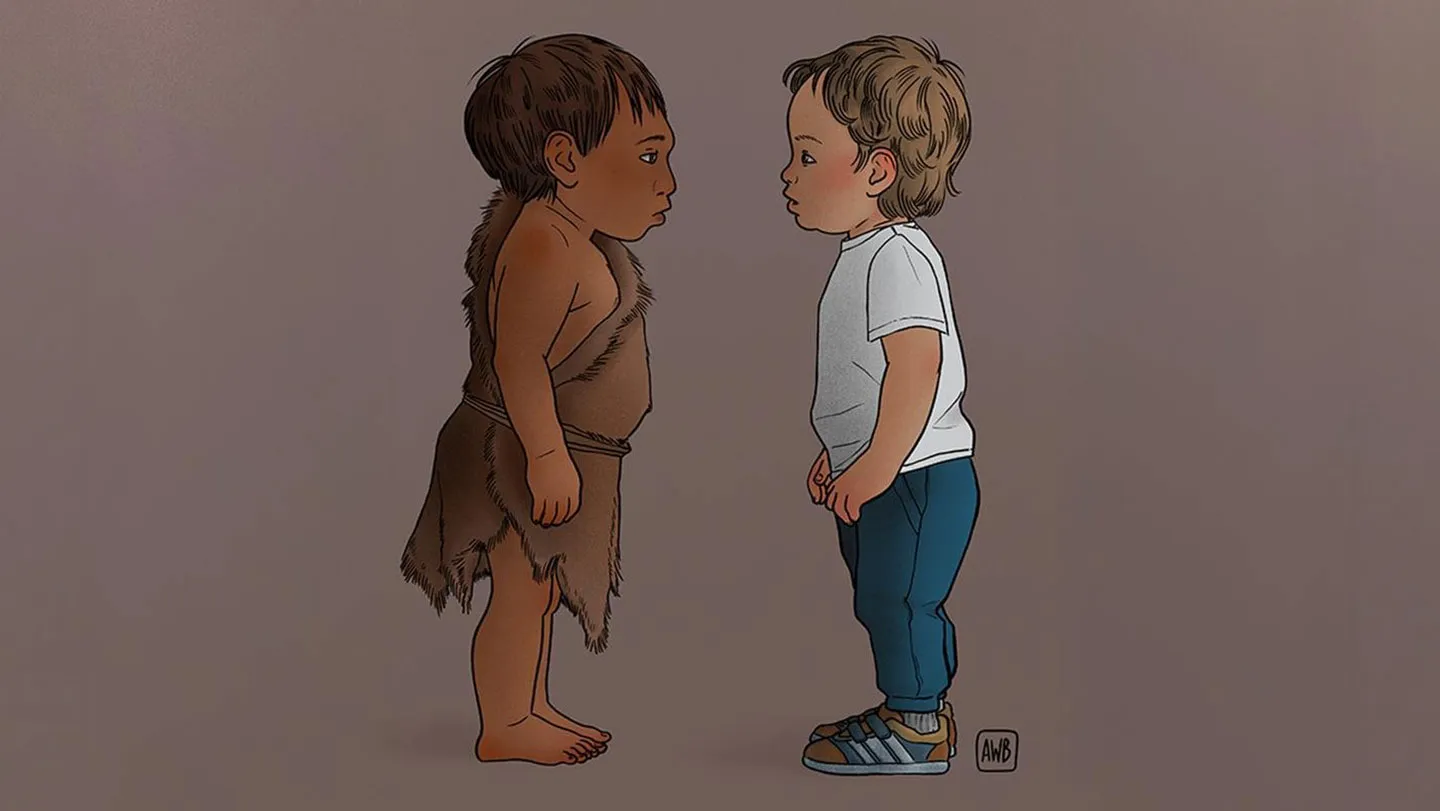
Our understanding of our closest ancient relatives has taken a fascinating turn, revealing that Neandertal babies likely entered the world much like modern human infants but embarked on a remarkably accelerated journey of growth. This intriguing insight comes from two independent scientific studies that examined the precious fossilized remains of two tiny Neandertals: one who passed away around the time of birth, and another who lived for about six months. When these findings are woven together, they paint a picture of a childhood that began at a very similar scale to our own Homo sapiens ancestors, only to fast-forward in physical development during the crucial months that followed.
The first chapter of this discovery centers on a deeply moving archaeological find: the remains of a late-term fetus or newborn who died approximately 55,000 years ago. Discovered decades ago in a rock shelter in southern Germany, the child’s legacy survived in twelve tiny bones. Recently, Alvise Barbieri, an archaeologist and geoscientist at the University of Algarve in Portugal, led a team that used advanced X-ray imaging to create highly detailed, digital reconstructions of these skeletal fragments. Their analysis revealed that while the infant’s overall bone size matched that of a modern human newborn, its arm and leg bones were already deceptively thick and dense, hinting at a robust physiology designed for rapid development even before birth.
The second half of the puzzle was pieced together by a study focusing on a slightly older infant, a six-month-old Neandertal who lived in a cave in northern Israel roughly 51,000 to 56,000 years ago. A research team led by Ella Been, a paleobiologist at Ono Academic College in Israel, used similar digital X-ray reconstruction techniques to examine the baby’s teeth and skeletal structure. Interestingly, while the child’s teeth were perfectly matched to the dental development of a six-month-old modern human, its limbs told a completely different story. The infant’s arm and leg bones looked sturdier and more advanced, closely resembling those of a modern human child twice its age.
These dual discoveries suggest that while Neandertals shared our dental milestones, their skeletal systems were on a fast track. Researchers believe this unique developmental split—where teeth grew at a modern pace but limbs accelerated—shows a distinct survival strategy. According to Barbieri, this intense growth spurt likely kicked off in the final stages of pregnancy and became highly pronounced during the first few years of life. By growing their bodies rapidly while keeping dental development steady, Neandertal infants may have been better equipped to handle the physical demands of their rugged ice-age environments.
The idea of a highly accelerated childhood challenges long-held assumptions about how similar we were to our evolutionary cousins. Ella Been notes that this rapid physical trajectory represents a major point of divergence between the two species during early childhood. While a modern human baby remains relatively fragile and dependent for a prolonged period, a Neandertal infant was quickly building a dense, powerful frame. This rapid progression suggests that Neandertal families experienced a much shorter, more intense window of infant vulnerability, forcing young minds and bodies to adapt to the pressures of their world at a breakneck pace.
While these findings offer a compelling look into the past, experts caution that the Neandertal experience may not have been uniform. Paleoanthropologist Michael Petraglia of Griffith University points out that growth rates could have varied significantly across different eras and geographic regions, influenced by climate, diet, and local hardships. Nevertheless, these two studies provide vital evidence that our ancestors and Neandertals possessed fundamentally different biological clocks. We may have started life in the exact same place, but Neandertals took a faster path to maturity, leaving behind a legacy of resilience written into the very bones of their young.