






High within the dense, emerald-green crown of the Democratic Republic of Congo’s primeval rainforests, a fleeting moment captured on a camera lens in 2008 set off a magnificent and relentless scientific chase that would eventually span over a decade. A mysterious, almost entirely black monkey turned its back to the camera, offering the photographer nothing more than a shadowy outline of a dark coat and the elegant, fluid curve of a long tail. For most casual observers, this blurry and incomplete digital snapshot would have been dismissed as an unusable photo, but for Junior Amboko, a passionate biological primatologist at Florida Atlantic University in Boca Raton, it was a tantalizing whisper from an unexplored biological world. Set against the majestic backdrop of the Congo Basin—a vast, biologically rich, and mist-shrouded wilderness that serves as the beating green heart of the African continent—the photograph suggested the thrilling possibility of a mammal completely unrecognized by modern international science. Within this ancient, closed-canopy labyrinth, where sunlight rarely penetrates the thick layers of leaves to touch the forest floor, this enigmatic primate shared its domain with our closest biological relatives, the bonobos, alongside seven other distinct species of arboreal monkeys. The sheer scale of this moist timberland, with its sprawling giant trees, dense winding rivers, and steep valleys, has long kept its ecological secrets guarded from the prying eyes of researchers. Amboko and his colleagues simply could not ignore the profound, magnetic pull of this biological mystery, realizing that the dark silhouette in the photograph might represent a living, breathing lineage of evolutionary history hiding in plain sight. This single, elusive image ignited a flame of curiosity, setting in motion a massive multi-year expedition to find, document, and ultimately understand a creature that had somehow managed to evade the classification books of global science, proving once and for all that our modern world still harbors wild, uncharted frontiers of incredible natural wonder.
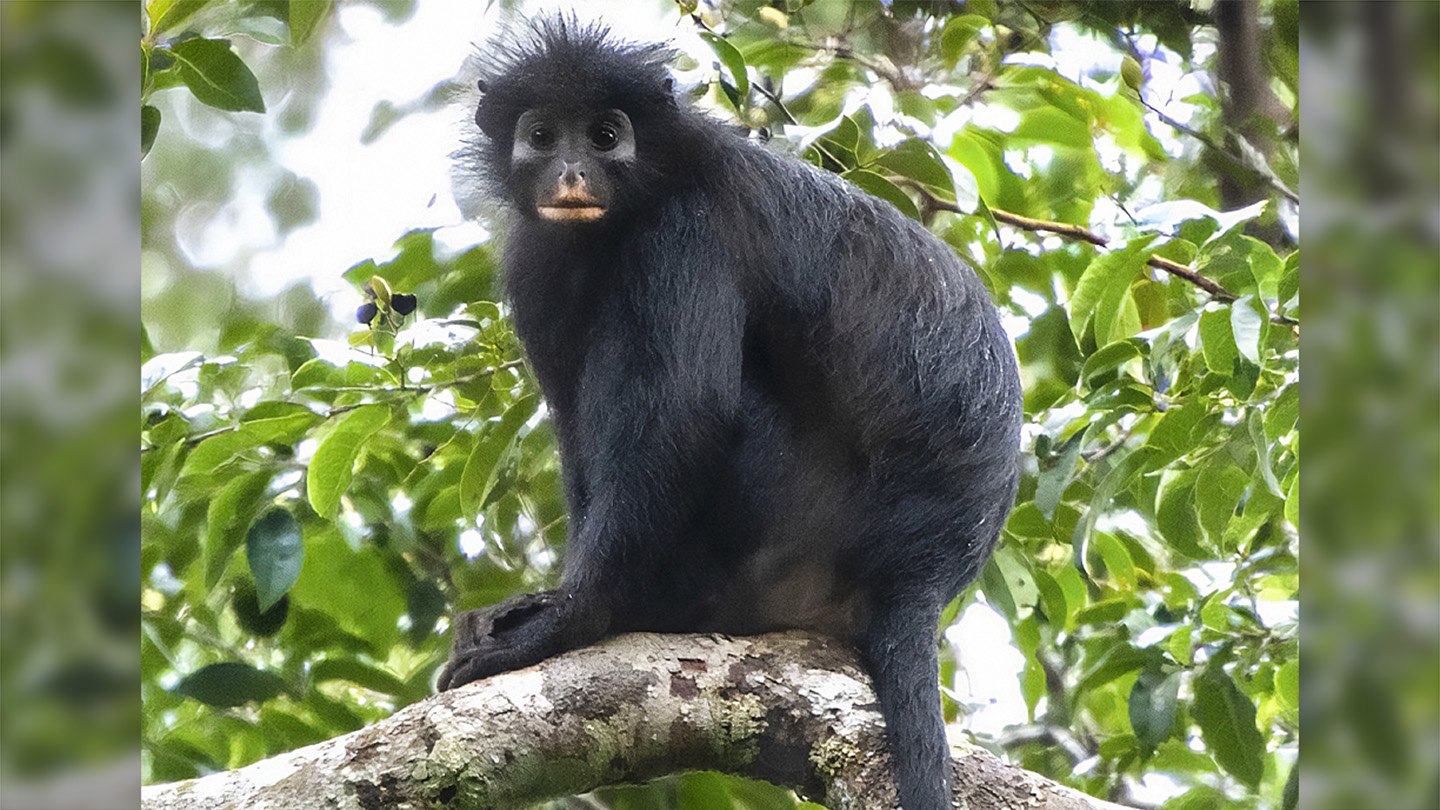
Turning this spark of academic curiosity into concrete, indisputable proof required years of intense, grueling paperwork and physical labor in some of the most remote and challenging environments on Earth. Between 2018 and 2022, Amboko and his dedicated team of field research assistants repeatedly plunged into the deepest sectors of the Congolese jungle, enduring torrential equatorial downpours, swarms of biting insects, and the absolute physical exhaustion of navigating thick, root-choked terrain. Their relentless perseverance was eventually rewarded when they logged dozens of successful visual sightings of the elusive monkeys high up in the swaying branches of the upper canopy layers. Utilizing high-powered binoculars and long-range lenses, the team began carefully noting a striking physical trait that immediately set this group apart from other local species: a brilliant, vibrant patch of bright orange hair framing the mouth, contrasting sharply with the monkey’s otherwise midnight-black coat. Beyond these visual encounters, the researchers worked tirelessly to map the auditory footprint of the species, recording deep, resonant, and incredibly loud roars that echoed across the forest canopy like miniature horn blasts in the early morning mist, a vocal behavior that suggested a highly developed spatial communication system. However, merely observing living animals in the wild was not enough to satisfy the high standards of standard taxonomy; the scientific process demanded physical, anatomical evidence. To satisfy this requirement, the team worked closely with the Congolese parks and nature authority, carefully cataloging and analyzing the skulls of primate carcasses confiscated from local poachers and bushmeat markets, building an incredibly rich and multi-faceted bank of biological data that combined ancient skeletal remains with modern observation.
To transform these compelling field observations into an officially recognized scientific milestone, the project crossed the ocean and entered the advanced laboratories of international evolutionary biology, where researchers began deciphering the creature’s deep physical and genetic mysteries. Julia Arenson, a brilliant evolutionary biologist at Yale University, lent her expertise to analyze the skeletal and cranial remains collected from the Congo. Upon her first detailed inspection of the confiscated skulls, she noticed a fascinating anatomical paradox: while the fundamental cranial structure bone-for-bone mirrored that of the formidable black colobus (Colobus satanas), it was remarkably and consistently miniature in size. This striking scale difference strongly indicated a unique path of evolutionary adaptation, but the ultimate, definitive proof lay locked deep within the microscopic world of comparative genetics. By carefully extracting, purifying, and sequencing mitochondrial and nuclear DNA from the preserved tissue samples, the research group was able to construct a highly detailed evolutionary family tree, leading to a jaw-dropping historical revelation of divergence. The comparative genetic data conclusively proved that this tiny black monkey represented an entirely distinct evolutionary lineage that had split from its nearest relative, Colobus satanas, at least four million years ago, quietly carving out its own evolutionary path through the epochs of environmental change in the Congo Basin. The culmination of this monumental, multi-continental scientific effort was officially shared with the global community on July 15, when the research team published their ground-breaking paper in the peer-reviewed journal PLOS ONE. They proudly introduced the newly named Colobus congoensis to the world’s taxonomic registries, completing the transition of this animal from a mysterious forest ghost into a validated scientific reality.
While the international scientific community rightly celebrates this breakthrough as a monumental achievement, the discovery has also ignited a crucial and humanizing conversation about local knowledge and the complex history of wildlife exploration. Long before Western journals published a single line about Colobus congoensis, and indeed long before modern scientific databases were even conceived, the indigenous communities living along the edges of these dense Congolese forests had fostered a deep, generational relationship with this dark-furred animal. Known locally by the beautifully descriptive name of “Likweli,” the monkey was an active, familiar presence in the daily lives, agricultural routines, and ancestral stories of the local human population, although modern researchers remain unsure of exactly when this name was first spoken or recorded. This dynamic highlights a persistent and complicated pattern in global science, where a species is only considered truly “discovered” once it receives a formal Latin binomial classification, sometimes brushing aside the rich ecological wisdom of the native people who have served as its true guardians for centuries. The recognition of Likweli highlights the need for a more respectful, collaborative approach to taxonomy that honors local vernacular alongside laboratory achievements. Tim Davenport, the highly respected Africa Director for the global conservation organization Re:wild, highlighted the extreme rarity of identifying entirely new primate species in our modern, technology-driven era. He noted that such discoveries are now almost exclusively restricted to the most remote, geographically challenging, and historically understudied pockets of our planet, where rugged terrains protect fragile ecosystems from the march of modern industrialization. This discovery reminds us that science is at its best when it does not merely conquer the unknown, but when it humbles itself to listen to the whisperings of those who have coexisted with nature since the dawn of memory.
Unfortunately, the deep sense of wonder and triumph surrounding the rescue of Colobus congoensis from obscurity is heavily shadowed by a sobering, highly urgent conservation reality: this newly named primate is already staring directly into the abyss of extinction. The geographic range of the Likweli is dangerously, precariously small, confined to a fragmented patch of closed-canopy forest that spans an incredibly tiny area of just 1,700 square kilometers. In the delicate balance of forest ecology, such a minuscule territory means that even a minor localized environmental disaster, localized disease outbreak, or aggressive push of industrial resource extraction could completely decimate the entire wild population. Making matters far more complicated are the immediate, daily survival needs of the surrounding human communities, where extreme poverty and limited access to resources drive an active trade in bushmeat and wood fuel. Hunters looking to support their families frequently target local wildlife, putting the slow-reproducing, highly specialized colobus monkey in constant, mortal danger. Alexander Georgiev, a distinguished primate ecologist based at Bangor University in Wales who was not directly involved in the research, has pointed out that the publication of this new species is not a finish line to celebrate, but rather an urgent alarm indicating that a rare piece of our planet’s ecological crown is at risk of vanishing forever. His warnings highlight the tragic truth that we are discovering major new species at the exact same speed that we are destroying their homes. This dynamic turns every taxonomic breakthrough into a desperate, high-stakes race against the clock, where the thrill of discovery is instantly replaced by the heavy burden of stewardship.
To ensure that the haunting, prehistoric roars of the Likweli do not permanently fade from the green canopies of the Congo, the path forward must be paved with deep human empathy, local collaboration, and proactive conservation strategies. Conservationists like Georgiev strongly advocate for a modern, community-centered model of environmental stewardship that rejects the old, exclusionary practices of building fences and instead places local Congolese populations at the direct center of the protection plan. True conservation in these economically distressed landscapes cannot succeed through simple decrees or outer-world mandates; it requires working closely with local leaders to design sustainable economic programs, improve regional food security, and offer viable alternatives to the bushmeat trade. By integrating traditional indigenous wisdom with cutting-edge satellite monitoring and threat assessments, researchers can map critical wildlife corridors, ensuring that the remaining 1,700 square kilometers of habitat are shielded from destructive logging operations and agricultural sprawl. In the end, the story of Colobus congoensis is much more than a collection of genetic data points and bone measurements; it is a profound testament to our deep, ongoing connection to the natural world and a reminder of our duty as caretakers of the Earth. By rallying our global and local forces to protect this beautiful, orange-mouthed sentinel of the canopy, we prove that humanity is capable of looking beyond our immediate needs to preserve the voiceless wonders of our planet. In doing so, we ensure that the ancient, mysterious music of the Congo Basin continues to echo through the misty canopy, inspiring future generations with its wild, untamed beauty.