






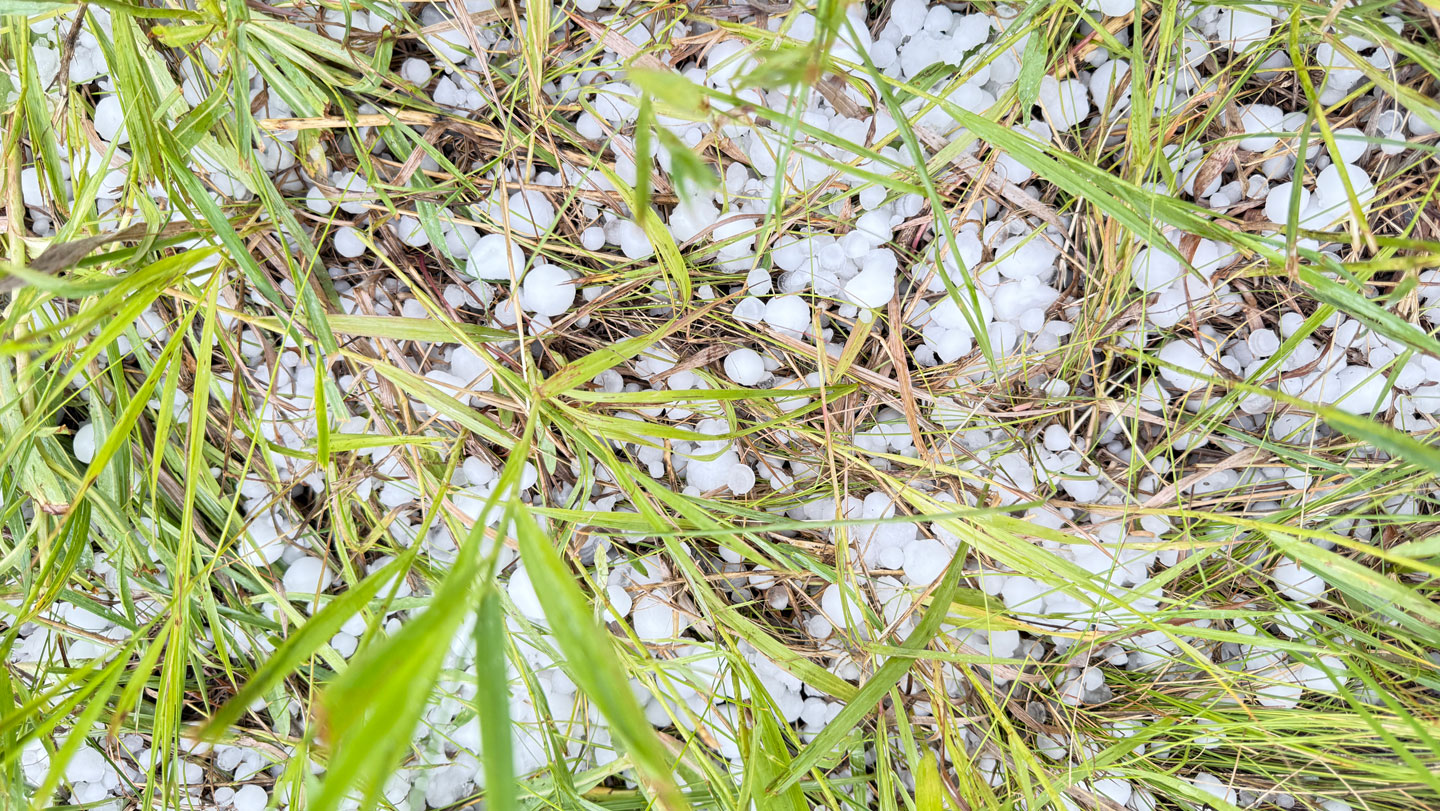
On the late afternoon of April 28, the sky over Springfield, Missouri, transformed from a bruised, foreboding gray into a scene of sudden, terrifying violence. A savage storm swept through the region, unleashing a barrage of ice chunks that defied belief, with some rivaling the size of baseballs and others dangerously surpassing the circumference of grapefruits. For those caught in its path, the experience felt less like a typical spring storm and more like an aerial bombardment; the stones shattered windshields, punched gaping holes through residential roofs, demolished greenhouses, and left a trail of battered vehicles and terrified homeowners in their wake. Tragically, the storm did not spare local wildlife or domestic animals, leaving many injured, and a handful of residents required urgent medical treatment for lacerations and contusions. Incidents of this caliber, which once felt like historic anomalies discussed only in local folklore, are increasingly dominating global news cycles. In an era marked by rising global temperatures, the idea of massive blocks of ice plummeting from a warming sky seems counterintuitive at first glance, as one might naturally assume standard melting processes would diminish frozen precipitation. However, groundbreaking atmospheric research published on May 27 in Nature reveals a worrisome paradox: while a warming planet may indeed melt smaller ice crystals, it is simultaneously creating the perfect atmospheric conditions to supercharge the growth of giant, highly destructive hailstones.
To understand why a warmer world breeds more violent ice storms, it is necessary to examine the wild vertical choreography that takes place within a severe thunderstorm. Hail is born when powerful, warm updrafts of wind loft moisture miles into high-altitude, supercooled clouds where temperatures sit well below freezing. In this frigid realm, liquid water droplets freeze instantly upon colliding with microscopic airborne particles like dust or soot, forming tiny ice embryos that are continually tossed upward by the convective winds. As these frozen seeds are cycled through layers of rich moisture, they accumulate concentric coats of ice, growing heavier with every passage until gravity finally overcomes the upward thrust of the storm’s winds and sends them hurtling toward the Earth. Seeking to map how these complex microphysical processes will unfold in our future climate, a research team at Peking University in Beijing developed a highly sophisticated computational simulation. Their model estimates how hailstones grow inside highly turbulent clouds by analyzing variables such as atmospheric temperature, localized moisture levels, and vertical wind shear. To ensure the reliability of their simulation, the Beijing researchers rigorously calibrated and tested their program against more than 14,000 documented hailstorms that spanned the globe between 2014 and 2021, creating a robust baseline to project how future atmospheric warming will alter the frequency and severity of these icy assaults.
The core revelation of the Peking University model lies in a structural shifting of ecological forces, representing a complex tug-of-war between two competing thermodynamic consequences of global warming. On one side of this equation is the fundamental law of physics dictating that warmer air can hold significantly more water vapor—roughly seven percent more moisture for every degree Celsius of warming. This increased moisture capacity acts as high-octane fuel for developing storms, providing developing hailstones with an abnormally dense reservoir of supercooled liquid water to feed upon during their upward journeys. Conversely, a warmer planet also features a much deeper layer of warm air near the surface, meaning that as hailstones fall from the high clouds, they must pass through a wider, warmer gauntlet before they reach the ground. As meteorologist Qinghong Zhang, who led the Peking University study, points out, this vertical thermal profile acts as a natural crucible that filters out smaller ice particles. While small hailstones are stripped of their mass and completely melted into harmless raindrops before ever touching soil, larger hailstones possess enough thermal inertia and physical mass to withstand this melting zone, allowing them to reach the surface as formidable, dense chunks of ice that pose a severe threat to humanity.
However, the Peking University study emphasizes that this intensifying hail hazard will not be felt equally across the globe, revealing a sharp divide between different latitudes. The researchers projected that high-latitude regions far from the equator—such as the northern United States, Canada, Europe, and parts of northern Asia—will face much higher risks of destructive hail. This regional disparity is driven by the fact that global warming is not uniform; temperatures are rising much more rapidly at higher latitudes, an atmospheric phenomenon that intensifies thermal instability in these temperate zones. According to meteorologist Shiyi Zhang, a coauthor of the study, this heightened temperature contrast strengthens the violent updrafts inside storm clouds, creating an atmospheric catapult capable of keeping massive hailstones suspended for longer periods so they can grow to unprecedented sizes. Meanwhile, tropical and subtropical regions closer to the equator may actually see a noticeable reduction in hail-induced damage. In these warm regions, the lower atmosphere is expected to become so thick with hot, humid air that even the most well-nourished hailstones will struggle to survive the descent, melting completely into heavy downpours long before they can threaten crops or infrastructure.
While the scientific community has praised this research for its ambitious scope, the study has also sparked crucial academic debates regarding the limitations of generalized climate modeling. Climatologist Davide Faranda of the French National Center for Scientific Research in Paris commended the Peking University team for providing a highly valuable and physically sound framework that brilliantly merges fundamental thermodynamics with long-range climate projections. However, Faranda urged caution regarding the study’s highly specific regional predictions, pointing out that hail is an inherently ultra-local weather event. Because the physical footprint of a typical hailstorm is incredibly narrow, traditional global climate models—which operate on coarse, larger-scale computational grids—lack the high-resolution capacity to directly simulate individual clouds or localized storm cells. This scale mismatch means that predicting exactly which municipality will see an increase in hail damage remains a challenge clouded by unavoidable uncertainty. Addressing these constructive critiques, Qinghong Zhang noted that her team took great care to validate their model against historical weather records collected over several decades in both China and the United States, concluding that the observed real-world trends align closely enough with the simulation’s output to make its broader projections highly reliable.
Ultimately, this pioneering study serves as a stark warning about the hidden costs of a shifting climate, emphasizing that severe weather adaptation must extend far beyond preparing for rising sea levels and prolonged droughts. If global greenhouse gas emissions continue to drive up global temperatures, the threat of oversized, high-velocity hail will likely become a major concern for communities, agricultural sectors, and economic markets worldwide. For farmers cultivating vast expanses of food crops in vulnerable mid-latitude regions, a single ten-minute hailstorm can instantly wipe out a season’s worth of labor, while insurance industries are already facing soaring claims from shattered solar panels, dented vehicles, and ruined building envelopes. Shiyi Zhang emphasizes that we can no longer rely on agricultural practices or building codes designed for the climate of the past century. As the very chemistry of our air columns changes, humanity must proactively adapt by reinforcing urban infrastructure, developing durable building materials, and deploying early-detection meteorological networks. By demystifying the complex physics of our changing skies, this research invites us to transform our relationship with the atmosphere—moving away from reactive panic and toward a future of informed, sustainable resilience.