





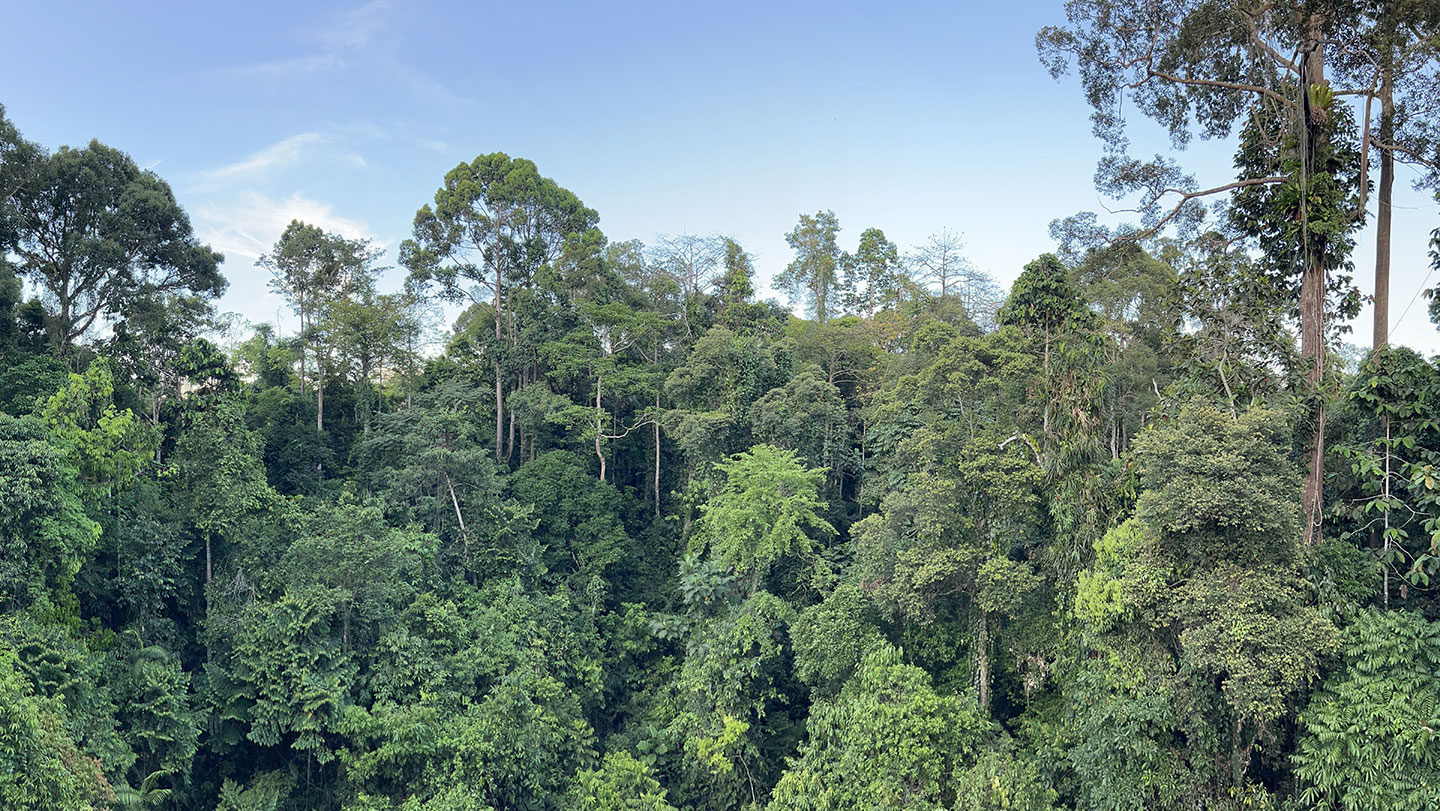
Long before the first golden rays of dawn filter through the thick, misty canopy of the Kabili Sepilok Forest Reserve on the Southeast Asian island of Borneo, a small, determined band of tree climbers and scientific researchers is already at work deep in the ancient jungle. Clad in heavy safety harnesses, helmets, and surrounded by tangled webs of climbing ropes, they prepare to scale some of the tallest living organisms on Earth: the colossal, majestic giants of the Dipterocarpaceae family. For decades, a dominant and seemingly logical assumption in forest biology has cast a shadow of vulnerability over these magnificent sentinels of the tropical rainforest. The prevailing scientific theory dictated that as trees grow taller, the remorseless pull of gravity and the sheer frictional resistance of transporting water across hundreds of feet of vascular plant tissue would make them uniquely susceptible to drought. It was widely believed that in times of severe water scarcity, these towering giants would be the first to suffer, their crown branches drying out and dying as their hydraulic systems failed to hoist moisture to their dizzying heights. However, a groundbreaking study published on July 2 in the prestigious journal Science has successfully challenged this long-held ecological dogma. By directly confronting a major assumption in tree drought biology, a daring international research team has shown that the water transport networks of these massive canopy-dominating trees are far more resilient than previously imagined. Their surprising findings not only redefine our basic understanding of plant physiology but also bring a major beacon of hope for wild forest conservation in an era of rapid global climate change, assuring us that these ancient giants are much better equipped to face a warming world than we ever gave them credit for.
To appreciate the scale of this scientific breakthrough, one must first understand the grueling physical struggle that occurs within a tree’s vascular system every single day. Water does not simply flow up a tree; it must be actively pulled upward against gravity by a process known as transpiration. As leaves release water vapor through tiny microscopic pores called stomata, it creates tension—a negative pressure known as “water potential”—that draws water up from the damp soil, through the roots, and up through long microscopic tubes called xylem vessels. In a monumental tree that stands over 70 meters tall—nearly three-quarters the height of the Statue of Liberty—this liquid column must overcome immense gravitational pull and substantial internal friction. Traditionally, scientists assumed that as a tree grew taller, this plumbing system would eventually hit a physical wall where the sheer length of the xylem would restrict water transport, leaving the top branches chronically dehydrated. During a severe drought, this delicate hydraulic system was expected to collapse entirely, as air bubbles would be sucked into the vessels—a catastrophic event known as a xylem embolism, which acts much like a block in a human blood vessel, preventing vital hydration from reaching the leaves. It seemed scientifically inevitable that the tallest trees would be the most fragile victims of a drying world, languishing while their shorter, understory neighbors survived. Yet, this elegant hydraulic theory had rarely been tested at the actual tips of the world’s tallest trees, primarily because retrieving fresh samples from the outer edges of a seventy-meter canopy is an incredibly dangerous and logistically daunting feat that few dared to attempt.
Seeking to bridge this gap between theory and reality, ecologist Arne Scheire, then working with the University of Exeter in England and now based at the Southeast Asia Rainforest Research Partnership in Malaysia, chose to venture into the humid, wild depths of Borneo’s ancient forests. Partnering with elite local tree climbers who possessed intimate knowledge of the canopy, Scheire and his team designed a rigorous research methodology that demanded supreme physical stamina and meticulous scientific precision. Waking up in the pitch-black hours of the early morning to catch the trees at their peak daily hydration, the brave climbers scaled 38 different dipterocarp trees representing five distinct species, spanning a dramatic height gradient from modest understory saplings of just under eight meters to towering giants reaching over 71 meters into the sky. At various heights along the massive trunks and up into the dizzying crowns, the researchers gathered leaf, stem, and branch samples at multiple intervals throughout the day. In total, they measured 25 key functional traits related to water transport and hydraulic architecture, monitoring how the plants responded to the scorching sun as the day progressed. This pioneering fieldwork transformed the quiet, misty forest of Kabili Sepilok into a vertical laboratory, providing the first comprehensive, multi-layered look at how a tree’s internal plumbing adapts to altitude and environmental stress under real-world conditions.
The data collected from the canopy revealed that these massive trees are not passive victims of physical laws, but master evolutionary architects. The researchers discovered that the trees utilize a brilliant two-fold mechanical strategy to bypass the limitations imposed by height. At their base, the tallest trees possess significantly wider xylem vessels than smaller trees do, allowing them to move vast volumes of water with surprising ease. This wider plumbing acts like a multi-lane highway, significantly reducing the frictional resistance that water encounters as it begins its long journey upward from the forest floor. As the water travels higher and the vessels naturally taper, the leaves in the upper canopy make their own crucial cellular adjustments. The team discovered that leaves at the very top of the tallest trees adaptively lower their dehydration limits, modifying their internal chemistry to withstand much higher tension and keep functioning even when water is hard to draw. By combining wider hydraulic conduits at the bottom with hyper-resilient leaves at the top, these forest giants effectively neutralize the hydraulic disadvantages of their immense height, ensuring a steady, reliable flow of lifegiving moisture even when gravity is pulling heavily against them.
The true test of these evolutionary adaptations arrived during the intense, prolonged drought that swept through Southeast Asia from 2023 to 2024. While many ecologists feared that this severe dry spell would cause widespread canopy dieback among Borneo’s tallest residents, Scheire’s team observed a completely different outcome. When they analyzed the growth rates and physiological stress levels of their sampled trees, they found absolutely no height-related drops in growth or survival. The towering giants weathered the environmental stress just as successfully as their shorter, understory counterparts, proving that their drought responses were entirely decoupled from their physical height. This empirical evidence brought immense satisfaction to researchers like Julieta Rosell, a plant functional ecologist at the National Autonomous University of Mexico, who was not involved in the study but had long suspected that trees possessed hidden mechanisms to cope with vertical stress. Rosell noted that while competing mathematical models had predicted these types of structural and chemical adaptations, actually proving their existence required the unprecedented, daring physical climb to the very tops of these living monoliths—a triumph of hands-on human curiosity over mere computer simulations.
By demonstrating that these towering tree families are far more resilient to drought than previously thought, the study offers incredibly reassuring news for global conservationists, climate scientists, and policy makers. Large tropical trees are the heavyweights of global carbon storage; they sequester massive amounts of aboveground carbon, regulate regional climates, produce vast quantities of seeds, and provide invaluable microhabitats for thousands of unique canopy-dwelling organisms. Because the iconic Dipterocarpaceae family is not uniquely vulnerable to drought, these ancient forests can continue to serve as highly reliable, long-term carbon sinks in a rapidly warming world, helping to lock away greenhouse gases that would otherwise accelerate climate change. Beyond the carbon mathematics, however, this research invites us to fundamentally alter our emotional connection to the natural world. As Rosell beautifully points out, these findings remind us that trees are not static, silent, or passive features of the landscape. They are dynamic, living entities that are constantly modifying their biochemistry and physical anatomy to conquer physical limits, quietly demonstrating an active, resilient intelligence that we are only just beginning to comprehend and admire, showing us that even the quietest giants are deeply active participants in their own survival.