





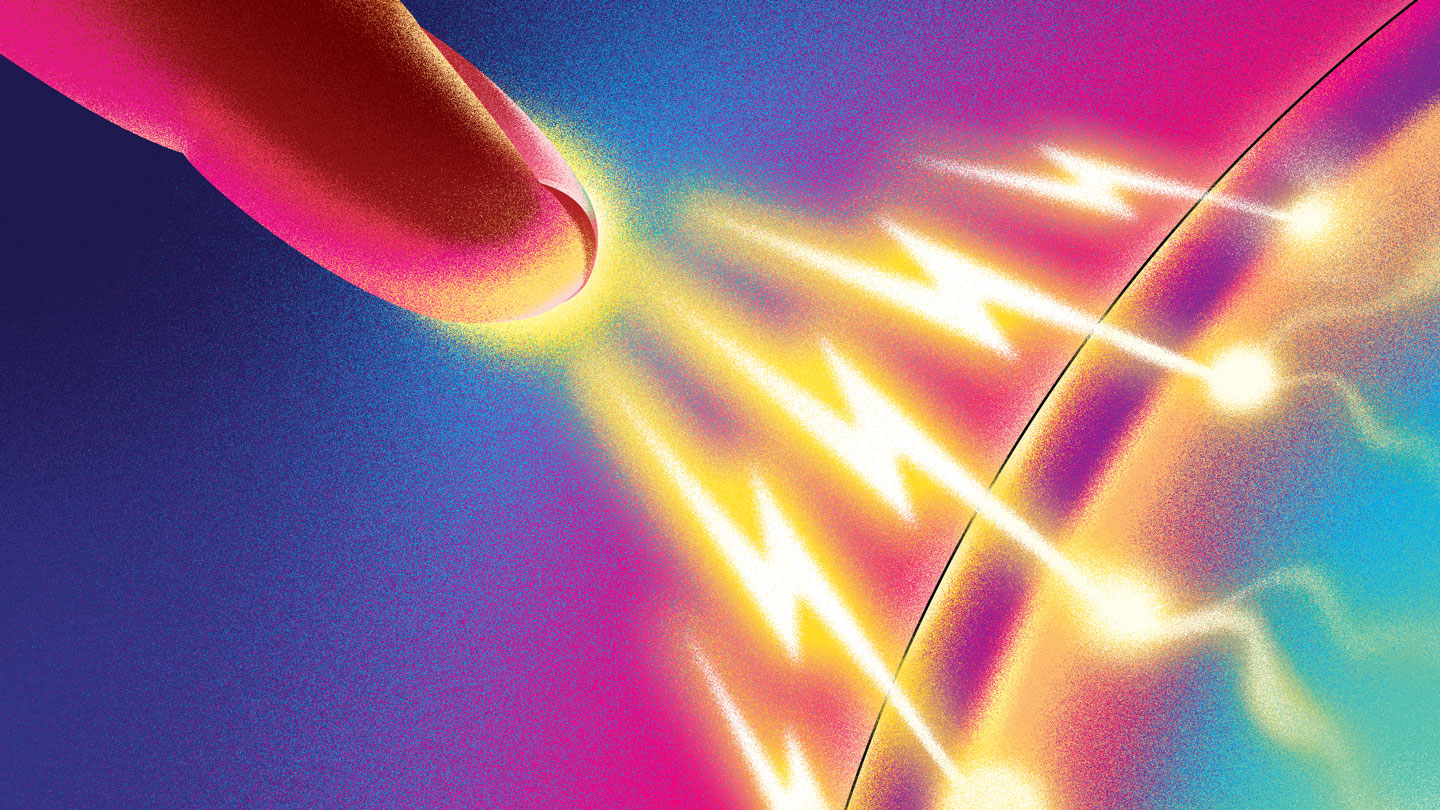
We all have a memory of static electricity, even if we have never called it that. It begins childhood with the great balloon-on-sweater trick, that brilliant moment when you rub a plastic toy against a shirt and then lift it over your head while a froth of hair rises toward it like seaweed longing for the tide. Later in life, it appears as the rude crackle of a laundry sheet in winter, the hair-raising cling of a polyester turtleneck, the sharp sting of a door handle after you have shuffled across a carpet. These moments settle in us as ordinary, explained by the word “static,” which somehow makes the whole mystery disappear. But here is the truth that nearly no one is told at the dinner table: scientists are still largely clueless about where static electricity actually comes from. Not because they are sloppy, but because the phenomenon is genuinely strange. It demands explaining how two smooth, seemingly inert materials can exchange invisible pieces of charge merely by touching, why different combinations behave differently, why humidity changes the outcome, and why a material that charged as “negative” in one experiment sometimes turns “positive” in another. There are sophisticated equations for lightning, for semiconductors, for the very basic rules of physics, and yet the humble act of rubbing a balloon on your hair sits quietly unsolved. That is the humbling backdrop this story: the most familiar electricity on Earth has kept its biggest secret for more than two thousand years, and the scientists still shrugging their shoulders about are not ashamed—they are actually thrilled.
Part of the problem is that we do know a lot, but knowing the ingredients only makes the meal harder. The idea behind static electricity is beautifully simple on paper. Everything is made of atoms, and atoms have electrons. Sometimes, when two materials become very close, one material’s electron affinity is stronger than the other’s, so an electron or two (or a small army of them) leaps across the contact surface. The material that loses electrons becomes slightly positively charged; the one that gains them becomes slightly negative. After the materials are separated, those charges look for a path to meet each other again. That’s the spark, the zap, the brief follow-up where the universe reverts to its quiet, neutral state. This book picture has been taught for decades, and the fundamental principle of charge conservation is still safe. But ask a scientist the next obvious question: exactly why does a particular kind of rubber always steal charge from a particular kind of plastic? Or why do surfaces that are chemically identical, but scraped differently, charge with different signs? There is no reliable, complete answer. The empirical work that does exist usually happens along the so-called triboelectric series, a list that arranges materials from likely positive to reliably negative, and it works like a kind of cosmological table for the curious. But just as a medieval astronomer could predict where the sun would rise without understanding the solar system, researchers can often predict the general charge of a material without understanding the underlying microscopic mechanisms. The truth is that real materials are not clean, simple surfaces. They are messy, oxidized, full of tiny cracks and whiskers, covered in a layer of water molecules, dust, stray hydrocarbons. The exact physics depends on things we cannot easily see or isolate; you cannot just take a piece of a shopping bag and put an equation on it, because the equation keeps changing with the weather, the pressure, and the way it is held.
That is where the quirky group of researchers enters the friendly stage. They are not a single official laboratory operating at world headquarters; they are a scattered, slightly obsessive collection of physicists, chemists, materials scientists, and perhaps some engineers who spend their Friday afternoons rubbing bits of plastic together. Some of them look like old-fashioned tinkerers, with greasy drawers filled with Teflon, nylon, microalgae, powders, rubber bands, and metal rods. They do not rely on supercolliders or billion-dollar instruments—though they love an electron microscope—because a great deal of the work can be done with a piece of amber and a bit of fur, with the same fervor that Thales of Miletus used more than twenty-five hundred years ago. What makes them quirky is not only their subject, but their cheerfulness. Instead of being frustrated by uncooperative results, they treat the contradictions like gifts. They can describe with a grin how they have accidentally set up a cloud of tiny charge and suddenly made an entire sheet of polyethylene burst into gold, and they redo the trial. They are obsessed with the tiny crackle that a pair of kids in rubber shoes can set off, and they see that crackle as a whole world of microscopic violence: atoms being pulled out of place, strands of molecules tearing, electrons racing across an invisible battlefield. They literally build their own static balls with conductive balloons and a pair of insulated aluminum plates, then rub them until the lab air smells of ozone; they are the kind of people who can make an adult feel like a child again, only in a good way.
Their recent experiments have begun to turn static electricity from a low-level annoyance into a thread of understanding a genuinely tiny and beautiful mechanics. One of the most interesting ideas, supported by careful work in various groups, is that the friction of rubbing does not merely “lightly pass” electrons around, as if from finger to finger. What actually happens is more like a battle: the surfaces, if you look at them on a micro scale, are not flat. They are made of lumps, valleys, isolated peaks. When you put them together and slide, those peaks hit each other violently. Stresses are concentrated on tiny spots, and the material can tear, shear, crack, and even break apart on these collision spots. The broken fragments, alternatively, are not neutral; they can carry charge. This quickly turns the picture of static electricity from a perfect orchestral swapping of a single electron to the atmosphere-chipping of two rough worlds, so bits of material are ejected and the tiny confetti particles are charged. The larger bits may come out positive; smaller bits, negative; whole process is a mixture of thermal, mechanical, and chemical in a micro, but still the visible macro: the static electric. Nothing feels more like a soccer match than this. The insight explains why the triboelectric series cannot be completely universal, because the environment can matter, which microcracks appear, what humidity does to the bits, what the exact pressure can be. No one has gained a complete map; many of these exploratory bits of volume and charge are candidates, and unsure of which are precisely right. But the researchers are human about this; they say, with fine spirit, that their job is to guess the still-incomplete some of the chemistry, and they are happy to rub the wrong surfaces one thousand times to get a single tiny glance.
Why should we care, in a world full of “dry” and faintly labeled things? Because static electricity is not just a parlor trick. It is the force behind printing toner, because electrostatic self-assembly, air purification, dust remediation in semiconductor clean rooms, the like. It can make the filters in a hospital catch microscopically, or it can make a grain silo risk exploding in a spark. For space explorers, it makes lunar dust stick to spacesuits and can damage machines. For pharmaceutical people, it makes powders clump, which can mean the difference between a car that was safely mixed and an uneven dose in manufacturing. And in our everyday quiet, it is the reason the protective film covers everything, and the same electrostatic drawing uses. If scientists can truly understand the origin of static electricity, they will be able to engineer materials with predictable behavior. They might create better triboelectric nanogenerators, battery-like. tiny machines that harvest wasted motion from the swipe of a hand; they might design ordinary surfaces that never invoke sparks; they could develop charging sprays, reduce industrial explosions, and make the world feel more solid. All that is already in the rough. The field is particularly in an unexpected resonance: the last few decades have provided tools to probe surfaces in ways as fluorophores and atomic force microscopes that could see the instant when two materials meet, and suddenly a field that was once pitied as “used” and “ill-defined” is becoming one of the most fruitful laboratories for thinking about modern electronics. The quirky groups at these meetings are not trying to invent a new gadget; they want to explain what happened yesterday in a dozen different small laboratories, and in the process, they are giving us respect for a everyday wonder.
The remarkable truth that they are exposing, with every new paper that is written, is not just an scientific exactness, but also a metaphor then. Scientific claims to “cluelessness” are not failures. They are openings. The researchers have learned that being clueless is not a source embarrassment; it is a sign of authenticity, because no one can pretend to know clearly. Human beings were once afraid of thunder; now we know it. Static electricity remains a near mirror: we can feel it, we can make it, we can play it, but we still spend an enormous amount of time trying to understand exactly how it happens. The quirky group has adopted this humility as a lifestyle. They are not specifically strange, with long beards; they are a place of wonder, laughter, and hope. They do not believe that answers will be shouted from a blackboard, but that they only need to rub more materials, count more grins, and be open to changing their minds. If you have ever held the charging balloon to a friend’s head while worrying that the shock might be an unavoidable assault, then you know what it’s like to be when you’re in the dark; the only difference is that this group has decided to follow the crackle down into the dark and switch it into a light. Next time, when you reach for the door and get static, do not already be annoyed. Smile, and know there is a small cluster of lovely obsessive people out there, all over the world, still delighted by the fact that their work is not done, and they are ready to adopt another dare from the very first spark of the cosmos.