




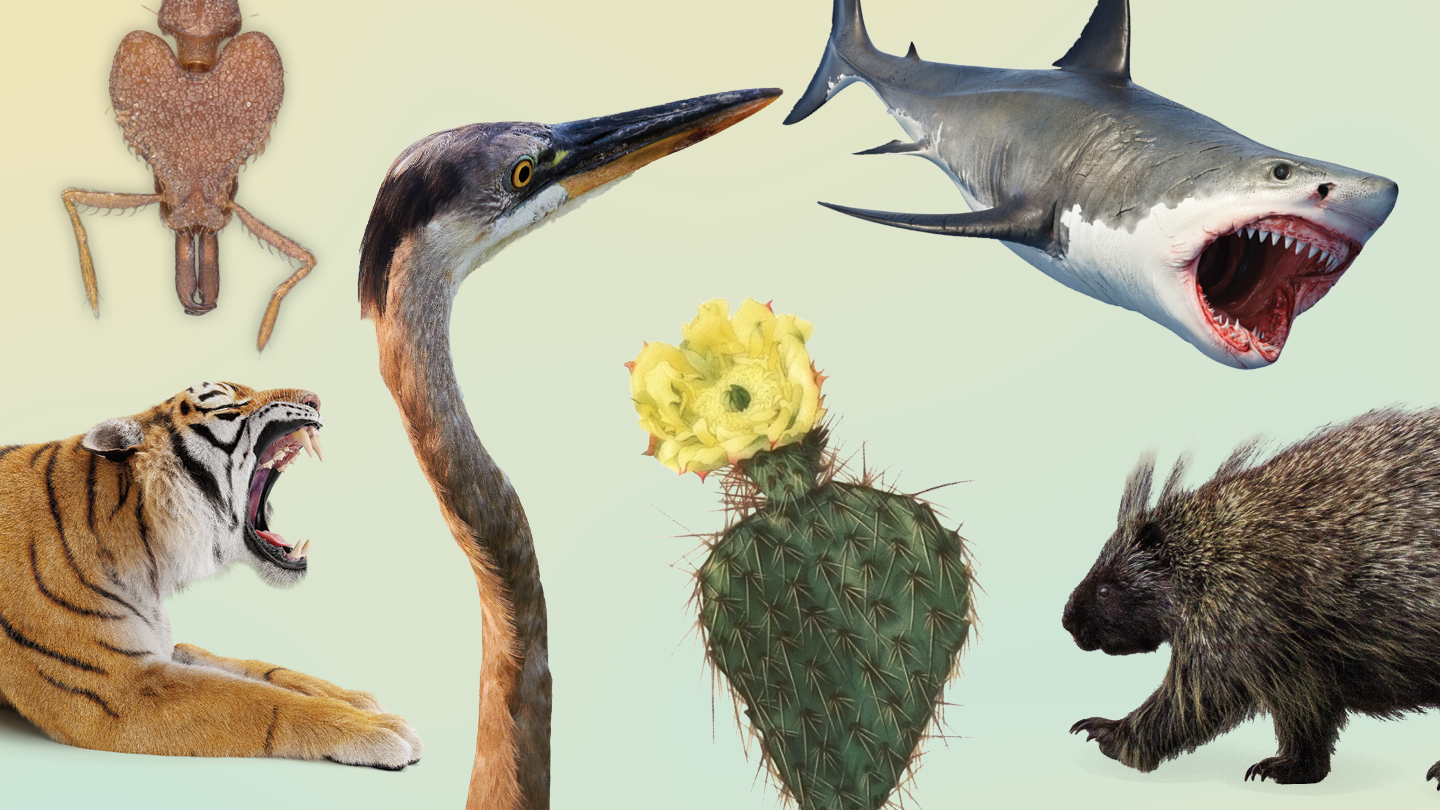
Think of every time you have tried to push a needle through a thick, stubborn piece of fabric. You want the needle to be sharp enough to slide in with just a whisper of pressure, but strong enough not to snap when you lean on it. That small, everyday frustration contains one of the deepest secrets of nature. From the curved tusks of elephants to the tiny, chalky love darts that snails fire into their mates, living creatures have evolved piercing tools in an astonishing variety of shapes. A team of researchers looked at 143 of these tools, spanning animals, plants, and even specialized body parts whose only job is to get through someone else’s flesh. They wanted to find the perfect piercing shape—the one design that would prove nature had settled on some universal ideal. What they found was something more subtle and, in a way, more beautiful. There is no perfect shape. No single winner. Instead, every piercing tool in nature is caught in a quiet, ancient trade-off between piercing ability and durability. You can have a tip that pierces beautifully but breaks easily, or a tip that stays strong but refuses to be sharp. You cannot have both at the maximum level at once. The story of nature’s needles, fangs, spines, and stilettos is not a story of champions. It is a story of negotiation.
To understand why this matters, it helps to think about what the researchers actually measured. Imagine trying to evaluate a knife not just by looking at it, but by testing how well it performs under real pressures. For each of the 143 piercing tools, the team had to take apart the geometry that makes something sharp. How fine is the tip? How sudden is the curve? How thick is the cross-section behind the point? How long is the shaft? What is it made of—hard enamel, brittle bone, flexible keratin, compressed calcium carbonate? These details decide how the tool interacts with force. Piercing ability is about efficiency: how little force you need to break through a surface. A very thin, needle-like tip concentrates all your force into an almost impossibly small area, which means it can slide into skin or hide or even wood with relatively little effort. Durability is about resilience: how much force the tool can absorb before it cracks, chips, bends, or snaps. But the geometry that makes a tip incredibly sharp is exactly the geometry that makes it fragile. A long, delicate point is vulnerable. Under pressure, it breaks. A thick, rounded tip is tougher, but it does not pierce so easily; it needs more force and often creates more damage. The researchers found that the 143 tools in their study did not cluster around a single ideal shape. Instead, they spread across a kind of trade-off frontier. At one edge are tools that are gloriously sharp but fragile. At the other edge are tools that are durable but blunt. In between, each species has found its own particular compromise.
These compromises become even more vivid when you look at individual examples. Consider the love dart of a snail. It is not meant for killing or hunting at all. It is a tiny, often curved hardened projectile that a snail fires into a potential mate during courtship, and it carries mucus that influences the partner’s reproductive success. The love dart needs to pierce once, maybe twice in a lifetime, and it does not have to remain intact for future meals or fights. For that kind of job, a fragile but exquisitely pointed design makes sense. It slips through soft tissue, delivers its chemical message, and then simply does not matter much whether it snaps or breaks. Now think of a tusk. An elephant’s tusk, or the tusk of a wild boar, is used for digging, prying, fighting, displaying dominance, and all sorts of rough, repeated labor. It does not need the precision of a scalpel. It needs to be strong enough to absorb brutal impacts without shattering. So a sharp, fragile point would be useless. The tusk is a blunt but powerfully durable instrument, more like a crowbar than a lancet. A viper’s fang lies somewhere in between. It is a hypodermic needle, hollow and delicate, designed to penetrate flesh quickly and deliver venom. But a snake cannot afford for its fang to break off in prey, so the fang must balance sharpness with enough structural strength to survive repeated strikes. The result is its own unique compromise, shaped by the species’ hunting style, prey toughness, and even the snake’s ability to grow replacement fangs.
No design can escape this negotiation, and that is why the study is so human. Every creature is not optimizing for a single number. It is optimizing for a whole life, a specific ecology, a particular set of needs and threats. A parasite that needs to pierce a host only once can be elegant and disposable. A predator that depends on its weapon for survival every single day must favor durability. An animal that uses its piercing tool for display and social status may sacrifice sharpness for size, shape, or ornament. Even the material itself limits what evolution can do. Calcium carbonate can be hardened but is brittle; keratin is tough and flexible but not as hard as enamel; enamel is brilliant at maintaining a sharp edge but is expensive to grow and repair. There is no universal solution because there is no universal problem. A mosquito’s proboscis, a porcupine’s quill, a sea urchin’s spine, a cat’s claw, the stinger of a wasp, the beak of a hookworm—each is an answer to a question that no other species is asking. The researchers were looking for a single best shape, but the animals kept answering, “Best for what?” A tool that wins in one situation fails in another. Nature is not a competition where everyone is trying to reach the same finish line. It is a series of local conversations between an animal and its own world.
There is also something important here for human engineers, and it is perhaps where the study touches us most directly. We live in a culture that loves the idea of the perfect product, the ultimate design, the unbeatable innovation. We want one tool that does everything and never breaks. But the study of these 143 piercing tools suggests that such dreams are not just unrealistic; they are almost nonsensical. Every engineered piercing device—from hypodermic needles to surgical scalpel blades to the tools used to cut composites in factories—faces the same fundamental trade-off. If you make a surgical needle incredibly fine, it causes less pain and less tissue damage, but it may bend or break inside the body. If you make it stronger and thicker, it is safer but more traumatic. There is no way to have both at once. The best you can do is choose the point along the trade-off curve that matches your need. A needle for a routine blood draw can be sharper and more fragile. A tool used to punch through tough, random materials in construction must be thicker and more durable. Engineers have begun to understand that they should not look to nature for the perfect shape, but for the whole chart of possible shapes. The real lesson is humility. No shape wins out. Instead, every shape is part of a great map of compromises, and the skill lies in reading the map and knowing where you are.
If we step back and allow ourselves to feel the poetry in this, the study becomes more than a scientific result. It becomes a reminder of how much wisdom lives in the ordinary world around us. Evolution has spent millions of years tinkering in every corner, testing every possible needle, every brittle quill, every heavy tusk. Its failures are fascinating, and its successes are never perfect—they are only good enough for the particular life that carries them. There is something humbling about a study that goes looking for a winner and discovers that no one wins. But there is also something liberating. The love dart is not less beautiful because it is fragile. The tusk is not weaker because it is blunt. The viper fang is not flawed because it must be replaced. Each tool is the answer to a question that mattered to a particular creature in a particular moment. And each one, in its own way, works. The next time you see a thorn on a rosebush, a crab’s claw, or even the needle in a sewing kit, you can think about this hidden geometry. Every sharp thing is a compromise between the desire to pierce and the need to remain. That is true of nature, and perhaps true of us as well. We all choose what kind of point we will be—how sharp, how strong, how breakable, how useful. And in that deep, ancient study of 143 piercing tools, the final answer is not that no one shape wins. It is that every shape is a victory for its own world, if only we have the patience to understand it.