


Imagine what it would mean to see again after years of darkness—not the full blaze of a sunset or the familiar face of a grandchild, but something smaller and almost mundane: the pale rectangle of a doorway, the dark silhouette of a hand reaching toward you, the subtle line of a hallway you can follow without bumping into walls. For a small group of people living with blindness caused by a genetic condition called retinitis pigmentosa, this kind of visual awareness is no longer a distant fantasy. In a groundbreaking experimental treatment, seven out of ten participants gained noticeable improvements in light sensitivity, and some were able to use custom-made goggles to detect objects and navigate through doorways they could not have seen before. The findings, published October 7 in the New England Journal of Medicine, are being hailed as a powerful proof of concept for optogenetics—a field that uses light-sensitive proteins to give cells new abilities. This study builds on a remarkable 2021 report in which the same approach allowed a single blind man to see and count objects, and the new results suggest that his experience was not a one-time miracle. It is an early, imperfect, yet genuinely encouraging sign that science may be able to reawaken parts of a damaged visual system and return a measure of independence to people who have lost it.
To understand why this matters so deeply, it helps to know what retinitis pigmentosa does. It is a genetic disease that progressively destroys the light-sensing cells in the retina, the thin layer of tissue at the back of the eye that captures light and turns it into signals for the brain. As those cells die, vision narrows and dims, often beginning with night blindness and difficulty seeing in low light, eventually leading to tunnel vision and, for many, complete blindness. For decades, there was no way to reverse this process. Researchers tried various approaches—gene therapy to correct the faulty genes, retinal implants to replace damaged cells—but success was limited and sometimes temporary. The new optogenetic treatment takes a fundamentally different approach. Instead of trying to repair or replace the retina’s original light detectors, it gives a different set of cells the ability to sense light. Specifically, scientists inject genetic instructions into the eye so that retinal ganglion cells—the neurons that normally act as messengers, carrying visual information from the eye to the brain—begin producing a light-sensitive protein. In this study, that protein came from algae and responds to amber light. The idea is not to recreate natural vision exactly, but to create a new, artificial pathway for light information to reach the brain. And while the results are modest, they are real: seven of the ten treated participants showed improved light sensitivity, and four of the eight who completed the full behavioral testing were able to find a doorway or follow a line while wearing the goggles.
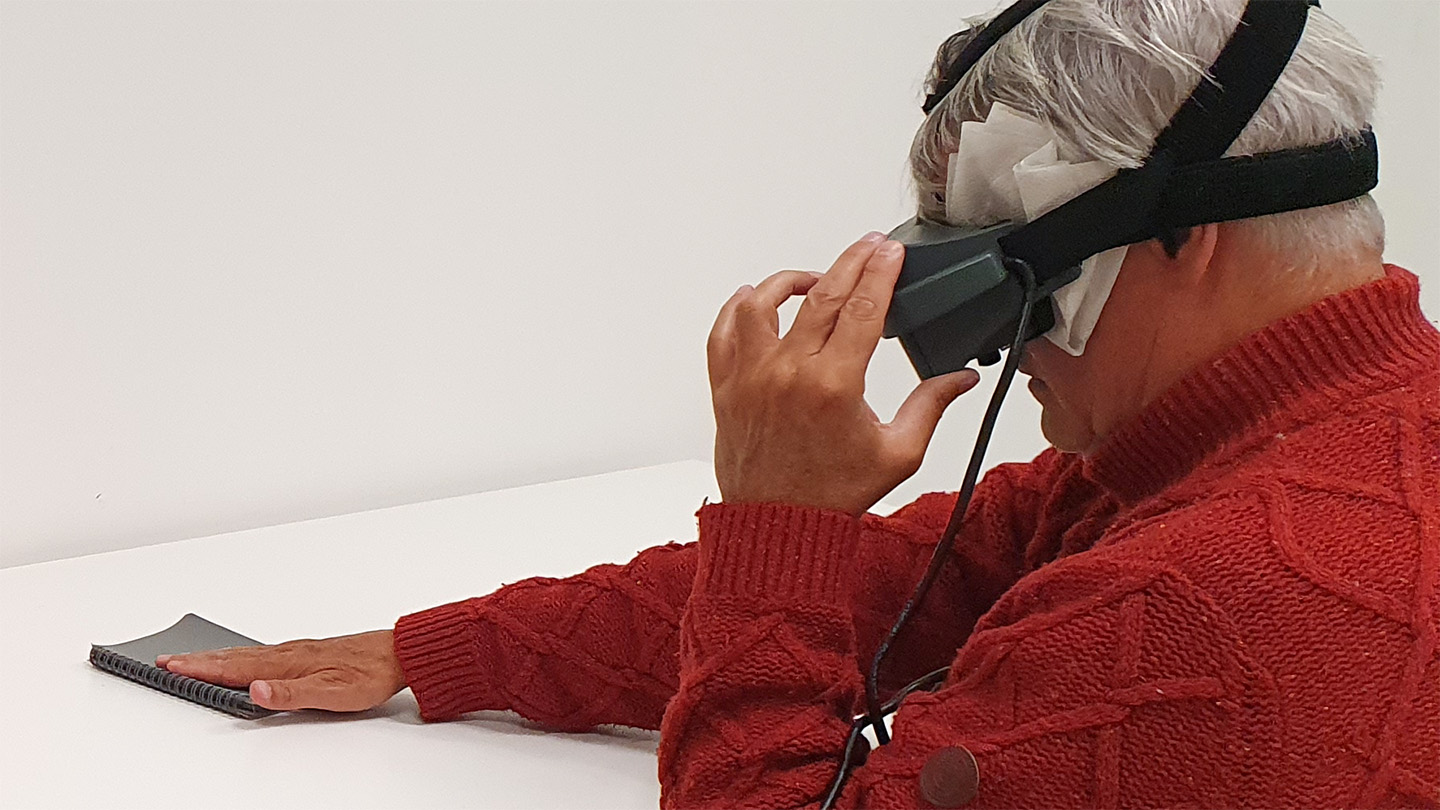
The technique at the heart of this work is called optogenetics, and it has been transforming neuroscience for years. Scientists use genetic tools to make specific cells sensitive to light, allowing them to switch neurons on or off with incredible precision. The pioneering research behind this method earned the 2026 Nobel Prize in Physiology or Medicine, awarded on October 5, and this new study shows that the technique is not just a laboratory curiosity—it can be applied to the human eye with genuinely measurable effects. In the current treatment, the researchers used a protein called ChrimsonR, which is derived from algae and is particularly good at responding to amber light. They injected the genetic instructions for this protein into the participants’ worse-seeing eye, where it was taken up by retinal ganglion cells. Once these cells began producing the protein, they became sensitive to amber light—but they needed a way to receive that light in a meaningful pattern. That is where the custom goggles come in. The goggles are equipped with a small camera that captures the visual scene in front of the wearer. But rather than trying to produce a natural image, the camera detects changes in brightness and converts them into pulses of amber light. Those pulses are then projected onto the retina, where they activate the treated ganglion cells. In other words, the goggles act as a translator, turning the messy, complex visual world into a simpler language that the newly sensitized cells can understand and pass on to the brain.
For the participants who responded, the experience was life-changing in ways that may seem small to sighted people but are enormous for someone living with blindness. Finding a doorway might sound trivial, but for a person who has not seen one in years, it means moving through the world with a little more confidence and safety. Following a line on the floor could help someone stay oriented in a corridor or avoid walking into a wall. These are not the grand, cinematic visions of restored sight—no one in the study was suddenly able to read a book, recognize a friend’s face, or watch a movie. But that was never the goal of this phase of research. The researchers, led by neuroscientist Botond Roska of the Institute of Molecular and Clinical Ophthalmology Basel in Switzerland, are careful to frame this as a proof of concept. “Optogenetics can bring back some visual activity and object sensitivity,” Roska said. That may sound modest, but it is a crucial first step. The 2021 study involved just one person, so there was legitimate uncertainty about whether the approach would work in others. Now, with a larger group showing measurable improvements, the evidence becomes much more compelling. It suggests that optogenetics has genuine potential to help people with certain forms of blindness—and that with further refinement, the improvements could become even more meaningful.
Still, there are important limitations, and the researchers are upfront about them. The approach depends on a working optic nerve, the cable that connects the eye to the brain. The retinal ganglion cells that are being treated must be able to send their signals along that nerve to reach the visual processing centers of the brain. If the optic nerve is damaged or has deteriorated, the treatment will not work. Study coauthor José-Alain Sahel, an ophthalmologist at the University of Pittsburgh, emphasizes this constraint. The therapy is designed for people whose blindness is caused by the loss of light-sensing cells, not by damage to the optic nerve itself. That narrows the population of people who could potentially benefit. There is also the question of how much vision can realistically be restored. The current system produces a relatively coarse, pixelated representation of the world—enough to detect a doorway or a line, but not enough to read text or recognize faces. The researchers acknowledge this and say they are already thinking about how to improve the technology. They hope to refine the goggles, the genetic instructions, and the way light is projected onto the retina to produce sharper, more detailed visual information. Future versions might allow people to distinguish shapes more clearly, or even to perceive faces in a rudimentary way. But those goals will require more research, more trials, and more time.
For now, the story is one of cautious hope. The field of vision restoration has seen many promising leads that failed to pan out, so it is natural to be skeptical. But the fact that multiple participants in this study experienced real, measurable improvements—and that those improvements translated into the ability to perform everyday tasks like finding a doorway—is a milestone worth celebrating. It means that a person who has been living in darkness can, with the help of an experimental treatment and a pair of goggles, suddenly perceive the world in a new way. It is not full sight, but it is a beginning. It opens the door to a future in which optogenetics might be combined with other therapies to restore even more vision, or in which the technology becomes sophisticated enough to help people navigate the world with far greater ease. The road ahead is long, and there are many scientific and practical hurdles to overcome. But for the people who took part in this study, and for the millions around the world living with degenerative eye diseases, the message is clear: the darkness is not absolute. Science is finding ways to let the light back in, one small step at a time.