


Deep within the ancient sediments of North Dakota lies a discovery that bridges millions of years, offering an unprecedented glimpse into the daily life of the most iconic predator to ever walk the Earth. It begins with a single footprint, massive and unmistakable, and expands into a trail of ancient steps that have captured the imagination of the scientific community. These four footprints, preserved in the rugged landscape of the Hell Creek Formation, are not just fossilized impressions; they are a moment frozen in time, a snapshot of a colossal creature going about its business at the very end of the age of dinosaurs. For the first time, researchers believe they are looking at the trackway of a fully grown, adult Tyrannosaurus rex, a discovery that feels less like a static fossil find and more like a ghostly echo of the creature’s living, breathing presence, offering tangible evidence of its gait, speed, and very existence in a way that isolated bones never could.
The significance of this set of tracks, published in the Journal of Vertebrate Paleontology, lies in the distinction between a single footprint and a continuous trackway. While a lone footprint tells us a footprint existed, a trackway is a story of movement.
It reveals the nuanced rhythm of how the animal placed one foot in front of the other, the subtle shifts in weight, and the cadence of its stride. Paleontologist Peter Falkingham of Liverpool John Moores University in England, emphasizes this crucial distinction, explaining that an isolated print is a static piece of data, while a trackway provides dynamic insight into foot placement and the mechanics of locomotion. This difference is paramount when trying to understand the behavior of animals that have been extinct for 66 million years. Just as a human toddler moves with an unsteady, wide-legged gait in sharp contrast to the efficient stride of a grown adult, it is highly probable that a young and an aging dinosaur moved in vastly different ways. The discovery of this adult trackway, therefore, not only confirms the presence of a giant but offers a unique and detailed look at the mature stride of an apex predator, providing critical data that can be used to model its movement and speed. The measurements of this 7-meter-long path suggest a deliberate and confident pace, about 1.6 meters per second, roughly equivalent to a person walking briskly, a surprisingly comfortable walking speed for an animal of such immense size.
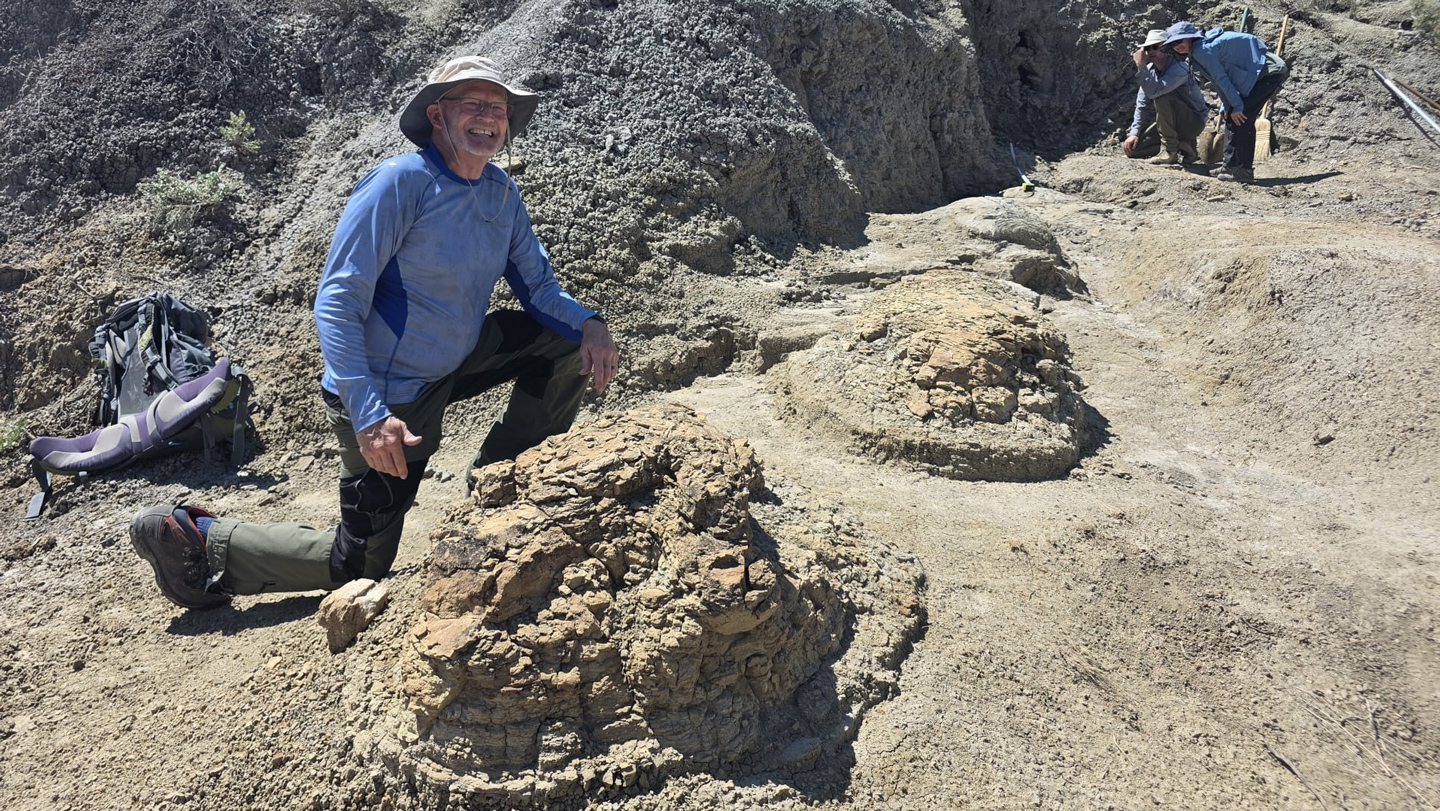
The story behind this remarkable find is one of serendipity, sharp eyes, and a profound understanding of the land. It was Kent Hups, a high school teacher and dedicated paleontologist, who stumbled upon the tracks in 2025 while fossil hunting along a steep incline. The footprints were not discovered as hollow depressions in the earth, but rather as raised, three-dimensional bulges, a fascinating inversion of the original prints. This occurred because sediment filled the muddy footprints millions of years ago, and that hardened filler proved more resistant to erosion than the surrounding rock, leaving behind what appears to be the very molds of the dinosaur’s feet, sticking out from the slope. When Hups laid eyes on the first print, he was immediately struck by its breathtaking size and form. The three-toed impression was an astonishing 80 centimeters across, a dimension that left no room for doubt in his mind. In that moment, a thought crystallized with profound clarity: this had to be a T. rex. For Hups, it was the thrill of a lifetime, a moment of pure connection with a creature he had dedicated his life to studying)Skip.
The scientific evidence, beyond the sheer enormity of the prints, aligns beautifully to support that identification. The slender, sharp toe impressions are characteristic of a theropod, the group of bipedal, three-toed dinosaurs to which T. rex belongs. Furthermore, the team’s surveys of the Hell Creek Formation have unearthed numerous T. rex fossils, including bones and teeth, painting a clear picture of an ecosystem dominated by this giant. While other, smaller theropods existed during that time, none possessed the sheer bulk and power of an adult T. rex. As Falkingham points out, while there is always the chance of discovering a completely unknown species, based on current knowledge of the fossil record and the ecosystems of North America at the end of the Cretaceous period, T. rex is essentially the only track maker capable of creating footprints of this magnitude. The combination of geological age, the morphology of the prints, and the known fauna of the region all point to the same conclusion, transforming four impressions in the rock into a decisive signature of the king of the dinosaurs. The discovery fills a significant gap in the fossil record, which previously had only single adult footprints or trackways from smaller, possibly juvenile, relatives.
With the identity of the track maker established, the team set about reconstructing its movements. By carefully measuring the stride length—the distance between consecutive steps—and considering the animal’s estimated leg length, they calculated the speed at which it was traveling. The resulting figure of 1.6 meters per second, or about 5.8 kilometers per hour, is a fascinating insight into the animal’s behavior. It suggests a leisurely stroll, not a high-speed chase. The T. rex was not hunting or fleeing; it was simply walking across its domain, perhaps patrolling its territory or searching for an opportunity for a meal. However, the researchers are quick to acknowledge the limitations of their data, as estimating speed from fossilized tracks is an inherently tricky business. The footprints, while spectacular, are not perfectly preserved, and factors like the firmness of the ancient mud and the exact mechanics of the foot for a dinosaur of this size could affect the calculations. The animal might have been moving slightly faster or slower than the precise number suggests.
However, the very existence of the trackway is a testament to the animal’s day-to-day life do we have a better understanding of its power and presence. Whether it was walking faster or slower, the footprints tell a story of a real animal, moving through a real landscape, and not just a character in a science fiction movie.
Perhaps the most tantalizing aspect of this discovery is the promise of more to come. A fifth step may very well be hidden within the hillside, waiting for the slow, patient forces of erosion to reveal it to the world. For Hups, this is a source of immense excitement and anticipation. He can’t wait to return to the site, to that ancient landscape, and continue his search for more clues. The discovery of this trackway does more than just provide a new data point for paleontologists; it humanizes these giants of prehistoryches the colossal and terrifying Tyrannosaurus rex to the simple act of walking. It transforms them from distant, skeletal monsters into an animal that experienced the world in a way we can directly relate to. You can almost picture the great beast, its massive head held low, ambling through the ferns and cycads of prehistoric North Dakota, its footsteps leaving imprints that would outlast mountainsles. This find is a powerful reminder that science is a journey of discovery, and that the Earth itself holds untold stories waiting to be uncovered by the curious and the patient. The footprints of the T. rex are not just an ancient relic; they are an invitation to step into the past, to join the search, and to look upon our planet’s deep history with wonder and awe.