






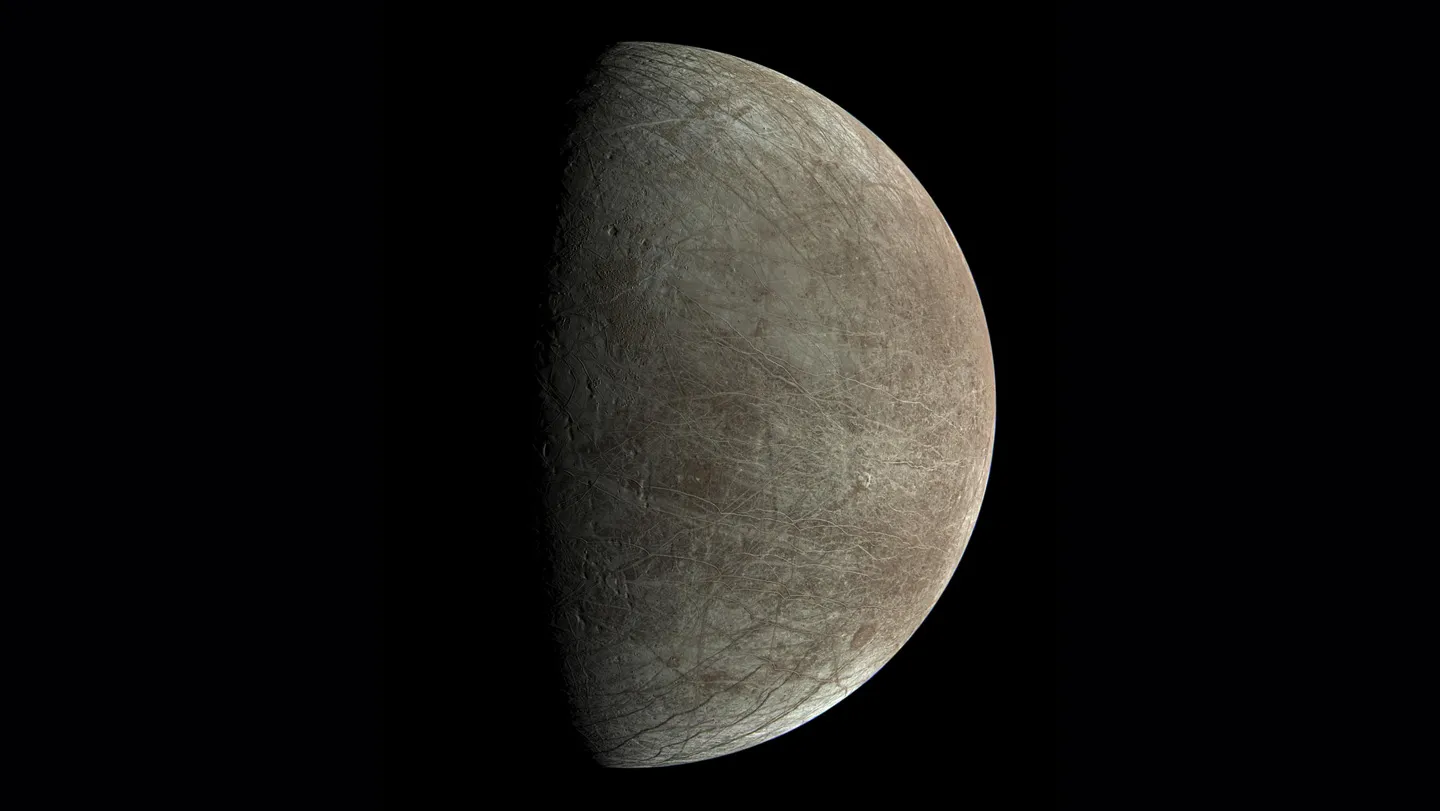
For centuries, humanity has gazed up at the night sky in quiet wonder, questioning whether our blue planet is the sole crucible of life in the vast, silent cosmic desert. Among the most promising candidate sanctuaries for life in our solar system is Europa, an enigmatic, ice-shrouded moon orbiting the gas giant Jupiter. In 2013, the astronomical community was sent into a collective frenzy when a team of researchers, led by planetary astronomer Lorenz Roth of the KTH Royal Institute of Technology in Stockholm, announced a truly breathtaking discovery. They had detected what appeared to be colossally powerful plumes of water vapor spewing hundreds of kilometers out into space from Europa’s south pole. This dazzling revelation, based on ultraviolet signatures captured by the legendary Hubble Space Telescope, suggested that Europa was actively venting its hidden secrets into the freezing void of space. To astrobiologists, this meant that the moon’s subsurface ocean—a vast, liquid abyss containing more liquid water than all of Earth’s oceans combined and cradled beneath kilometers of solid ice—might not be locked away from our reach forever. The prospect of these active geysers offered a thrilling biological shortcut, a cosmic invitation suggesting that a passing robotic spacecraft could easily swoop through these celestial fountains, catch the drifting spray, and analyze it for signs of alien biology without ever having to undertake the daunting, perhaps impossible task of landing on and drilling through the moon’s brutal, miles-thick glacial shell.
Yet, as is so often the case in the grand, self-correcting march of scientific inquiry, nature has a way of tempering our grandest expectations with humbling silence. Armed with the initial thrill of their discovery, Lorenz Roth and his international colleagues returned to the Hubble Space Telescope over the subsequent decade, convinced that they now possessed the temporal and spatial map to catch these planetary fountains in mid-eruption once again. But as the years rolled on and observation after observation was logged, the expected spectacles simply failed to materialize; the spectacular water jets had seemingly vanished into thin air, leaving behind only the cold, uncooperative blackness of space. “They disappeared,” Roth recently remarked, reflecting on the sobering outcome of their painstaking, multi-year follow-up campaign. “I don’t think there’s any strong evidence left.” The realization that these magnificent plumes might have been nothing more than a transient event, or perhaps an observational illusion altogether, represents a poignant moment of scientific heartbreak. It serves as a gentle reminder of the profound vulnerability of our endeavors to map the cosmos, where the difference between a groundbreaking paradigm shift and an empty data set rests on the finicky, fleeting whims of a distant world.
To understand how such an electrifying discovery could simply melt away into the background noise of space, one must appreciate the extreme technical hurdles of examining a small, distant moon through the eyes of an orbiting observatory millions of miles away. Published in the May issue of the journal Astronomy & Astrophysics, the team’s exhaustive new study detailed their analysis of twenty separate Hubble observations collected between 2013 and 2020, alongside a re-evaluation of the historical data sets from 1999 and 2012 that had sparked the original hypothesis. Viewed through Hubble’s ultraviolet instruments, Europa does not appear as the crisp, beautifully marbled sphere we see in spacecraft flyby photos; instead, it manifests as a blurry, erratic ghost, resembling the fuzzy static of an old, detuned analog television. In this hyper-sensitive regime, the margin for error is razor-thin: miscalibrating the physical boundaries of Europa’s edge by just one or two pixels can completely skew the results, turning standard background emission noise into artificial plumes of water vapor. Furthermore, in the thirteen years since those initial, tantalizing signals were recorded, our broader understanding of the Jovian system has matured significantly. Scientists now know that Europa is enveloped in a permanent, surprisingly vast exosphere of hydrogen gas, an atmospheric shroud that easily absorbs and scatters ultraviolet light, creating a spectral haze that was likely misread in the past as the dramatic venting of subsurface geysers.
The loss of these prominent plumes is a significant blow to our immediate strategies for searching for extraterrestrial life, as they represented the most accessible doorway into an environment that is otherwise maddeningly locked away from human hands. Europa’s subsurface liquid ocean is kept warm by the constant gravitational flexing of Jupiter’s immense tidal forces, creating a subterranean environment that many scientists believe could mimic the hydrothermal vents on Earth’s deep ocean floors, where life is thought to have first sparked. However, this dark marine world is entombed beneath an icy crust estimated to be anywhere from ten to thirty kilometers thick—a barrier far too formidable for any drilling technology we can currently conceive, let alone transport across millions of miles of deep space. Active plumes were highly prized because they functioned as a free sample-return mechanism, throwing organic molecules, salts, and potentially even microbial life-forms directly up into orbital space. Without these reliable doorways to the deep, the prospect of studying Europa’s oceanic chemistry becomes vastly more complex, expensive, and distant, forcing scientists to rethink how we might one day confirm whether anything is swimming or thriving beneath the moon’s frigid, unyielding surface.
But the story of Europa is far from finished, and this scientific regression has only served to sharpen our resolve and refine our tools for the next great chapter of space exploration. While Hubble may have lost the scent of the water plumes amid the hydrogen fog, the ultimate verdict will not be delivered from an observatory orbiting Earth, but by a spacecraft that will actually travel to the icy world itself. NASA’s highly sophisticated Europa Clipper spacecraft is currently charting a course across the solar system, scheduled to arrive at the Jovian system in April 2030 to begin a series of daring, low-altitude flybys of the moon. Equipped with an incredibly advanced suite of mass spectrometers, dust analyzers, and thermal cameras, Europa Clipper is specifically designed to sniff out and analyze even the most microscopic, localized geysers that would easily escape Hubble’s notice. Scientists like Roth retain a quiet, cautious optimism that smaller, intermittent venting events may still be taking place along the fractures in the ice shell, waiting for a close-range visitor to catch them in action. As Roth notes, “I’m excited for Europa Clipper having the possibility and the instruments to find smaller things,” reminding us that while the massive plumes of our imagination have quieted, the real secrets of Europa are simply waiting for a closer look.
Ultimately, this celestial mystery reminds us that the pursuit of science is rarely a straightforward ladder of constant triumphs; rather, it is a winding path paved with false starts, corrected errors, and long stretches of quiet waiting. The dissolution of Europa’s legendary water plumes is not a failure, but a triumph of scientific integrity, proving that researchers are willing to challenge and dismantle their own prized discoveries in the relentless pursuit of verifiable truth. We now find ourselves in an era of profound astronomical anticipation, poised on the precipice of a years-long vigil as robotic explorers traverse the silent gulfs of space. For scientists and stargazers alike, there is a profound, human beauty in our collective willingness to embrace this uncertainty, to sit comfortably with the words of Lorenz Roth when he admits, “We have another four years of not knowing.” It is this very capacity for endless patience, coupled with an insatiable need to look beyond our own horizon, that defines the human spirit. Whether Europa’s deep oceans are sterile deserts of dark water or thriving hubs of alien biology, the journey to find out remains one of the greatest adventures our species has ever undertaken, proving that even when the skies grow quiet, our curiosity never truly dims.