





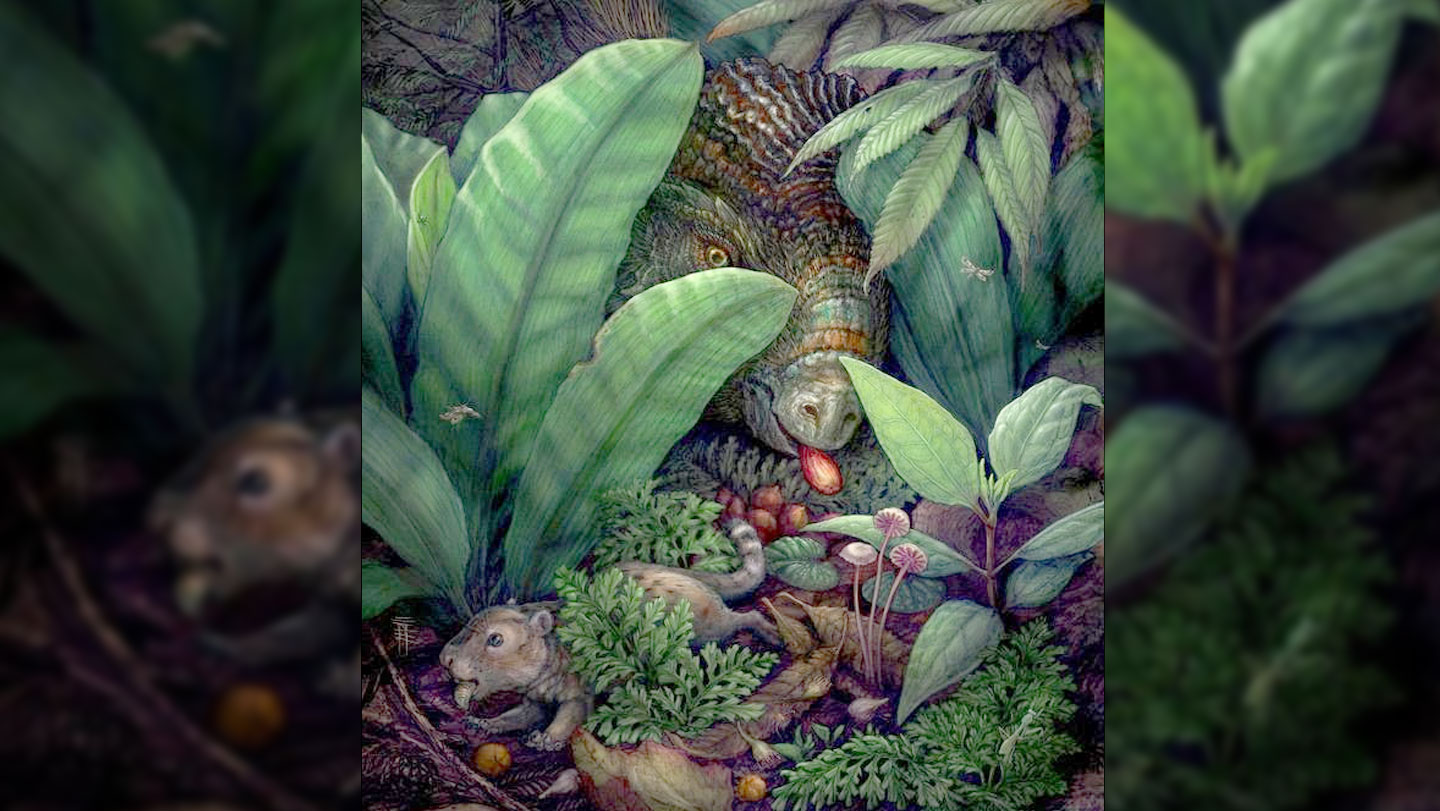
Imagine taking a stroll through a forest 74 million years ago. In our collective imagination, dominated by movies and classic museum murals, this prehistoric landscape is often depicted as a sterile, monolithic world of survival—a dense, humid jungle of towering conifers, giant cycads, and primitive ferns painted in dull shades of green and brown. Yet, groundbreaking new research invites us to re-envision this ancient wilderness with a splash of unexpected color and sweet aroma. Picture a Cretaceous sky, busy with flying reptiles, but look down at the branches below: they are heavy with fleshy, blueberry-sized fruits, while the forest floor is scattered with fallen seeds waiting to sprout. The air would have carried a distinct sweetness, rich with the young smells of the world’s very first orchards. This was not a harsh, barren wasteland, but a complex, cooperative ecosystem where some of the world’s most famous dinosaurs may have regularly treated themselves to prehistoric fruit salads. A comprehensive analysis of fossilized plant remains suggests that the delicate, symbiotic relationship between fruit-bearing plants and the hungry animals who disperse their seeds did not wait for the post-asteroid era to begin; it was already thriving millions of years before the dinosaurs met their sudden, dramatic end.
This discovery, published in the renowned journal Science, radically upends decades of scientific consensus regarding the history of life on Earth. Historically, the evolutionary timeline of flowering plants—known to botanists as angiosperms—was framed as a slow, conservative struggle during the Mesozoic era. For generations, paleontologists believed that these early flowering varieties were evolutionary minor players, relying almost exclusively on the wind, water, or other passive physical forces to carry their seeds across the primeval landscape. According to this long-held theory, angiosperms only truly came into their own after a massive asteroid struck the Yucatan Peninsula 66 million years ago, triggering a mass extinction that wiped out all non-avian dinosaurs and paved the way for the Age of Mammals. In this post-apocalyptic theater, mammals and birds supposedly took center stage, and plants responded by rapidly evolving delicious, fleshy fruits to entice these new warm-blooded companions to carry their seeds far and wide. This neat, linear narrative suggested that the vibrant, modern forests we rely on today were a relatively recent evolutionary invention. However, paleoecologist Jaemin Lee of the University of California, Berkeley, and his coauthors have shattered this assumption, proving that the botanical stage was set long before the curtains closed on the dinosaurs.
The material proof behind this paradigm shift is as remarkable as it is delicate, resting on a meticulous analysis of fossilized “diaspores”—the scientific term for the reproductive units of a plant, such as fruits and seeds, that are designed to be dispersed. Between 1992 and 2016, dedicated teams of paleontologists working in the arid flatlands of south-central New Mexico uncovered an extraordinary botanical archive buried deep within a layer of ancient volcanic ash. This ash had acted as a natural time capsule, falling softly over the prehistoric forest floor and sealing fragile organic structures away from air, decay, and the crushing weight of geological time. Over nearly a quarter-century of careful excavation, researchers collected 450 distinct plant specimens from this volcanic bed. When Lee and his team carefully examined the fossils, they discovered an astonishingly diverse community of plants, distinguishing nearly 80 unique shapes and sizes among the fossilized seeds and fruits. While some specimens featured elegant, paper-thin wings designed to catch the thermal drafts of the Late Cretaceous, more than a third of the fossils were identified as fleshy, berry-like fruits. The largest of these long-lost treats were roughly the size of small dates. Lee recalled that standing over the stone slabs, looking at clusters of these plump diaspores huddled together, felt exactly like looking at modern trays of fresh grapes or bowls of pistachios, connecting our modern culinary experiences directly to a landscape frozen in stone.
This abundance of soft, sugary fruits immediately raises a captivating ecological question: who, exactly, was eating this ancient buffet? In our modern world, the relationship between fruiting plants and animal life is one of nature’s most beautiful partnerships; plants invest massive amounts of energy into producing sweet, nutritious outer coatings, and in return, animals consume the fruit and deposit the resilient seeds elsewhere, often packed with a natural dose of fertilizer. The striking physical similarities between these 74-million-year-old diaspores and modern berries strongly suggest that Cretaceous animals were active participants in this very same ecological dance. Long before modern herds of mammals occupied the plains, a diverse and busy cast of ancient creatures was likely maintaining the health of these forests. Small, rodent-like mammals rustling under the leaf litter, flying pterosaurs nesting high in the branches, and early Cretaceous birds—which were already beginning to diversify—likely relied on these early angiosperms for vital energy. Even formidable, herbivorous dinosaurs, known to have eaten the tough, fibrous seeds of conifers, may have eagerly adjusted their foraging habits to enjoy these soft, calorie-rich treats as they became more abundant. While matching specific extinct animals to their favorite fruits is an ongoing challenge, previous discoveries of fossilized dinosaur dung—rich with digested seed armor—provide tantalizing evidence that prehistoric vertebrates regularly ingested these plants, even if identifying the exact culprit behind a piece of fossilized poop remains one of paleonotology’s most notoriously difficult tasks.
This exciting botanical revelation does not stand alone; instead, it harmonizes perfectly with broader, emerging patterns of how angiosperms behaved during the Late Cretaceous. As paleobotanist Selena Smith from the University of Michigan in Ann Arbor points out, flowering plants during this epoch were undergoing a fascinating, rapid structural revolution. They weren’t simply inventing new ways to reproduce; they were actively redesigning their leaves to photosynthesize more efficiently, growing larger, developing complex root and vascular networks, and diversifying their physical shapes to outcompete older plant lineages. In this light, the sudden appearance of elaborate, animal-dependent fruits is not a bizarre anomaly, but a highly logical step in a broader botanical upgrade. As plants became more efficient at capturing sunlight and water, they finally had the excess energy required to build sugary, wasteful-looking structures like berries to bribe the local wildlife. Prior to Lee’s study, the fossil record for large, fleshy fruits from the Cretaceous was frustratingly sparse, leading many scientists to assume that the ancient forest floor was a quiet, uninviting place for any creature looking for a quick, sugary meal. Thanks to the New Mexico ash bed, we can now see that the evolutionary foundations of our modern, dense, canopy-dominated forests were laid down much earlier, under the very feet of the dinosaurs.
As researchers absorb these dramatic findings, they are already looking to the horizon, eager to find out just how widespread these ancient fruit forests really were. Brian Atkinson, a paleobiologist at the University of Kansas who was not involved in the original study, emphasizes that the next critical phase of research must involve surveying other Late Cretaceous geological sites around the world. Confirming that these massive, fleshy fruits were a global phenomenon rather than a isolated peculiarity of the New Mexico peninsula would permanently rewrite our handbooks on ancient ecology. This study serves as a beautiful, humbling reminder of how much of our planet’s deep history remains quietly sleeping beneath the surface, waiting for the right blend of patience, luck, and volcanic ash to bring it to light. Ultimately, this research humanizes a deep, cold past, transforming our picture of the ancient world from a place of relentless, alien violence into an environment that harbored quiet pockets of surprise, sweetness, and ecological partnership. It reminds us that the simple warmth of eating a handful of fresh fruit is not a modern human privilege, but a beautiful, shared legacy that connects our breakfast tables to the wild, extraordinary creatures of a lost world.