

For as long as humans have lived in mountainous regions, the sudden rumble of an earthquake has been a herald of danger. The ground shakes, and moments later, the sound of rocks tumbling down a cliff face follows, a chaotic symphony of gravity and fractured stone. This is a familiar story on Earth, but a new chapter of this planetary narrative has been written on Mars. For the first time, scientists have found compelling evidence that earthquakes on the Red Planet, known as marsquakes, are also powerful enough to send massive boulders cascading down hillsides. This discovery offers a fascinating new way to understand seismic activity not only on Mars but potentially across other rocky worlds in our solar system. The research, which is currently reshaping our understanding of the Martian surface, provides a tangible, visible connection between the planet’s deep interior rumblings and its ever-changing exterior landscape.
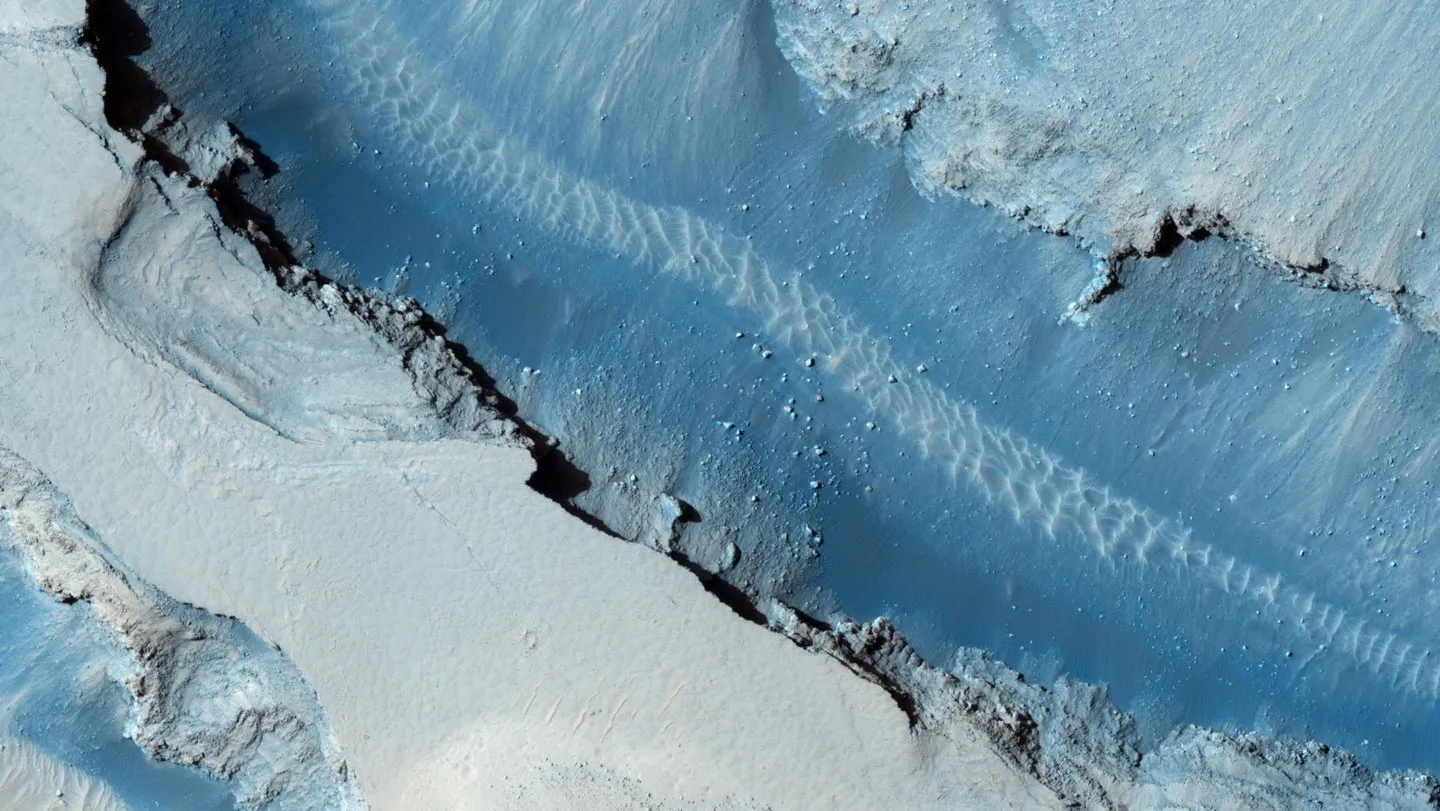
The finding came from an unlikely but brilliantly effective source: a seismometer that was stationed on the Martian surface for four years as part of NASA’s InSight lander mission. Since its touchdown in 2018, InSight has acted as the Red Planet’s first dedicated listening post, detecting over a thousand marsquakes. Many of these were traced back to a particularly dynamic and fractured region known as Cerberus Fossae, a long and complex system of troughs and fissures located just north of the Martian equator. This area is a geologist’s paradise, a landscape riddled with steep slopes, dramatic cracks, and a legacy of movement. It was here that researchers from the Physical Research Laboratory in Ahmedabad, India, began to notice something extraordinary while sifting through high-resolution imagery of the region. When they compared pictures taken over time, they saw a striking number of new, dark lines scarring the dusty slopes—the unmistakable signature of boulders that had been violently dislodged from their resting places.
The trigger for these impressive rockfalls appears to have been a specific marsquake recorded in July 2019, a significant temblor that originated just a few tens of kilometers from Cerberus Fossae. This quake was one of the most powerful detected by the InSight lander, and its seismic waves traveled outward, shaking the fragile Martian regolith. By meticulously comparing satellite images of the region taken in June 2019 and December 2020, the research team identified an astonishing 27 new boulder tracks. Each of these tracks is a complex structure, composed of dozens or even hundreds of individual marks left by boulders as they bounced, rolled, and carved their way down slopes. The very existence and incredible number of these new features showed that the ground had been violently agitatedBERKELEY, shaking the landscape like a rug being snapped clean of dust, sending whatever would come loose tumbling downhill.
What makes this discovery even more remarkable is the sheer scale of the event when compared to the region’s typical background activity. In the past, scientists had used extensive historical imagery to calculate a baseline rate of change for Cerberus Fossae. Their statistics suggested that only about two new boulder tracks would form in a year, a low rate of geological change that painted a picture of a relatively static, though geologically active, area. To find 27 brand-new structures in a span of just 18 months was entirely unexpected. It was a dramatic and sudden surge of activity that pointed to a single, powerful catalyst. The researchers concluded that the July 2019 marsquake was almost certainly the culprit, a colossal event that jolted the region with enough force to trigger a widespread cascade of rockfalls across a wide area
While the evidence points to a seismic cause, the event has also presented scientists with a compelling mystery. The 27 new rockfalls did not appear randomly across the landscape; they were all located on the north side of one of the prominent valleys that slice through Cerberus Fossae. This is puzzling because there are actually more boulders available to move on the southern slopes of the valley. If the marsquake was a simple, uniform shaking, you would expect landslides to occur wherever boulders were plentiful secret. The team is honest about their confusion, with one planetary scientist, Vijayan, stating plainly, “That puzzles us.” The likely explanation, they suggest, is that the complex geology of the region, with its faults, fractures, and varying rock densities, acts as a lens for seismic waves. The shaking from the quake doesn’t just spread out as a simple, uniform pulse; it is refracted, reflected, and channeled, causing some areas to shake with far greater intensity than others. The Martian crust is not a dull, uniform block, but a complex patchwork that dictates exactly where the energy of a quake will be felt most profoundly.
The ability to detect and analyze these boulder falls as a proxy for strong seismic shaking has profound implications for future exploration and even human settlement on other worlds. Seismic data is notoriously difficult to collect across the solar system, as it requires placing sensitive instruments directly on the surface of a planet or moon, a costly and technically challenging endeavor. However, as this study demonstrates, you don’t always need a seismometer to know where the ground has been badly shaken. You just need to watch how the landscape responds. The presence of fresh boulder tracks can act as a permanent, visible record of past seismic activity, effectively serving as a planetary-scale warning sign. As humans venture further out into the cosmoscars, this knowledge will be invaluable for site selection. Just as we wouldn’t build a major city on an Earthly fault line without proper engineering, we can look for boulder tracks on Mars or other worlds to identify zones that are seismically active and hazardous. These tumbling rocks are far more than just geological curiosities; they are silent sentinels, providing critical insight into the hidden forces that shape the surface of planets beyond our own. They whisper a clear message from the depths: the ground beneath your feet may not be as still as it seems.