






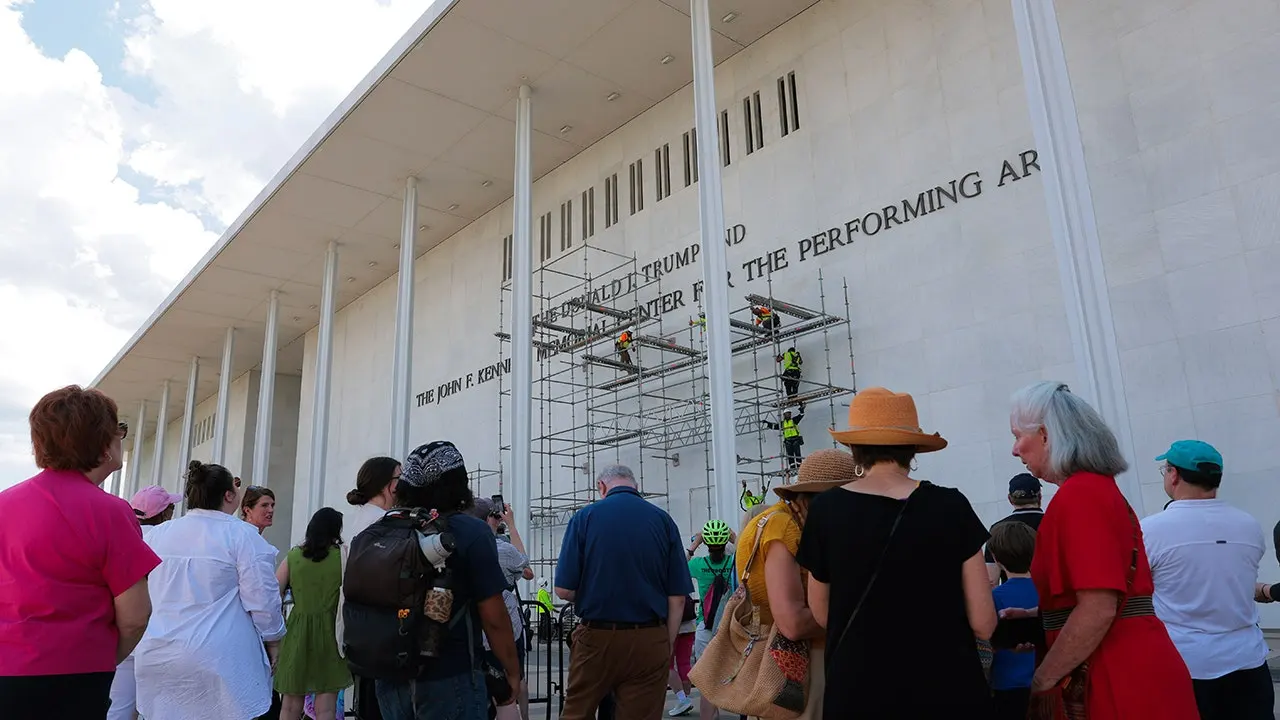
On a humid Friday morning in Washington, D.C., the air around the Potomac River was filled not with the soaring melodies of a symphony, but with the harsh, metallic clanging of construction. Passersby and tourists paused along the plaza of the John F. Kennedy Center for the Performing Arts, watching as workers in hard hats and safety harnesses carefully erected a web of metal scaffolding against the building’s pristine white marble facade. Armed with crowbars, drills, and heavy-duty adhesive removers, these laborers began the delicate, highly visible task of dismantling a legacy written in brass. One by one, letters were unbolted and lowered to the ground, systematically dissolving the newly minted title: “The Donald J. Trump and John F. Kennedy Memorial Center For The Performing Arts.” For the workers executing the physical labor, it was simply another demanding shift under the watchful eyes of the capital’s press corps; for the nation, however, the scene served as a stark, visceral illustration of America’s deeply fractured political and cultural landscape, where even the sanctum of the performing arts cannot escape the gravity of partisan warfare.
To understand how these two wildly contrasting political figures came to share top billing on one of the nation’s most prestigious cultural institutions, one must look back to the quiet, highly controversial maneuverings of the Kennedy Center’s board of trustees the previous December. In a surprise, unanimous vote, the board had approved a sweeping resolution to permanently alter the name of the historic building, arguing that the former president deserved lasting physical recognition for his administration’s massive financial intervention. According to the board’s public arguments, Trump’s legislative and executive actions had effectively rescued the legendary institution from “financial ruin and physical destruction” during a period of unprecedented economic hardship brought on by prolonged pandemic closures. Almost overnight, the workers had arrived to affix the bold, gilded letters bearing Trump’s name to the exterior wall, igniting an immediate firestorm of public outrage, artistic protests, and deep internal division. To supporters, the renaming was a well-deserved tribute to a leader who kept the lights on in America’s premier cultural living room; to detractors, it felt like an existential desecration of a monument originally built to honor a slain young president who championed the timeless, apolitical nature of human creativity.
The administrative euphoria of the board was short-lived, however, as the renaming quickly ran headfirst into a formidable legal roadblock in the form of U.S. District Judge Christopher Cooper. In a meticulously argued opinion, Judge Cooper issued a decisive ruling declaring that the Kennedy Center’s designation was not a mere branding asset to be bartered or modified at the whim of an appointed board of trustees, but rather a national monument created, funded, and named by an explicit act of Congress. Cooper maintained that under federal law, the board had grossly exceeded its administrative authority, asserting that only the legislative branch has the constitutional power to alter the name of a federally chartered institution honoring John F. Kennedy. The legal reality was stark: no matter how much money a president helped secure, and no matter how unanimous a board’s vote might be, they could not bypass the democratic process to carve a new name into the bedrock of American history. The ruling reestablished a firm boundary between temporary political gratitude and the permanent, legislated memory of the nation, effectively ordering the immediate removal of the newly installed signage.
Refusing to accept defeat without a fight, the Kennedy Center’s board launched a frantic, multi-front legal counteroffensive in a desperate bid to keep the Trump name on the building while they pursued a formal appeal. Their legal team filed a flurry of motions, including an immediate administrative stay and a stay pending appeal, passionately arguing that removing the physical letters before a higher court could fully review the merits of the case would cause irreparable harm, confusion, and unnecessary financial expenditure. They urged the courts to grant a temporary pause, hoping that a sympathetic panel of judges would look favorably upon the board’s original intent to honor their financial savior. Yet, the legal machinery operated with cold, uncaring efficiency; Judge Cooper flatly denied the board’s request for a stay on Friday morning, and a three-judge panel of the U.S. Court of Appeals for the D.C. Circuit swiftly followed suit, turning down an emergency motion for administrative relief. With their legal avenues exhausted and the courts refusing to grant them even a temporary reprieve, the board was left with no option but to watch as the physical undoing of their controversial December decision commenced in broad daylight.
The swift legal defeat did not sit well with Donald Trump, who took to his social media platform, Truth Social, to launch a blistering, deeply personal assault on the integrity of the judicial process and those who orchestrated the name’s removal. In an angry late-May tirade, Trump accused Judge Cooper of being a partisan actor, referring to him as a “Trump Hating Judge” and suggesting, without evidence, that the ruling was influenced by the political leanings of the judge’s wife, Amy Jeffress. By pointing out that Jeffress had served as a high-ranking Department of Justice attorney during the Obama administration and had legally represented several prominent critics of his presidency, Trump sought to frame the legal dispute not as a matter of statutory interpretation, but as a coordinated, corrupt hit job by the Washington establishment. This public broadside transformed a dry, technical dispute over administrative law into a highly personalized grievance, rallying his loyal base and highlighting the deep-seated skepticism that many Americans hold toward the perceived impartiality of the federal judiciary.
As the sun began to set on the Washington skyline, the scaffolding remained in place, a temporary metal scar on a building designed to symbolize the unifying power of human expression. With the controversial letters finally dismantled and packed away into storage boxes, the facade of the Kennedy Center slowly returned to its original, familiar state, leaving behind only faint outlines where the brass once clung to the marble. This brief, turbulent chapter in the history of the monument serves as a powerful reminder of how modern political polarization can effortlessly swallow even our most sacred cultural sanctuaries, turning places of artistic refuge into battlegrounds for national identity. While the legal papers are filed away and the political rhetoric eventually cools, the empty space on the wall stands as a quiet testament to a fragile truth: in a democracy, the names we choose to carve into our national monuments are not merely administrative decorations, but enduring statements of our collective values that cannot be easily rewritten by the shifting winds of political fortune.