






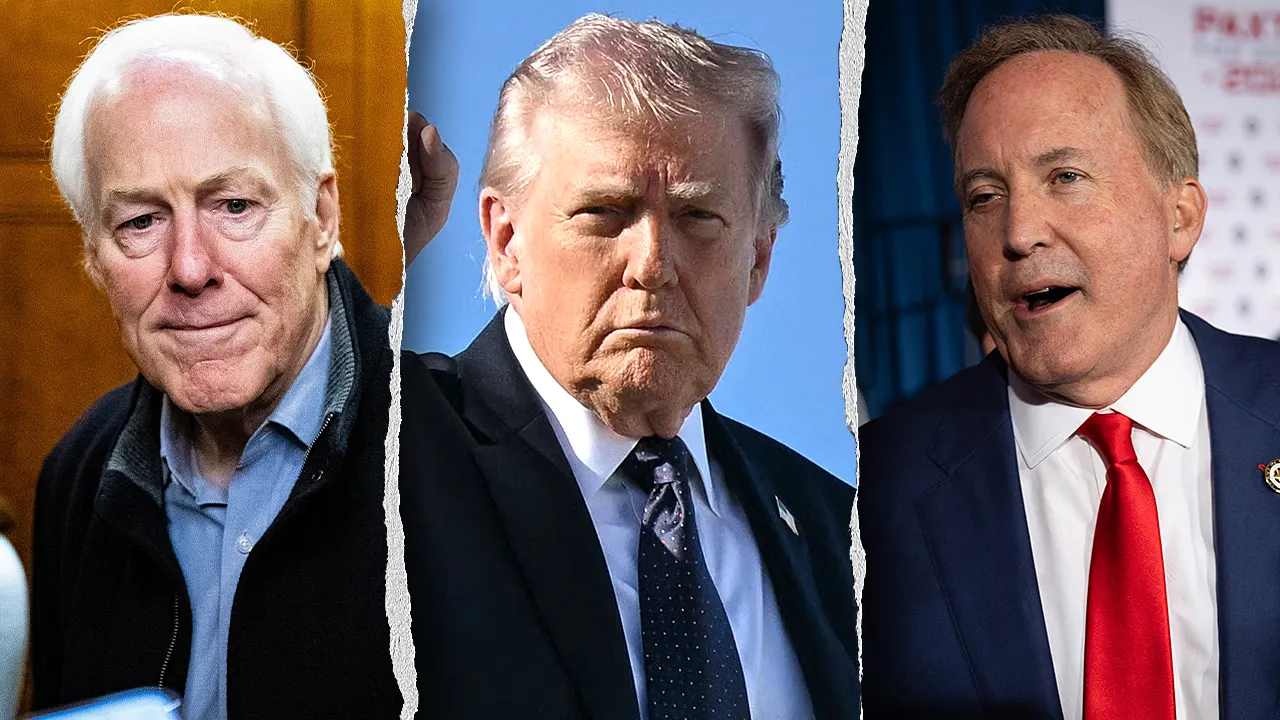
Texas politics has always been characterized by its outsized personalities, fierce independence, and zero-sum power struggles, but the current Republican primary runoff has transformed the Lone Star State into a high-stakes arena for the very soul of the GOP. At the absolute center of this political maelstrom is former President Donald Trump, who has unleashed his formidable rhetorical arsenal against one of the state’s most enduring conservative figures, Senator John Cornyn. This is no ordinary intra-party squabble; it is a meticulously choreographed loyalty test designed to signal to the entire nation who truly commands the Republican fortress. Trump’s endorsement of Texas Attorney General Ken Paxton—a polarizing figure who embodies the combative, anti-establishment ethos of the MAGA movement—serves as a direct challenge to Cornyn’s long-standing leadership brand. For years, Cornyn has navigated the delicate corridors of Washington with a quiet, institutionalist pragmatism, but in the modern Republican landscape, pragmatism is increasingly viewed through the lens of betrayal. Trump’s public denunciation of Cornyn as “VERY disloyal” lays bare a deep-seated grievance, stemming from the senator’s perceived hesitation to fully back the former president’s legal and political crusades. By elevating Paxton, a controversial figure who has consistently weaponized his office to fight culture-war battles, Trump is testing whether personal fealty to him outweighs decades of quiet legislative work. The stakes could not be higher for the national balance of power, as the winner of this exhausting Republican runoff will go on to defend a seat that is absolutely crucial to maintaining the GOP’s razor-thin control of the U.S. Senate. This high-tension matchup is not merely a localized clash, but a macrocosm of the broader struggle playing out across the United States, where traditional conservative values are being systematically stress-tested against the raw, emotional force of personal loyalty.
To understand the sheer animosity of this primary runoff, one must look at the stark contrast between the two men vying for the hearts of Texas voters: the polished, collaborative John Cornyn versus the embattled, defiant Ken Paxton. Cornyn, who has consistently pointed out that his voting record aligned with Trump’s agenda over ninety-nine percent of the time, finds himself in the bizarre position of having to defend his conservative credentials to a base that seems to value rhetorical aggression over policy metrics. He represents an older era of Texas conservatism—one built on steady governance, strategic alliances, and party discipline—backed by Senate Majority Leader John Thune and the well-funded machinery of the National Republican Senatorial Committee. On the other side of the dividing line stands Paxton, an attorney general whose political career reads like a dramatic legal thriller, complete with indictments, a high-profile state senate impeachment trial from which he narrowly escaped, and a highly publicized, deeply messy divorce fueled by allegations of personal indiscretion. Yet, rather than destroying his political viability, these compounding scandals have seemingly forged Paxton into a martyr figure for the hard-right grassroots, who view his legal troubles not as evidence of corruption, but as proof of a weaponized “deep state” trying to silence a true warrior. Paxton has masterfully flipped the narrative, accusing Cornyn of being weak on border security, hostile to Trump’s border wall, and out of touch with the populist anger that fuels modern Republicanism. This dynamic has left Texas voters grappling with a profound ethical and strategic choice: do they choose a battle-tested, scandal-free statesman who understands the levers of federal power, or do they embrace a defiant disruptor whose legal baggage might cost the party dearly in a general election but whose ideological purity remains beyond question for the MAGA faithful?
While the Republican candidates tear each other apart in a primary of mutually assured destruction, a quiet storm is gathering on the Democratic side in the form of State Representative James Talarico, a charismatic rising star who represents the changing face of Texas. Unlike progressives who rely solely on ideological firebrands, Talarico has cultivated a reputation as a thoughtful, eloquent leader capable of synthesizing progressive ideals with a deeply moral, often faith-based vocabulary that resonates with moderate and independent voters. After defeating the highly visible progressive Jasmine Crockett in a high-stakes March primary, Talarico has positioned himself as a formidable challenger, raising a stunning twenty-seven million dollars in just the first quarter of the year. This financial juggernaut has sent shivers down the spines of pragmatic Republican strategists like Cornyn, who warns that if the scandal-ridden Paxton wins the GOP nomination, it will open the floodgates for an unprecedented avalanche of national Democratic funding designed to flip the Texas Senate seat. Cornyn’s electability argument is simple yet urgent: he won his last general election by an impressive ten percentage points, proving he can appeal to the moderate suburbanites who have increasingly drifted away from the more extreme elements of the Republican Party, whereas a Paxton nomination would drag the entire down-ballot ticket into a defensive quagmire. Paxton, however, has already begun shifting his campaign apparatus to target Talarico directly, attempting to paint the young Democrat as a radical leftist whose policies would destroy the Texas miracle of low taxes and economic growth. This general election preview highlights the existential anxiety felt by everyday Texans, who are watching their state’s historic political identity hang in the balance, caught between the gravity of a shifting demographic landscape and the fierce resistance of a deeply entrenched conservative ideology.
The ideological civil war within the Texas GOP is not limited to the Senate race; indeed, the down-ballot primary runoff for Texas Attorney General has devolved into an equally bitter, incredibly expensive proxy war that questions what it truly means to be a conservative in the modern era. Here, Representative Chip Roy, a cerebral and fiercely independent conservative heavyweight who serves as a former chief of staff to Senator Ted Cruz, is locked in a brutal combat with State Senator Mayes Middleton, a wealthy oil executive who has poured seventeen million dollars of his personal fortune into his campaign. This race has transcended standard policy debates to become a deeply personal conflict over authenticity and political pedigree, with Roy showcasing his extensive courtroom experience as a former prosecutor and assistant attorney general to argue that he is uniquely qualified to lead the state’s legal battles on day one. Middleton, meanwhile, has leveraged his immense wealth to saturate the airwaves with ads accusing Roy of being a “traitor” to the MAGA cause, pointing to moments when Roy broke with Donald Trump on specific constitutional principles and policy votes. Roy has responded with characteristically sharp rhetoric, arguing that conservative convictions cannot be bought with an inheritance and that his long, documented history of fighting for fiscal discipline and border security speaks louder than any expensive television ad campaign. This clash exposes a critical fissure in the contemporary conservative psyche: is adherence to the “America First” movement defined by uncritical, absolute loyalty to a single leader’s directives, or does it belong to those who independently fight for constitutional principles even when it occasionally rubs the head of the party the wrong way?
As the major statewide races dominate the headlines, the congressional runoffs are producing their own share of jaw-dropping drama, nowhere more vivid than in the newly redrawn, majority-Latino 35th Congressional District. In the Democratic runoff, what should have been a standard debate over local representation has exploded into national controversy due to shocking social media posts by housing activist and sex therapist Maureen Galindo. Galindo sparked widespread outrage across the political spectrum by suggesting that an ICE detention center should be converted into a prison to house American supporters of Israel, adding a graphic and highly controversial proposal for a castration facility aimed at pedophiles, who she bizarrely claimed would likely include most Zionists. These extreme remarks, combined with her accusations of treason against her moderate opponent, Bexar County Sheriff’s Deputy Johnny Garcia, have created a rare moment of absolute alignment among establishment Democrats, progressive champions like Alexandria Ocasio-Cortez, and state-level leaders who have all rushed to endorse Garcia in an effort to contain the political damage. This frantic effort to distance the Democratic Party from such radical, fringe rhetoric highlights the delicate tightrope that party leadership must walk in a state where demographics are shifting but voters remain culturally conservative on many fronts. For everyday voters in this district, the race has transformed from a debate about economic opportunity and local infrastructure into a referendum on basic public decency, highlighting how nationalized culture-war rhetoric can distort and derail local political discourse.
As Texans head to the ballot box to settle these deeply contentious contests, the entire state political map is being aggressively redrawn by partisan forces and personal rivalries, setting the stage for a dramatic general election that will test the absolute limits of party loyalty. From the highly competitive, Houston-based 18th District where veteran lawmaker Al Green faces a spirited challenge from a younger generation represented by Christian Menefee, to the newly drawn 9th District where a proxy battle between a Trump-backed veteran and an Abbott-backed state representative is playing out, the sheer complexity of these races reflects a state in a deep transitional phase. These runoffs are no longer just about choosing candidates; they are high-stakes negotiations over the direction of Texas, determining whether the state will continue down a path of uncompromising, nationalized populist warfare or return to a more traditional form of pragmatic, localized conservatism. In the end, the ultimate power rests not in the hands of endorsement-issuing former presidents in distant resorts or wealthy self-funders with millions to burn, but with the independent-minded people of Texas who must decide what kind of leadership they want to project to the rest of the country. As the dust settles on Tuesday, the results will provide a definitive, raw, and human answer to whether the Republican brand in Texas has been permanently transformed in Donald Trump’s image, or if the independent streak of Texas voters remains a force capable of charting its own distinct path.