






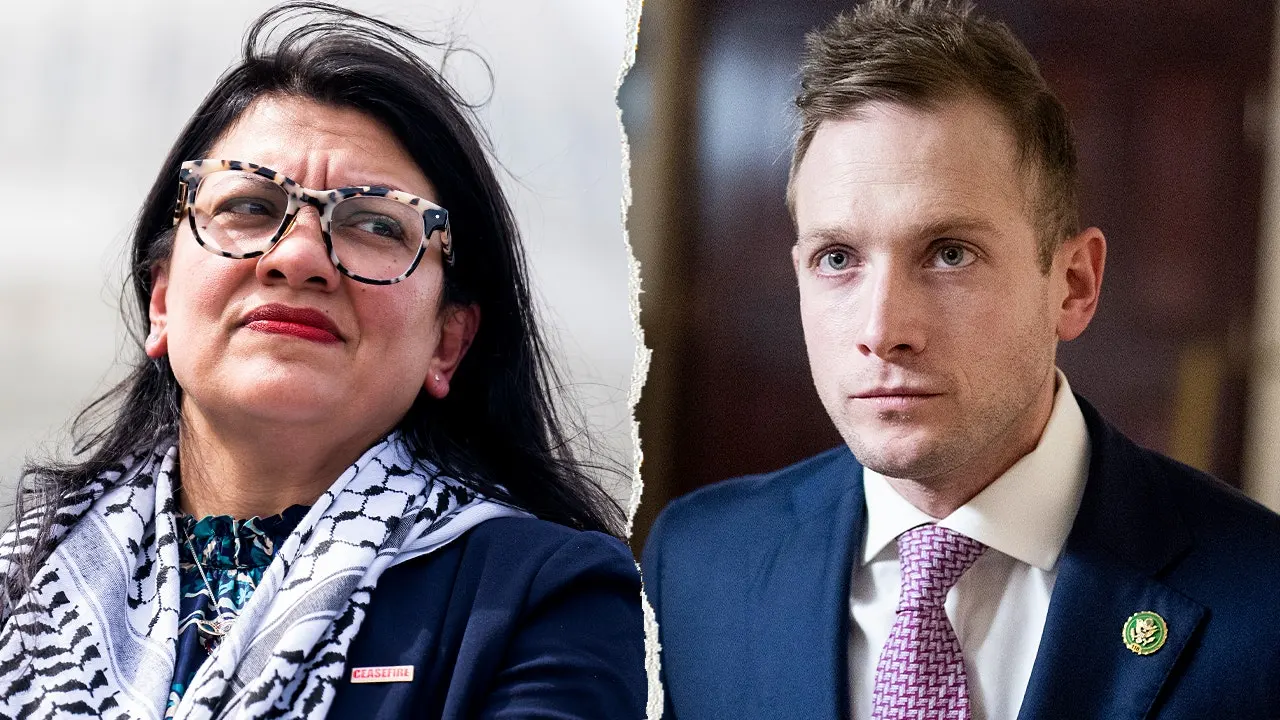
On a seemingly routine Wednesday evening, the historic chamber of the United States House of Representatives transformed from an orderly room of debate into a chaotic coliseum of raw human emotion, exposing the deep-seated polarization that governs modern American politics. What began as a highly charged foreign policy debate over a resolution regarding U.S. military involvement in Lebanon quickly degenerated into an intensely personal confrontation that shocked onlookers, silenced the chamber, and froze legislative proceedings. The catalyst for this dramatic breakdown was a fiery speech by Representative Max Miller, a Republican from Ohio, who stood before his peers and launched a direct, blistering assault on the character of Representative Rashida Tlaib, a Michigan Democrat and prominent member of the progressive coalition known as “the Squad.” Miller did not mince words, accusing Tlaib of harboring sympathies for, and maintaining associations with, violent extremist factions, most notably Hezbollah—the heavily armed, Iranian-backed militant group designated as a foreign terrorist organization by the United States government. The gravity of such an accusation on the House floor cannot be overstated; it was not merely an attack on Tlaib’s legislative agenda, but a direct challenge to her loyalty to the nation, her moral standing, and her integrity as an American lawmaker. In an instant, the clinical atmosphere of C-SPAN broadcasts was replaced by an electric, volatile tension, as lawmakers from both sides of the aisle began shouting over one another, signaling a profound shift from political disagreement to outright personal warfare. The echoing arguments and visceral defensiveness displayed in those chaotic minutes served as a stark reminder that the violent, complex proxy wars of the Middle East are no longer distant foreign policy abstractions, but deeply personal domestic battlegrounds that can instantly ignite the tempers of the people elected to lead the American republic.
At the heart of this intense parliamentary blowup was a legislative push spearheaded by Representative Tlaib, designed to force President Donald Trump to withdraw all United States military personnel currently stationed in Lebanon. Tlaib, a Palestinian-American whose identity and political career have been defined by her outspoken advocacy for marginalized communities in the Middle East, sought to bring the resolution to a high-profile floor vote on Thursday. From her perspective, the measure was a matter of urgent humanitarian concern and moral clarity, intended to prevent the United States military from being dragged into, or indirectly supporting, Israel’s escalating military campaign against targets in Lebanon. Tlaib argued passionately that American resources and personnel should not be weaponized to facilitate foreign wars that inflict devastating civilian casualties. However, the resolution itself contained a glaring omission that instantly drew the ire of her political opponents: it made absolutely no mention of Hezbollah, the very group whose rocket barrages had catalyzed the conflict with Israel. For House Republicans, this omission was not an oversight, but a deliberate and deeply troubling political statement. GOP lawmakers seized on the silence regarding Hezbollah, arguing that removing American troops from the region would create a hazardous security vacuum that would directly benefit the terrorist group. In their view, by advocating for a complete U.S. military withdrawal while refusing to explicitly condemn Hezbollah, Tlaib and her progressive co-sponsors were effectively acting as civilian accomplices or legislative proxies for the militant organization, a narrative that framed the policy debate not as a disagreement over peace, but as a struggle between national security and terrorist enablement.
The escalating rhetoric reached a shocking peak when Representative Miller leaned into his microphone to deliver a highly provocative barb that cut through the legislative noise. “Hezbollah is a terrorist organization… and its members are butchers that you like to hang out with to a certain extent,” Miller asserted, looking directly toward Tlaib. The intensely personal nature of the remark immediately shattered the fragile remaining decorum of the chamber. When Tlaib reacted with audible outrage, defending her dignity amidst the escalating hubbub, Miller retorted with a patronizing query, asking, “Are we getting a little emotional?” This rhetorical jab, laden with gendered and cultural undertones, only added fuel to the fire, prompting Tlaib to point a finger and loudly declare Miller’s statements a direct and unacceptable attack on her character. She demanded that the presiding officer, Representative Jay Obernolte of California, immediately rule Miller’s remarks out of order. What followed was a stunning display of legislative paralysis; rather than proceeding with the business of the country, the House floor was effectively frozen for over an hour. As parliamentarians and party leaders huddled in frantic, hushed whispers to consult procedural guides, the quiet tension in the room was palpable, and the steady beating of the gavel did little to calm the anxious lawmakers. Ultimately, Obernolte was forced to deliver a rare and severe sanction, ruling that Miller’s words were indeed out of order and striking them entirely from the congressional record, while banning the Ohio Republican from speaking on the House floor for the remainder of the legislative day.
Despite the strict procedural silencing of Miller, the partisan rancor did not dissipate; instead, it found a new, equally defiant channel through Representative Brian Mast, a Florida Republican and the Chairman of the House Foreign Affairs Committee. Demonstrating the intense, unyielding solidarity that characterizes modern congressional factions, Mast, a wounded combat veteran who lost both legs serving in Afghanistan, took to the podium to speak on his colleague’s behalf, delivering a message of unrepentant boldness that escalated the standoff. “Yes, I said it. I own it, and I stand by it,” Mast declared, broadcasting Miller’s unvarnished sentiments back into the record and demonstrating that many in his party were unwilling to back down from the core rhetorical assault. Mast then attempted to officially enter a series of highly controversial documents into the congressional record to substantiate the allegations against Tlaib, a move that the Michigan Democrat immediately and vigorously blocked. Among these documents was a prominent Fox News Digital investigative report from 2023, which detailed allegations that Tlaib had been an active member of a private, hidden Facebook group wherein users had openly glorified and celebrated the horrific October 7 terrorist attacks carried out by Hamas inside Israel. By attempting to bring this external media report into the official archives of Congress, Mast sought to permanently brand Tlaib with the stigma of terrorist sympathy, while Tlaib’s fierce objections highlighted her ongoing struggle to defend herself against what she and her supporters view as a coordinated, Islamophobic smear campaign designed to delegitimize her advocacy for Palestinian human rights.
Beyond the high-drama theater of personal insults and procedural warfare lay a complex web of genuine geopolitical concerns and real-world stakes that highlight the dangerous disconnect between political posturing and actual military strategy. The Republican opposition to Tlaib’s resolution was grounded in a serious warning about the safety of American citizens and military assets currently on the ground in the volatile Middle East. GOP lawmakers argued that forcing an immediate US military withdrawal from Lebanon would severely compromise the security of the American embassy in Beirut, leaving diplomats vulnerably exposed in a country experiencing intense instability. Furthermore, they pointed out that the small contingent of U.S. forces in Lebanon plays a critical, non-combat role in advising and training the Lebanese Armed Forces (LAF), which serves as the country’s official military and the primary domestic counterweight to Hezbollah’s overwhelming influence. By withdrawing these training missions, critics argued, the United States would essentially be abandoning the Lebanese state, allowing Hezbollah to completely co-opt the country’s security apparatus. This policy dilemma was highlighted during a tense exchange when Chairman Mast directly questioned Representative Delia Ramirez, a progressive Illinois Democrat and co-sponsor of the resolution, asking whether she supported maintaining a U.S. presence to help the Lebanese army fight Hezbollah. Ramirez’s evasive response—insisting that Mast was “having a different debate here”—underscored the immense difficulty progressives face when trying to balance their anti-war principles with the messy, violent realities of regional security and counterterrorism.
As the dust settled on a day of unprecedented rancor, the fate of the controversial resolution became increasingly clear, pointing to a quiet death on the House floor Tuesday and Thursday amidst a wave of bipartisan opposition. Far from uniting the legislature in a grand gesture of peace, the measure has instead served to expose the deep ideological rifts within the Democratic Party itself, leaving party leadership in a precarious position as they weigh progressive anti-war sentiments against mainstream commitments to international security alliances. This legislative episode, rich in personal vitriol but impoverished in collaborative problem-solving, illustrates a tragic truth about the current state of American governance: that the human capacity for empathy, nuance, and constructive debate is increasingly being sacrificed on the altar of hyper-partisan spectacle. While lawmakers on Capitol Hill engage in dramatic shouting matches, use weaponized personal attacks, and parse parliamentary rules of decorum, the actual human beings living in the crossfire of the Middle East conflict continue to face the daily horrors of war without transition or relief. The spectacle in Congress offers no comfort to those on the ground; instead, it serves as a sobering reminder of how easily the immense responsibilities of global leadership can be overshadowed by the pursuit of partisan victory, leaving a deeply disillusioned nation to watch its leaders retreat into their respective ideological bunkers while the world continues to burn.