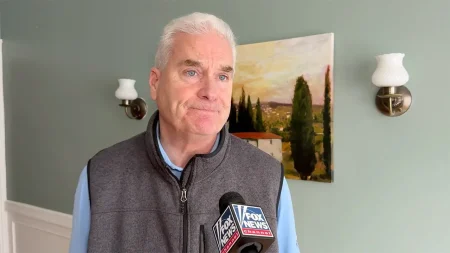






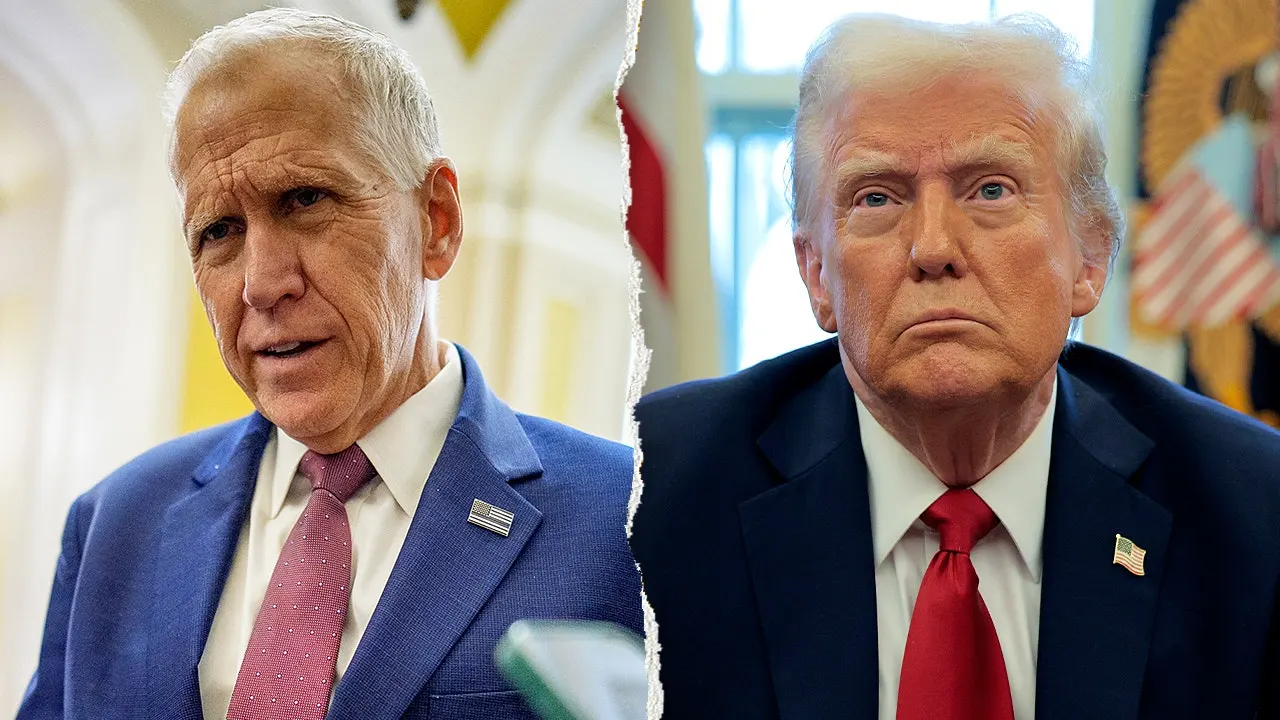
The corridors of power in Washington, D.C., have long been a theater of shifting alliances, but few breakdowns carry as much raw, human drama as the current, deeply personal fracture between Senator Thom Tillis of North Carolina and former President Donald Trump. What started as a standard, pragmatic political partnership during the early days of the administration’s legislative pushes—including the push to pass the president’s key bills—has slowly and painfully devolved into an open, bitter feud that highlights the profound identity crisis currently gripping the modern Republican Party. For Tillis, a traditional conservative who spent decades navigating the often-treacherous and highly polarized waters of North Carolina politics, the decision to step away from the upcoming electoral cycle was not merely a mechanical career transition, but a release valve from an increasingly volatile, unpredictable ideological environment. As he watched the political party he had dedicated his entire adult life to transform under the weight of populist pressure and aggressive rhetoric, his quiet, personal determination to speak his mind without the looming fear of a brutal primary challenge became his ultimate weapon of political survival and moral freedom. The latest chapter in this dramatic political divorce did not unfold in quiet Senate committee rooms, but in the ruthless, unfiltered arena of social media, where decades of public service can be instantly reduced to a hostile, demeaning caricature by a single post. This highly public, embarrassing unraveling represents a larger, systemic anxiety felt by many Senate Republicans, who daily find themselves caught in an agonizing bind between their survivalist loyalty to a dominant populist leader and their constitutional duties to their constituents, the rule of law, and their own personal consciences. It is a deeply human tragedy of political alienation, wherein a sitting, veteran senator feels compelled to warn his colleagues that the erratic, self-serving impulses of their supreme figurehead are actively dismantling their hard-fought chances of maintaining control over the upper chamber of Congress.
The opening salvo of this latest round of public hostilities came directly from Trump’s digital sanctuary, Truth Social, where the former president unleashed a characteristically fierce, personalized, and deeply biting attack on the retiring North Carolina senator. Rebranding Tillis not as a veteran lawmaker who has served with distinction, but as a cowardly “nitpicker” and a “quitter,” Trump sought to rewrite the history of Tillis’s decision to retire, framing it as an act of absolute surrender rather than a principled step back from the brink of modern political madness. According to Trump’s highly personal version of events, the tension between them reached a boiling point when he flatly informed Tillis that he would never, under any circumstances, endorse him for another run at the Senate, claiming that the immense physical and emotional toll of managing Tillis’s constant “drama” was simply too much to bear for the party, mockingly adding that Tillis could not have won the seat anyway. In Trump’s telling, this endorsement denial was the blow that forced the senator to withdraw under the guise of choosing a peaceful retirement. The former president did not hold back his sheer disdain for the media’s portrayal of Tillis as a brave dissenter, mocking the very idea of his courage and instead accusing him of being a cowardly “RINO”—a Republican in Name Only—who was now free to spend his remaining months in office colluding with like-minded internal enemies to actively undermine the party’s collective future out of sheer spite. This public thrashing beautifully illustrates the highly volatile, tribal nature of modern conservative politics, where any deviation from absolute, unquestioning fealty to the party leader is met with total social and professional excommunication, leaving leaders like Tillis to be cast out as saboteurs rather than respected colleagues.
Faced with this digital execution, Tillis chose not to retreat into silent obscurity, but to mount a highly calculated and devastating counteroffensive on the social media platform X, bypassing the usual diplomatic channels to target the very architects of Trump’s latest policy initiatives. Instead of engaging in a direct, undignified shouting match with the former president himself, he cleverly redirected his fire toward the inner circle of advisers who have increasingly steered the administration into deeply controversial waters, effectively arguing that Trump is being led astray by a cabinet of radical ideologues. With rare candor, Tillis systematically dismantled the credibility of these key officials, pointing finger after finger at what he characterized as a series of disastrously un-republican decisions that threaten the core principles of conservative governance. He laid the blame for a highly controversial $1.8 billion “anti-weaponization” fund squarely at the feet of U.S. Pardon Attorney Ed Martin, while accusing Housing Director Bill Pulte of pushing dangerous, fifty-year mortgages and a misguided housing package that threaten the long-term stability of the American housing market. He did not stop there; Tillis targeted Commerce Secretary Howard Lutnick for advocating the state-backed takeover of private companies with taxpayer dollars—a policy fundamentally at odds with traditional free-market capitalism—and took a direct, swipe at War Secretary Pete Hegseth. Tillis accused Hegseth of orchestrating the reckless, politically motivated purge of decorated military brass at the Pentagon and, even more damningly, failing to hold Russian President Vladimir Putin accountable for the horrific atrocities, including rape, kidnapping, and murder, committed against innocent Ukrainian civilians. By proudly declaring that if opposing these radical, un-American deviations from conservative orthodoxy made him a “RINO,” he would gladly and proudly wear the badge, Tillis laid bare his deep frustration with the “stupid stuff” he believes is directly tanking the party’s electoral prospects.
From the perspective of the White House, however, the view is entirely different, framing Tillis’s outbursts not as principled, old-school conservatism, but as the dying gasps of an outdated, establishment political class that utterly fails to understand the raw power and momentum of the populist movement. White House spokeswoman Olivia Wales quickly issued a defiant, polished defense of the administration, painting Trump as the “unequivocal leader,” the best possible messenger, and an unmatched force for conservative victory in modern political history. In a carefully worded statement designed to rally the base and marginalize internal critics, Wales pointed to a list of monumental achievements over the past year, claiming the administration had delivered the most secure border in American history, massive tax cuts for the struggling middle class, and violent crime rates dropping to historic lows. To the White House, the key policy decisions that Tillis and his traditionalist colleagues find so offensive are actually the highly effective, commonsense solutions demanded by an American public weary of standard Washington gridlock and institutional decline. By drawing a sharp, unrelenting contrast with the “radical Democrats” whom they accuse of opening the floodgates of illegal immigration and being notoriously soft on crime, the administration seeks to minimize the gravity of the growing rebellion within their own ranks. For the absolute loyalists in Trump’s orbit, any internal debate, pushback, or request for intellectual consistency is viewed as an unwanted distraction from the ultimate holy war against the political left. This communications strategy effectively places Tillis outside the tent, packaging his legitimate complaints as a betrayal of the working-class voters who put Trump in power. Ultimately, this defense underscores a profound, seemingly unbridgeable chasm between the old guard of the GOP, who value policy details and institutional norms, and Trump’s brand of governance, which operates on instincts, populism, and direct communication with a fiercely loyal voter base.
Yet, beneath the polished press releases and polarized rhetoric lies a very real, consequential governance crisis, epitomized by the explosive controversy surrounding the Department of Justice’s newly established $1.8 billion “anti-weaponization” fund. This specific fund, designed to combat what loyalists claim is a deep-state bias within the federal legal system, has sent shockwaves through the Senate GOP, ultimately derailing crucial, bipartisan efforts to plan and fund vital immigration operations, including securing the borders, hiring patrol agents, and funding ICE for the remainder of Trump’s term. To many seasoned Republican lawmakers, the creation of a massive, poorly defined financial pool with virtually no congressional oversight was an absolute bridge too far, leading to an extraordinary, high-pressure showdown behind closed doors on Capitol Hill. Tillis was among the loudest, most passionate voices in a furious “dogpile” of conservative senators who turned their collective wrath upon Acting Attorney General Todd Blanche during a tense, private meeting on Wednesday where the frustrations of several years of administrative overreach finally boiled over. The intense anger in that room reflected a profound constitutional anxiety that the executive branch was systematically stripping Congress of its fundamental power of the purse to reward political allies, creating a dangerous situation that could easily be weaponized by future administrations of either political party. It was a moment of raw, painful realization for many senators, who saw the very agencies tasked with securing the nation’s borders being starved of essential resources in order to feed a highly ideological, domestic political project that serves a narrow political segment. This closed-door confrontation highlighted how deep the internal rebellion runs, revealing that behind the public unity, many senators fear the political fallout caused by these rogue executive actions.
At the absolute heart of Tillis’s moral outrage is a deeply troubling human question that strikes at the core of the nation’s civic soul: who, exactly, stands to benefit from this multi-billion-dollar fund? In his public statements, Tillis gave voice to a dark, haunting suspicion shared by many of his colleagues—that this “anti-weaponization” initiative could ultimately be used to provide direct financial compensation to the very individuals who attacked Capitol Police officers during the January 6th insurrection. For Tillis, the idea of using hard-working American taxpayers’ money to reward people who pled guilty to committing physical acts of violence against law enforcement officers defending the Capitol is not just bad policy; it is a sickening inversion of the core conservative values of law, order, and personal accountability. “How absurd does that sound coming out of my mouth?” Tillis asked, his words dripping with a mix of raw disbelief, profound anger, and deep sorrow for the state of his party’s moral compass in this new era of populist politics. It is this fundamental clash of principles—the defense of the men and women in uniform who put their lives on the line versus the political rehabilitation of those who sought to halt the peaceful transition of power—that ultimately defines the tragic, human rift between Tillis and the current administration. As the country hurtles toward a high-stakes November election, Tillis’s defiant crusade stands as a powerful, cautionary tale of a seasoned politician trying to save his party from its own self-destructive, populist impulses, even if it means burning down his remaining bridges to do so. Ultimately, his warnings serve as a vital marker of a time when the fight for his party’s soul was waged not just for power, but for basic decency.