





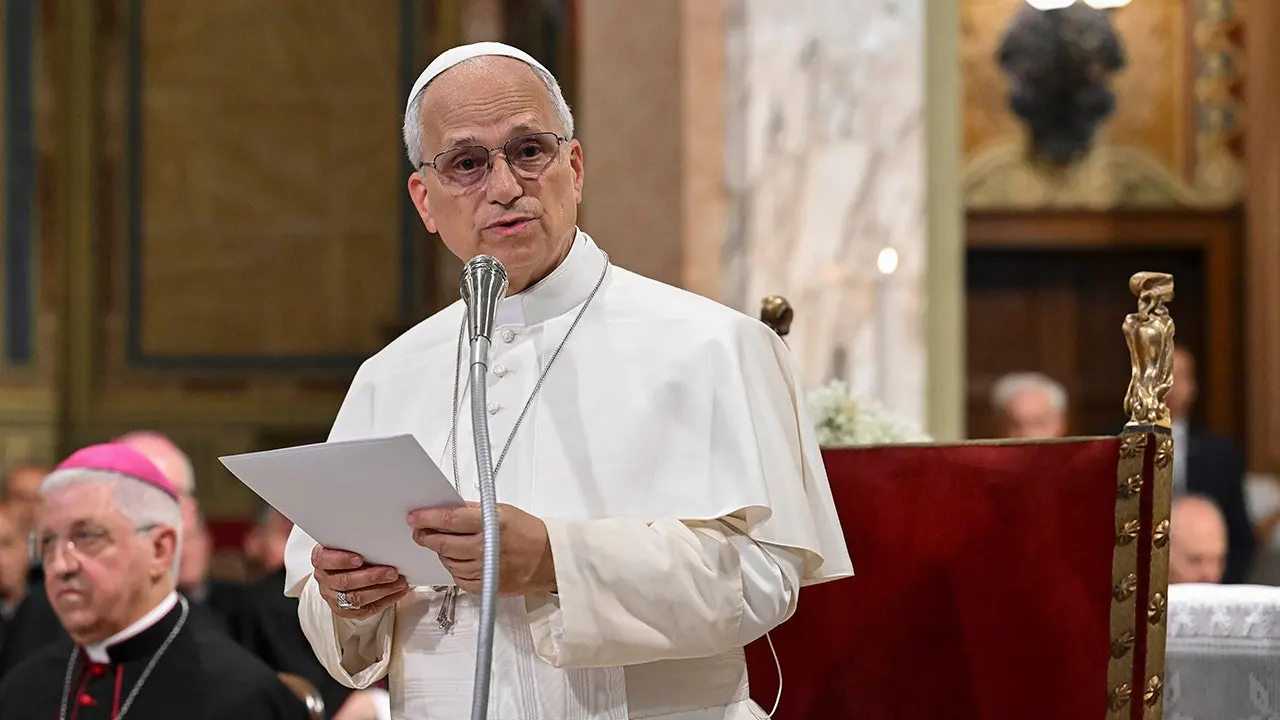
Under the soft, amber glow of twilight in the historic northern Italian town of Sant’Angelo Lodigiano, a quiet but politically charged pilgrimage took place that captured the brewing ideological storm between the Vatican and the White House. Pope Leo XIV, the historic first American-born pontiff, knelt in deep, silent prayer before the tomb of Saint Frances Xavier Cabrini, the patron saint of immigrants. The quiet rustle of rosary beads and the flickering of votive candles offered a sharp contrast to the fierce global debates raging outside the sanctuary walls. For Leo, this visit was not merely a traditional homage to a beloved historical figure; it was a deliberate, deeply personal manifesto. By honoring Mother Cabrini—who left her Italian homeland in the late nineteenth century to spend her life ministering to impoverished immigrants in the crowded tenements of Chicago and New York—the American Pope sought to reframe one of the most polarizing issues of the modern era. In an emotional address to a crowd of young Catholics, Leo spoke with a vulnerability that bypassed rigid dogma, asking what could possibly be more urgent in our current historical moment than a missionary spirit entirely dedicated to welcoming, protecting, and integrating the displaced.
This urgent defense of the marginalized has placed Pope Leo on a direct, highly publicized collision course with the administration of President Donald Trump, drawing a sharp theological line in the sand against the “America First” agenda. As the Trump administration ramped up aggressive immigration enforcement, border walls, and sweeping deportation raids, Leo used his global platform to champion the human beings living in the shadows of these policy decisions. The theological friction reached a boiling point when Leo explicitly and forcefully backed the United States Catholic Bishops in their public condemnation of the administration’s immigration raids, describing the state-sanctioned separation of families and the fear instilled in immigrant communities as “extremely disrespectful” to the basic dignity of the human person. To Leo, these actions are not abstract debates over sovereignty or national security to be played out on cable news; they are moral crises that inflict deep trauma on vulnerable families who migrated simply to survive. While critics in Washington have accused the newly minted Pope of inappropriate political interference, Leo has firmly rejected the label of politician, arguing instead that his fierce defense of migrants is a direct, non-negotiable requirement of the Gospel, rooted in the ancient Christian mandate to welcome the stranger.
To understand Leo’s pastoral heart, one must look to the long shadow of his predecessor, Pope Francis, whose historic pontificate was defined by an unwavering solidarity with the poor. In his evening homily, Leo bridged the past and the present by invoking the memory of Francis, the son of Italian immigrants who fled economic ruin for the shores of Argentina. Leo posed a searching, rhetorical question to the young faithful gathered in the pews: if Mother Cabrini were alive today, what would her missionary heart compel her to do, and what would a Pope like Francis ask of her? By connecting Cabrini’s nineteenth-century mission to Francis’s modern legacy, Leo sought to demonstrate that the defense of immigrants is not a passing progressive trend, but an foundational pillar of the Catholic faith. It is an inheritance of mercy passed down through generations, urging the comfortable to confront the uncomfortable realities of global displacement. This continuity of message serves to remind the world that behind every legal battle and border barricade are living, breathing human beings who share the same hopes, fears, and dreams of safety that drove our own ancestors to cross oceans.
This global vision of compassion was put on vivid display just one week prior, when Leo traveled to Spain’s Canary Islands, a beautiful archipelago that has tragically transformed into a treacherous bottleneck for West African migrants fleeing conflict, climate devastation, and crushing poverty. Standing on the ocean-battered shores where so many makeshift boats have capsized, Leo met with survivors, listening to harrowing stories of survival and loss that rarely make it into political soundbites. In these intimate, emotionally raw encounters, the Pope did not see statistics or security threats; he saw the face of an abandoned humanity. He issued a stern, prophetic warning to world leaders against the soul-crushing tendency to reduce human tragedies to mere numbers on a ledger. Instead, he made an impassioned plea for the creation of “legal and safe pathways” for migration, arguing that when wealthy nations close their legal doors to those in absolute despair, they do not stop migration—they simply condemn desperate families to the deadly perils of the open ocean and the cruel exploitation of human traffickers.
The diplomatic shockwaves of the Pope’s unwavering stance have reverberated through the highest corridors of power, creating palpable tension between the Holy See and Washington. This strain was illustrated by reports that U.S. Secretary of State Marco Rubio, a Catholic himself, was scheduled to hold high-stakes meetings with Vatican and Italian officials in an effort to manage the widening ideological divide. Yet, even as professional diplomats worked behind the scenes to smooth over these disagreements, Pope Leo continued to make quiet, strategic moves that signaled his refusal to back down. Most notably, he appointed a fiercely pro-immigration bishop to head a diocese that includes Palm Beach, Florida—the geographic home of President Trump’s Mar-a-Lago resort. This deliberate appointment sent an unmistakable message that the Catholic Church’s moral authority and pastoral mission will not be compromised or sidelined for political expediency, asserting that the Church’s loyalty belongs to the marginalized, not to the powerful.
In a move packed with immense symbolic weight, the Vatican announced that Pope Leo will make a highly anticipated pilgrimage to the tiny Mediterranean island of Lampedusa on the fourth of July. The choice of the date is a brilliant, provocative piece of pastoral theater: on the very day the United States celebrates its independence and its history as a beacon of liberty for the tired, poor, and huddled masses, its first native-born Pope will stand on a rocky European island that has become both a gateway of hope and a massive graveyard for African migrants. Lampedusa holds a sacred, emotional place in the modern history of the Church, having been the destination of Pope Francis’s very first journey outside Rome in 2013, where he famously begged the world to wake up from the “globalization of indifference.” By choosing this powerful location and date, Pope Leo XIV challenges his own homeland, and indeed the entire Western world, to look into the mirror and ask if they are truly living up to the ideals of freedom and human dignity they so proudly celebrate. Through his tribute to Saint Frances Xavier Cabrini, the Pope leaves us with a hauntingly beautiful reminder that we are all travelers in search of a home, and that our shared humanity will always be far more sacred than the borders we draw to keep each other apart.