






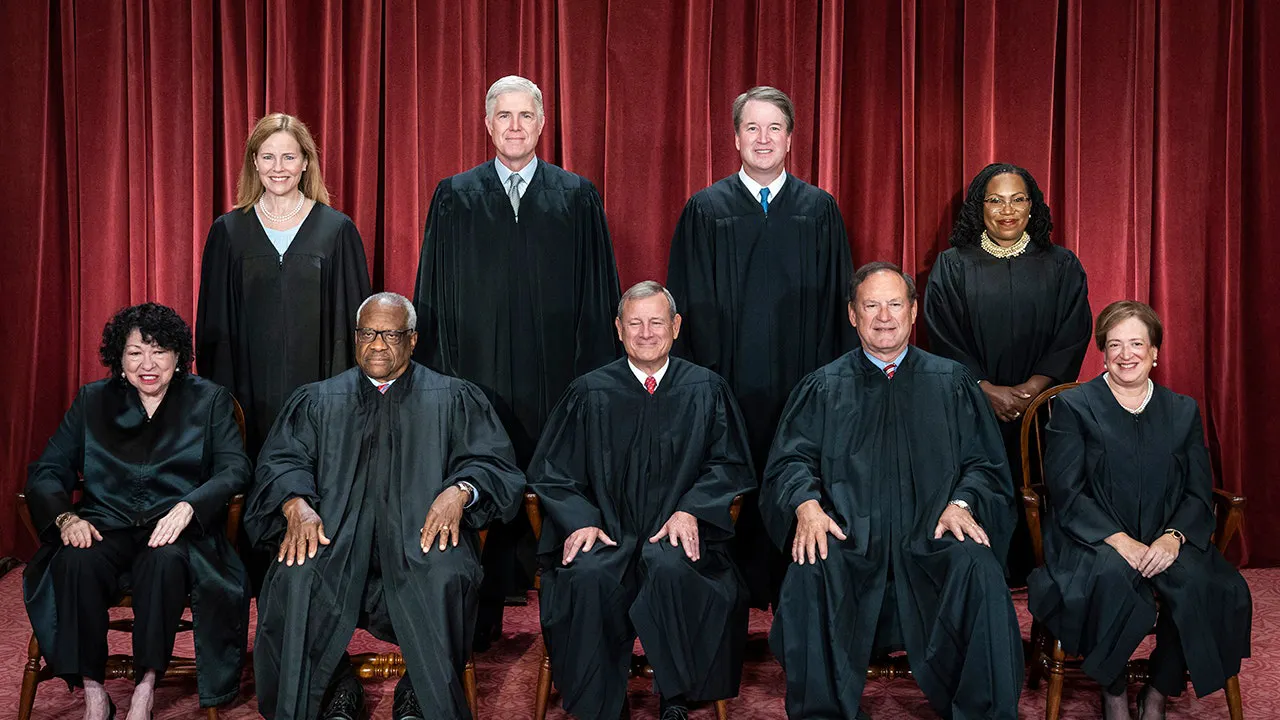
On a deceptively peaceful Wednesday evening in Fairfax County, Virginia, the fragile sanctuary of a suburban neighborhood was suddenly disrupted by a malicious digital ambush known as “swatting.” At approximately 9:02 p.m., local dispatchers received an alarming call through their non-emergency line reporting that gunshots had been heard at the residence of United States Supreme Court Justice Amy Coney Barrett. For any family, the sight of flashing police lights reflecting off bedroom windows in the dark of night is a terrifying, heart-stopping experience, but for a sitting Supreme Court Justice, the stakes are immediately elevated to a national security crisis. Swatting is not a harmless childhood prank; it is a calculated, high-tech weaponization of emergency services designed to draw heavily armed tactical units to an innocent target’s home under the false pretense of an active threat like a mass shooting, bomb threat, or hostage standoff. Fortunately, the Fairfax County Police Department responded with incredible professionalism, instantly coordinating with the specialized Supreme Court Police personnel permanently assigned to protect the justice’s residence. Together, they quickly determined that the report was completely fictitious, preventing an escalation that could have put lives in danger, but leaving behind yet another chilling reminder of the personal vulnerability that now shadows the lives of our nation’s highest public officials and their families.
The morning after the terrifying incident, a casual observer watching the proceedings inside the majestic, marble-clad courtroom of the Supreme Court would have noticed absolutely nothing amiss. Justice Barrett took her seat on the bench alongside her colleagues with her trademark composure, her voice steady and clear as she read aloud summaries of two complex judicial opinions she had authored. No mention of the previous night’s security scare escaped her lips, nor did she allow the lingering adrenaline of the hoax to disrupt the solemn execution of her constitutional duties. This stark juxtaposition—transitioning from the target of a potentially lethal security threat at home to delivering legal opinions on the national stage just hours later—highlights the profound, silent burden borne by modern public servants. Behind the black robes and the grand titles are real human beings with spouses and children, individuals who must somehow compartmentalize their fears, shield their loved ones from the vitriol of the public square, and continue to serve the republic under the constant threat of violence. The quiet dignity Barrett displayed on Thursday morning was a testament to her deep professional resilience, but it also painted a sobering portrait of the immense personal cost that now accompanies public service in an era where the lines between political disagreement and personal safety have been entirely erased.
To understand the gravity of the swatting call targeting Justice Barrett, one must view it not as an isolated act of malice, but as part of a dangerous, multi-year trend of escalating intimidation directed at the American judiciary. Ever since the unprecedented leak of the Dobbs v. Jackson Women’s Health Organization draft opinion in May 2022, which signaled the imminent end of federal abortion rights under Roe v. Wade, members of the court’s conservative majority have lived under a cloud of heightened security threats. The peace of their private homes, which has historically been respected as a sacred boundary away from the heat of political battle, has become a primary target for aggressive demonstrations, with protesters regularly gathering on suburban sidewalks to shout slogans and brandish signs. This atmosphere of intense hostility reached a terrifying climax in June 2022, when Nicholas John Roske was arrested near the Maryland home of Justice Brett Kavanaugh, armed with a handgun, a crowbar, pepper spray, and zip ties, later admitting he had traveled across the country with the intent to assassinate the justice. Although Roske was intercepted by law enforcement and subsequently sentenced to federal prison, the underlying message remained clear: the traditional avenues of peaceful political protest have increasingly surrendered to a dark culture of physical coercion and violent threats.
The practice of swatting represents a particularly insidious form of harassment because it actively co-opts the state’s protective apparatus and turns it into an instrument of terror against innocent citizens. When a malicious actor fabricates emergency calls reporting violent crimes in progress, law enforcement officers are forced to assume the worst, often responding with swat teams, tactical gear, and a heightened level of defensive aggression that maximizes the risk of a fatal misunderstanding. In a crowded suburban environment, such an escalation poses an existential threat to the targets, their neighbors, and the responding officers themselves, who are unwittingly thrust into a highly volatile situation where any unexpected movement could end in tragedy. Reacting to the news of the hoax at Barrett’s home, Republican Senator Mike Lee of Utah expressed the widespread anger felt by many, calling swatting an explicit attempt to get an innocent person killed and demanding that the perpetrators face lengthy federal prison sentences. As these incidents continue to rise, the FBI has intensified its investigations into the networks behind them, recognizing that the technique is being systematically deployed by anonymous actors to harass and silence public figures, forcing local police departments to continuously refine their protocols to distinguish between real emergencies and digital traps.
Regrettably, the threat hanging over the Supreme Court is reflective of a much wider, more alarming national epidemic where political disagreements are increasingly met with physical violence. The year 2024 alone has witnessed shocking milestones of partisan hostility, most notably the two public assassination attempts on former President Donald Trump, including a terrifying incident at a rally in Butler, Pennsylvania, where a bullet grazed his ear, narrowly missing a catastrophic outcome. However, this toxic environment is not confined to high-profile political figures with elite federal security details; its poison has trickled down to ordinary citizens who dare to express their beliefs in their own neighborhoods. For instance, just this month, a California military veteran known for transforming his property into a patriotic landmark adorned with American flags and political memorabilia was brutally beaten to death in his own yard. These tragedies serve as a grim warning of how quickly ideological differences can degrade into raw, physical rage, leaving families shattered and local communities living in a constant state of fear. When political discourse is replaced by physical assault, the fundamental concept of a free society is compromised, and the safety of every citizen is placed in jeopardy.
As we reflect on the swatting incident at Justice Barrett’s home and the broader wave of threats facing our nation’s leaders, we are forced to confront a fundamental question about the future of our democracy: can a free republic survive when its public officials must govern from behind bulletproof glass and under the constant protection of armed escorts? The rule of law requires that judges be free to interpret the Constitution based solely on legal merits, entirely insulated from external pressure, intimidation, and the fear of personal harm. When we allow political disagreement to cross the line into personal terror, we threaten to destroy the fragile social contract that holds our diverse nation together. Protecting our leaders—regardless of their political ideology—is not about taking political sides; it is about defending the integrity of our democratic institutions and ensuring that the voice of reason is never silenced by the threat of violence. To restore sanity to our public life, American society must collectively reject the normalization of political violence, enforce severe consequences for those who weaponize fear, and strive to rebuild a culture where disagreement is met with debate rather than destruction. Only by safeguarding the physical safety of those who serve can we hope to preserve the principles of justice, liberty, and peace that have sustained our nation for nearly two and a half centuries.