


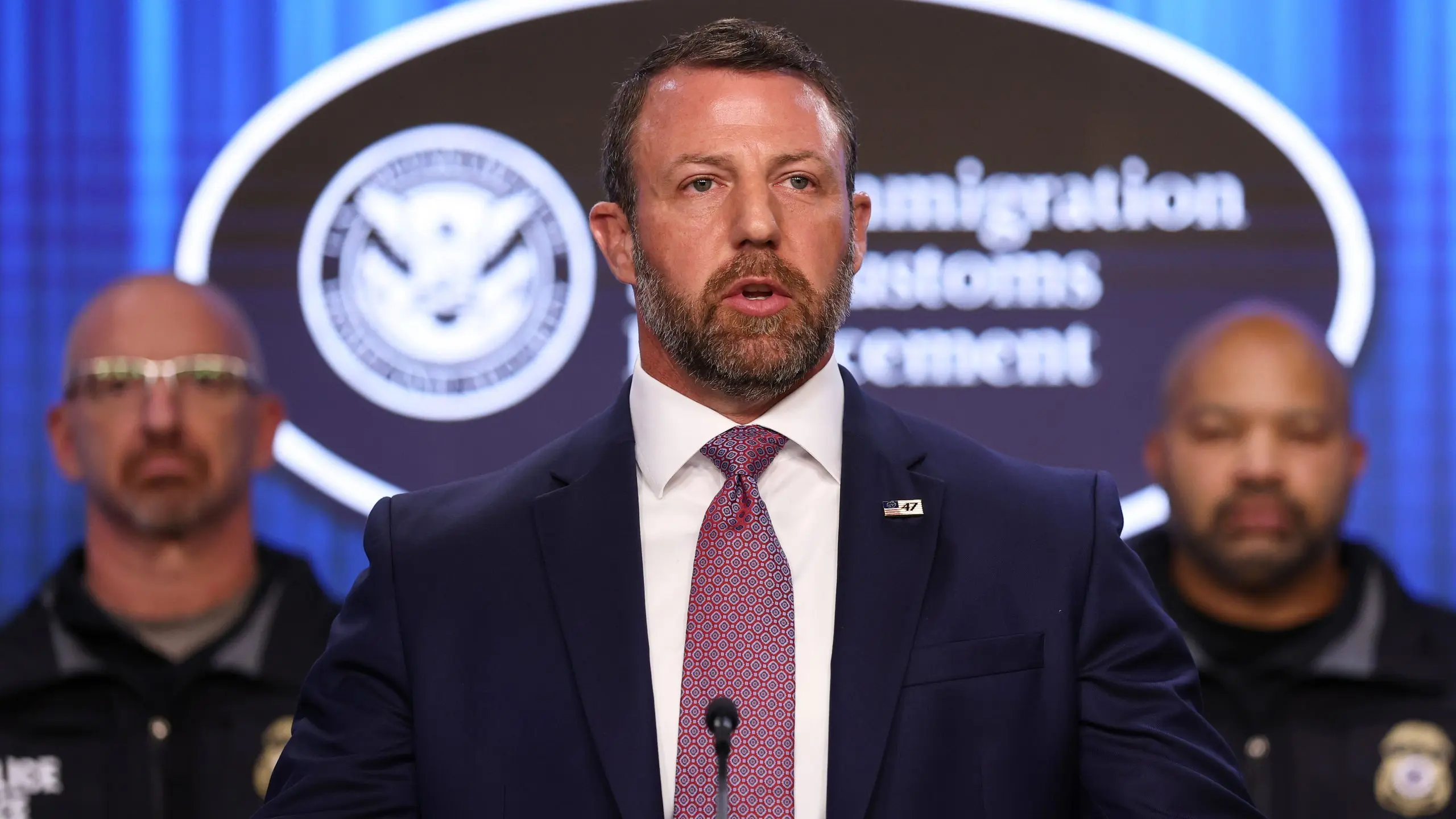
Homeland Security Secretary Markwayne Mullin stepped onto Fox News’ “The Ingraham Angle” on Tuesday looking like a man who had come to deliver a warning, not a conversation. The timing was everything. The midterm elections had just delivered a punishing blow to the Republican Party, Democrats had secured majorities in both chambers, and whispers were already spreading that President Donald Trump might be willing to deal with Democrats on immigration. Mullin wanted to extinguish that idea before it could catch fire. With Laura Ingraham sitting across from him, he offered a message that was deliberately simple and completely uncompromising: “Amnesty will never be on the table.” It was a statement that left no room for negotiation, no opening for interpretation, and no sign of weakness. For the millions of conservative viewers watching at home, it was exactly the kind of bluntness they wanted to hear after an election that felt like a setback. Mullin understood that the political moment was fragile. Many Republicans felt anxious and uncertain, worried that the party might drift toward softer positions. He was there to reassure them, to promise that the administration’s stance on immigration would not be shaken by election results. His voice carried the weight of someone who believed that this was not just a policy debate but a moral stand. He spoke about national safety with urgency, as if the country itself were being tested. That first declaration, delivered without hesitation, set the tone for everything that followed: no deals, no amnesty, no retreat.
Mullin didn’t just make promises; he pointed to numbers. He told viewers that the Department of Homeland Security has been deporting roughly 3,600 people a day, a figure that is almost hard to wrap your mind around. It speaks to a massive, relentless operation. He said plainly: “We haven’t slowed down at all.” But he also added nuance, explaining that the agency has “re-prioritized” its work to focus on “the worst of the worst.” His list was intentional and visceral: murderers, rapists, child predators, drug bankers, cartel members. He wanted the public to understand that these are not people who simply crossed a line. They are dangerous individuals whose presence in American communities threatens families and children. By framing the enforcement priorities this way, Mullin was speaking to the heart of every parent who worries about the safety of their neighborhood. He was also acknowledging, perhaps indirectly, that the optics of mass deportation are complicated. He tried to humanize the policy by suggesting that the government is not attacking innocent families, but removing violent criminals. It is a rhetorical strategy that has become common in immigration debates, but Mullin delivered it with a kind of raw conviction that made it feel personal. Behind each number, he implied, is a case that deserved scrutiny and action. The daily count of 3,600 removals represents an enormous logistical effort, involving law enforcement officers, detention facilities, legal proceedings, and flights. It is not abstract machinery. It is made up of people making difficult decisions under intense pressure. Mullin’s message was that the system, as brutal as it may seem to critics, is operating with purpose. And under his leadership, that purpose is not going to change.
The political subtext of Mullin’s appearance was impossible to ignore. Republicans had just lost the midterms, and the party’s internal battle over strategy was beginning to erupt. President Trump had floated the idea of working with Democrats, and that suggestion had angered a significant portion of his base. Mullin effectively shut the door on that possibility. When Ingraham brought up the idea of bipartisanship, Mullin answered with a hard truth as he saw it: “You can’t trust the Democrat Party we’ve been working with at all. You can’t, because nothing’s enough for them.” There was anger in his voice, but there was also exhaustion. It was the frustration of someone who felt that every concession to Democrats only led to more demands, that the other side would never satisfied until the border was completely open. This kind of language is deeply emotional. It speaks to a feeling of betrayal, not just political disagreement. Mullin was telling conservatives that they cannot expect their opponents to share their values or to honor agreements. He was also telling Democratic leaders that their election victories would not make them trustworthy partners in his eyes. It was a pointed refusal to accept the usual Washington narrative that after elections, leaders come together to find common ground. Instead, Mullin insisted that some issues are too important for compromise. He framed immigration not as a series of policy details but as an existential issue, where trust is essential and where a failure to be vigilant can have catastrophic consequences. That message resonated with a base that was already suspicious of the Democratic Party’s shifting positions, and it left no question about where he stood.
Mullin then took his argument to another level by attacking the ideological direction of the Democrats. He specifically invoked the Democratic Socialists of America, or DSA, claiming that the group is effectively “running the Democrat Party right now.” He accused them of wanting to “defund the country.” In his view, that means defunding the Department of Homeland Security, the very agency responsible for protecting American soil. “You want to defund the country that is the agency that’s tasked with keeping our homeland safe? Doesn’t make any sense,” he said. This rhetorical move was designed to ignite outrage. The word “defund” carries the memory of the broader “defund the police” movement, and Mullin was carefully connecting that idea to national security. He was trying to paint a picture of a radical left that would rather dismantle protections than ensure safety. For many viewers, that image is terrifying. It brings to mind a nation without border enforcement, without counterterrorism operations, without agencies to respond to disasters. Mullin wanted to make this abstract political battle feel immediate and personal. He was speaking up for the men and women of DHS, the patrol agents who walk the border trails, the analysts who track threats, the officers who watch the coastlines. He was saying that these are not enemies to be defunded, but protectors to be supported. By attacking the DSA, Mullin was also warning moderate Democrats that they are being pushed by a more extreme wing of their party. It was a strategy meant to divide the opposition and rally Republicans around a shared sense of danger. The result was a segment that felt less like an interview and more like a rally speech, filled with urgency and appealing to a deep desire for order.
One of the most striking parts of Mullin’s interview was his reliance on the power of the presidency to block whatever Democrats managed to pass. He recalled President Trump’s comments about the veto, and he embraced that authority enthusiastically. “The president has made it very clear he controls the veto. So if they were to send something over that the president and the Republicans don’t agree with, he can veto it, and he will veto it,” Mullin said. He went even further: “The president will not sign anything that isn’t in the right movement for this country and the Republican Party.” This is the language of political resistance. Mullin was acknowledging that Democrats now control Congress, but he was also insisting that their power is not absolute. A veto is the ultimate check, the final line of defense against legislation that the administration finds unacceptable. For Republican voters, this is a comforting thought. It means that even in a season of defeat, their interests are still protected. For Democrats, it is a warning that every bill they pass could be stopped by a single signature withheld. Mullin’s words were also a subtle reminder that the presidency remains in Republican hands, and that the fight over immigration is far from over. He was not conceding anything. He was drawing a line in the sand and inviting his supporters to stand behind it. The veto conversation also highlighted the choreography of Washington politics, where every public statement is carefully crafted to manage expectations. Mullin was managing expectations by telling both sides that compromise is impossible and conflict is inevitable. It was a message of perseverance and defiance, designed to keep the Republican coalition united after a bruising electoral defeat and to prepare the ground for the battles that lie ahead.
At its core, Mullin’s interview was about one central idea: a country without controlled borders cannot be a safe country. He captured that philosophy in a simple, memorable sentence: “You can’t have a secured nation and you can’t have a secured city if you don’t know who’s in your country.” It is a statement that resonates on a very human level. It asks people to imagine their own streets, their own neighborhoods, and to think about what safety really means. Confidence in public safety comes from knowledge, from knowing who is entering and who is leaving, from having systems that verify identities and uncover threats. Mullin was arguing that immigration enforcement is not just about following rules or punishing the undocumented. It is about the basic peace of mind that every community deserves. If anyone can enter the country without detection, he suggested, then no place is truly secure. That logic is straightforward, and it appeals to an instinct that cuts across political identities. There is something deeply human about wanting to protect one’s home, one’s family, and one’s neighbors. Mullin was tapping into that instinct and transforming it into a political argument. He was also rejecting the idea that harsh enforcement is cruel. In his vision, the true cruelty is exposing citizens to danger by failing to know who is among them. His closing remarks left no room for ambiguity. The administration would continue to deport, continue to prioritize criminals, continue to resist amnesty, and continue to treat immigration enforcement as a matter of life and death. It was a performance designed for the cameras, but it was also a reflection of a deeper conviction. For Mullin, the immigration debate is not an abstract policy problem. It is about the survival of the nation, the safety of cities, and the ability of ordinary people to live without fear. And as the midterms fade into memory, that message remains his answer to the changing political winds.