



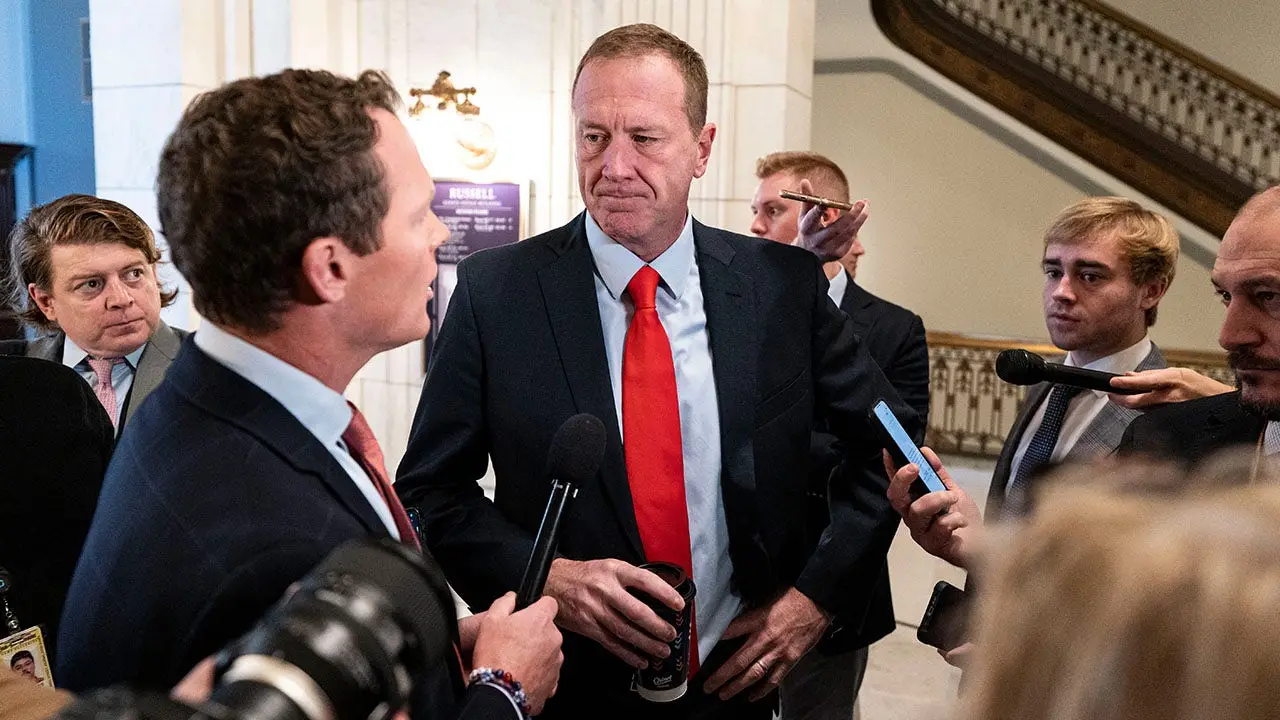
The debate over American immigration policy has escalated from a policy disagreement into a profound philosophical conflict regarding the nature of national sovereignty, rule of law, and civilizational preservation. At the center of this dialogue is Missouri Republican Senator Eric Schmitt, who recently issued a stern warning against what he terms the “suicidal empathy” of the Democratic Party’s border policies. Commenting on the integration of his legislative proposal into the latest federal reconciliation package—which secures crucial funding for Immigration and Customs Enforcement (ICE) and Customs and Border Protection (CBP)—Schmitt argues that current progressive immigration strategies endanger the structural framework of the United States. He maintains that the resistance to robust border enforcement is not merely a matter of excessive humanitarianism, but rather a calculated political strategy designed to consolidate electoral power. By ignoring the traditional boundaries of citizenship and statehood, Schmitt contends, the political left is pursuing a path that threatens to undermine the foundational stability of the American republic, swapping national security for short-term political leverage.
To directly address the operational challenges posed by local non-cooperation, Schmitt successfully secured a $350 million provision in the House-passed federal funding package, specifically designed to empower ICE agents to apprehend criminal illegal immigrants upon their release from local law enforcement custody. This targeted funding aims to counteract the policies of sanctuary states and cities, where local officials frequently decline to cooperate with federal immigration detainers. From a logistical perspective, Schmitt emphasizes that apprehending individuals directly at the doors of local correctional facilities is vastly safer and more efficient for law enforcement officers than conducting high-risk raids in residential neighborhoods or workplaces afterward. Without the coordination of local jails, federal agents are forced to track suspects through communities, significantly increasing the probability of violent confrontations and accidental harm to bystanders. This legislative adjustment seeks to restore a seamless handoff between local judiciaries and federal immigration authorities, ensuring that individuals who have committed domestic offenses are seamlessly transitioned into the deportation pipeline rather than being released back into public spaces.
The civilizational stakes of this policy friction are immense, representing a critical juncture for the preservation of Western legal traditions. Schmitt argues that a sovereign nation’s most basic obligation is to determine who is allowed to enter its territory and under what conditions they must depart; to abandon this right is to abandon the concept of the nation-state itself. The reality on the ground in sanctuary jurisdictions reveals a stark departure from these sovereign principles, illustrated by over 18,000 instances in 2025 alone where local authorities refused to honor ICE detainers, letting individuals with pending immigration violations walk free. By actively shielding non-citizens who have committed crimes from federal deportation procedures, sanctuary jurisdictions have effectively inverted the traditional moral and legal hierarchy, prioritizing ideological non-cooperation over the safety of the citizens they are sworn to protect. This systemic refusal to coordinate has fractured the unified front necessary for national security, creating geographical loopholes where federal law is rendered toothless by local political decree.
To understand the human cost of these policy failures, one must look at the tragic real-world violence that has occurred in the wake of lax enforcement and uncooperative local jurisdictions. The societal consequences are not theoretical; they are written in the devastating stories of communities forced to bear the brunt of criminal behavior. Recently, the nation watched in horror as four members of the brutal Venezuelan street gang, Tren de Aragua, pleaded guilty to the cold-blooded murder of two American citizens. In California, another undocumented immigrant stood in court, grinning before a judge, while facing charges for the tragic death of an innocent two-month-old infant. Meanwhile, in Senator Schmitt’s home state of Missouri, a perpetrator was sentenced to twenty-five years in prison after the horrific sexual assault and impregnation of a twelve-year-old girl. These devastating accounts underscore the warning from border advocates that failing to deport individuals who cross borders illegally—especially those who go on to commit violent acts—has catastrophic consequences for everyday families who expect their government to maintain basic public safety.
The political divide over these issues reflects a fundamental disagreement on the necessity of home security and federal law enforcement. Schmitt expresses disbelief at the political resistance to basic enforcement measures, pointing to the progressive undercurrents that have previously rallied around demands to “defund ICE” and weaken border enforcement apparatuses. From the conservative perspective, the reluctance to deport convicted criminals or to denaturalize those who have committed hostile acts on American soil is completely indefensible and defies logical explanation. While advocates for sanctuary policies often frame their resistance in terms of civil rights, community trust, and humanitarian compassion, critics argue that such positions act as a de facto endorsement of lawlessness that erodes public trust in legal institutions. This polarization has created a scenario where federal agencies must fight uphill battles not only against transnational criminal organizations, but also against domestic political entities that actively impede the execution of federal immigration mandates.
Ultimately, the inclusion of Schmitt’s provision in the latest federal funding package represents a pivotal effort to realign public policy with the basic expectations of the American electorate. The struggle over immigration is not merely a technical debate regarding visa allocations or border walls; it is a defining struggle over the integrity of the social contract between a government and its citizenry. By allocating specialized resources to circumvent the obstructions of sanctuary jurisdictions, the legislation asserts that the rule of law must remain uniform across the country, regardless of local political trends. As the United States navigates these complex cultural and legal challenges, the outcome of these policy enforcement efforts will likely dictate the safety, stability, and sovereignty of local communities for generations to come. For lawmakers like Schmitt, the path forward requires a clear, unwavering commitment to national security and a rejection of policies that sacrifice public safety on the altar of political ideology.