


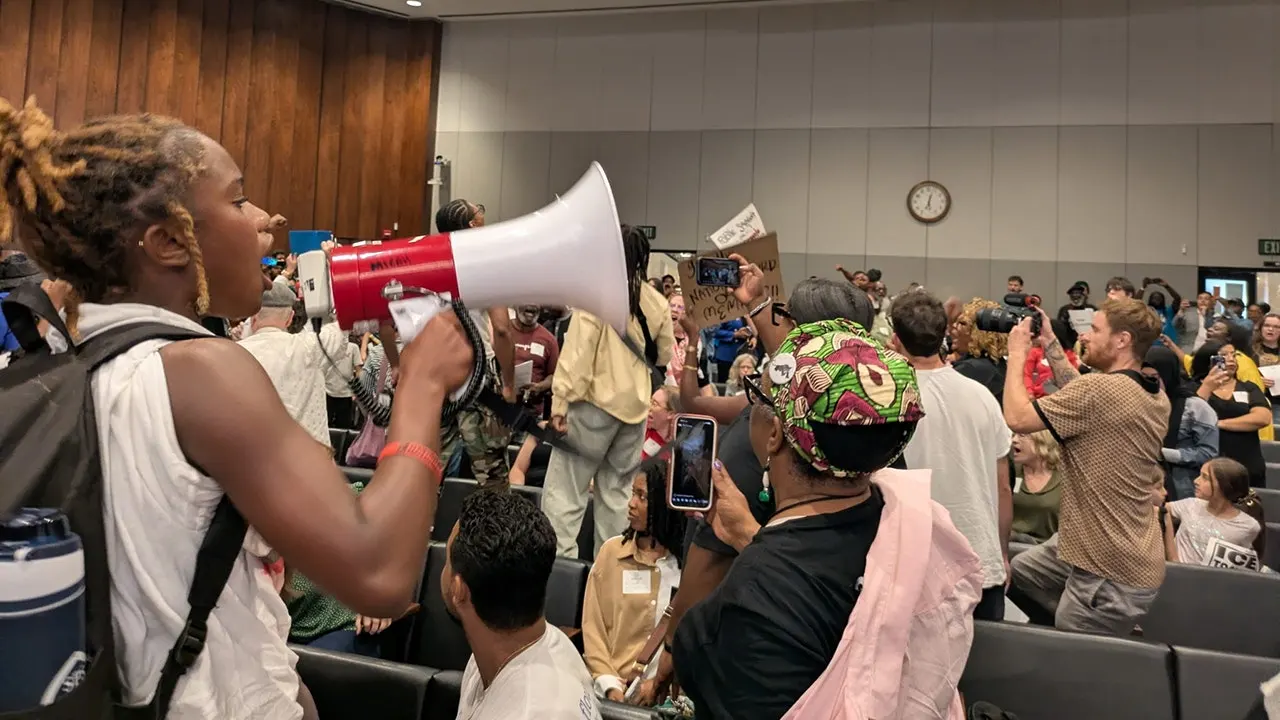
It was the kind of night that Memphis politics rarely sees up close—or maybe the kind that has become impossible to avoid. A City Council meeting that was supposed to be a straightforward vote on whether to pause new data center construction for a year turned into a swirling scene of anger, frustration, and raw civic emotion. As council members took their seats, the chamber was packed with residents who had come expecting a decision. Instead, they watched the vote get postponed until October 20, and the disappointment in the room turned into something louder. Protesters began chanting, “This is our city,” and “Show me what democracy looks like,” their voices filling the chamber and spilling into the hallways. Police moved in to clear the room, and in the lobby, a fight broke out between two women, with video capturing punches being thrown. Memphis Police later said no one was detained or injured, and it was unclear whether the fight was connected to the meeting at all. But the image of it—two people scuffling in the marble lobby while city leadership tried to regroup—felt like a metaphor for the entire evening: a community divided, a decision deferred, and a conversation that nobody quite knew how to have.
At the center of the storm was a proposed ordinance that would place a 12-month moratorium on new data center projects in Memphis. The pause, if approved, would give the city time to study how these massive facilities affect public health, electricity and water supplies, air quality, noise levels, and the character of surrounding neighborhoods. The issue is no longer abstract. Elon Musk’s SpaceXAI has already built its massive Colossus supercomputer facilities in the Memphis area, and their presence has transformed parts of the region into a hub for artificial intelligence infrastructure. For some residents, that transformation has been unsettling. They worry about the enormous amounts of electricity and water needed to keep the data centers cool and running around the clock. They worry about the hum of machinery, the strain on the power grid, and the environmental costs that come with cutting-edge technology. Others see an economic opportunity that could define Memphis for decades, and they fear that a year-long pause would send a signal that the city is closed for business. The ordinance was always going to be a hard vote, and the night reflected that tension from beginning to end.
The council itself was clearly not immune to the emotional weight of the moment. Councilwoman Yolanda Cooper-Sutton, visibly frustrated, exchanged words with protesters and then turned her ire toward Councilman J.B. Smiley Jr., the lead sponsor of the moratorium. “That’s all he does; he brings up mess,” she said, her voice sharp with exasperation. “That’s all you do, J.B. Smiley, confuse the people over, over, and over again.” It was a harsh rebuke, delivered in public, and it captured how fractured the council had become on this single issue. Smiley had pushed hard for a final vote that night, arguing that residents had shown up precisely because they expected the council to act. Postponing the decision, he said, was a failure to honor their presence and their concerns. But seven council members voted to delay the measure, while five opposed the delay, and one member was absent. The postponement meant the debate would continue, but so would the uncertainty—and the resentment. For Smiley, the night was deeply disappointing. “When the community shows up, we just have to listen to them,” he said afterward. “I’m disappointed that we didn’t listen with ears. I hear you, I understand. Let’s figure out how we can do what you want, but also what we believe would be in the best interest of the community.”
What made the debate so complicated is that both sides believe they are fighting for Memphis. Those in favor of the moratorium argue that the city has a responsibility to protect its residents before welcoming more large-scale industrial projects. They point to the fact that data centers require massive amounts of electricity—often enough to power entire small towns—and that water consumption for cooling can strain local supplies. They also raise concerns about diesel backup generators, air emissions, and the increased truck traffic that comes with construction and maintenance. For residents living near existing facilities, the noise alone can be disruptive, and many feel that decisions about where these centers go have been made without meaningful community input. The moratorium, in their view, is not anti-technology and not anti-jobs. It is about slowing down long enough to understand the full picture. It is about making sure that Memphis does not repeat the mistakes of other cities that welcomed massive infrastructure projects without first establishing strong protections. The people who packed the council chamber were not there because they oppose progress; they were there because they want progress to be fair, transparent, and rooted in the health and safety of the community.
On the other side, the argument is about momentum and opportunity. Councilman Jeff Warren warned his colleagues that a year-long pause could push data center companies to look elsewhere. “If we pass a moratorium, there’s no reason for them to think they need to come here,” he said. “They get the same benefit from going to DeSoto County, Crittenden County, Fayette County, Tipton County.” His point was simple: the competition for high-tech investment is fierce, and neighboring municipalities are eager to attract these projects with fewer restrictions. A moratorium, however well-intentioned, could be read as a red flag by companies that prize speed and certainty. Memphis Mayor Paul Young has tried to strike a middle path. He has said the city needs more rules governing data centers, acknowledging legitimate concerns about water, electricity, air quality, noise, and zoning. But he has also pointed to the tax revenue these facilities generate and has stressed the importance of keeping the pressure on to get the right regulations in place quickly. “We need to keep the pressure high and make sure that we get the guardrails in place that we need for our community to feel protected,” Young said. “There’s a role for all of our agencies to play. The thing I want to make sure is that we do it expeditiously.” In other words, he wants to be both cautious and competitive, and that is not an easy line to walk.
Ultimately, the chaotic council meeting was less about data centers themselves than about a deeper question: who gets to decide what Memphis becomes? The residents who filled the chamber and raised their voices were demanding to be heard in decisions that affect their daily lives. They do not want to wake up one morning to the hum of another data center next door, or to wonder whether the water they drink is being diverted to cool servers in an industrial park. They want a seat at the table, and the postponement of the vote felt, to them, like the table being pulled away at the last moment. But the council members who voted to delay were not trying to dismiss those concerns; many of them believe that a rushed vote would only make things worse, and that the city needs data and careful study before drawing bright lines. The fight in the lobby and the shouting in the chamber were not signs of a broken city. They were signs of a city that cares enough to argue, that still believes its voice matters, and that is not willing to let technology and money decide its future without a public debate. The moratorium will come back before the council on October 20, and when it does, the same passions will likely fill the room. The question remains whether Memphis can find a way to listen to each other, not just to speak over one another. The outcome of that vote will matter, but so will the manner in which the city reaches it. For now, the data centers are still running, the city is still debating, and the people are still watching—waiting to see if their leaders will turn chaos into something like understanding.