

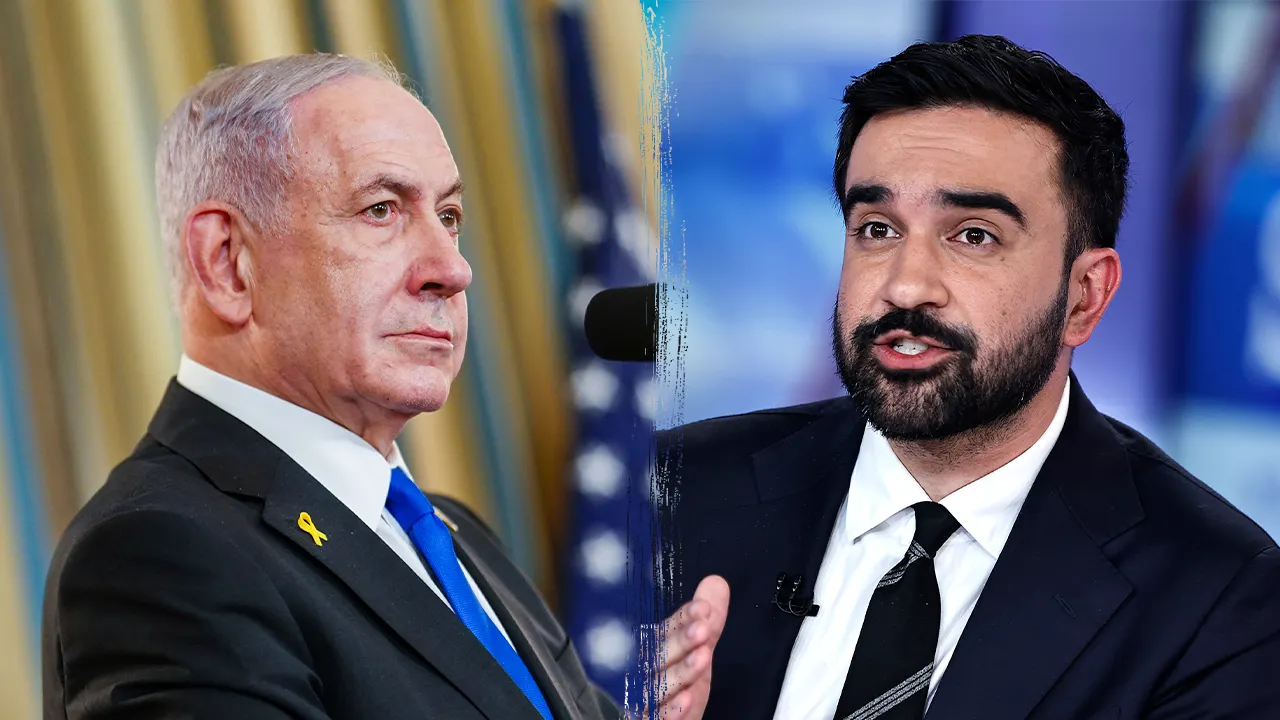
New York City Mayor Zohran Mamdani fired back at Israeli Prime Minister Benjamin Netanyahu on Tuesday after Netanyahu released a video accusing the mayor of supporting Hamas terrorists and inciting unrest against Jewish New Yorkers. The exchange marked the latest flare-up in an increasingly personal, politically charged feud between the two leaders, and it came at a particularly delicate moment, just days before Netanyahu is expected to arrive in New York to address the United Nations General Assembly. When reporters asked about the video, Mamdani rejected the accusation outright. “We all know that what the prime minister has said in that video is not true,” he said. He then turned the focus back on Netanyahu, pointing to the International Criminal Court’s arrest warrant for the Israeli leader. “What we do know to actually be the truth when it comes to the prime minister is that he is the subject of an International Criminal Court arrest warrant for alleged war crimes and crimes against humanity.” But Mamdani did not stop with the legal point. He went further, calling Netanyahu “the architect of horrific genocide against Palestinians” and noting that just a few days earlier, Israeli forces had killed an 11-year-old boy in what was supposed to be a safe zone in Gaza. “So that is what I have to say to his video,” the mayor concluded. It was a blunt and forceful response, delivered with the kind of directness that has become Mamdani’s political signature. The fact that New York Magazine and other outlets have covered every twist of this conflict suggests just how unusual it is for an American city mayor and a foreign head of government to engage in such a public war of words, especially on the eve of an international summit. Mamdani has become one of the most visible American elected officials to describe Israel’s actions in Gaza as genocide, and Netanyahu has clearly decided that the mayor is a threat worth addressing personally.
The video that triggered Tuesday’s response was unsparing in its language and clearly designed to put Mamdani on the defensive. “Shame on you, Mr. Mamdani. Shame on you for supporting the Hamas terrorist monsters who butchered our people. Shame on you for inciting riots against New York Jews,” Netanyahu said. He went on to promise that when he speaks before the U.N., he will “tell the truth” about Israeli soldiers and about Mamdani himself. “I’m coming to the U.N. I am going to tell the truth about our heroic soldiers, and I’m going to tell you the truth about you,” he added. The prime minister’s language was deliberately stark, framing the conflict as a moral struggle between civilization and terror. In his telling, there is no room for nuance: Mamdani’s criticism of Israeli military policy is not legitimate dissent but support for “monsters” who slaughtered civilians. Netanyahu also invoked the safety of Jewish New Yorkers, claiming that Mamdani’s rhetoric has made Jews in the city afraid. That claim touches a deeply sensitive nerve in New York, where concerns about anti-Semitic incidents have grown since the October 7, 2023 attacks. It also reflects a broader political strategy: Netanyahu has long sought to delegitimize critics of Israel by linking them to terrorism and anti-Semitism, and Mamdani has given him a convenient target. The fact that Mamdani is a Muslim elected official from Queens, known for his progressive activism, makes the confrontation even more pointed. Netanyahu’s video was not just a statement about policy; it was a political intervention into New York City’s local politics, intended to shape how the public sees Mamdani ahead of the mayor’s own future ambitions. It also puts pressure on Jewish leaders, politicians, and ordinary citizens in New York to choose sides in a debate that no city can avoid while the Gaza war continues to dominate the news.
The arrest warrant has been a central thread of Mamdani’s critique for months. The ICC issued the warrant in November 2024, alleging war crimes and crimes against humanity. Netanyahu and his government have rejected the allegations and challenged the court’s authority, and the United States has historically refused to recognize ICC jurisdiction over Israel. But for Mamdani, the warrant is a legal fact with moral weight. During his mayoral campaign, he explored whether New York City could somehow execute the warrant against Netanyahu, a proposal that immediately drew outrage from Israeli officials and pro-Israel advocacy groups. After taking office, Mamdani acknowledged that the city could not enforce the warrant on its own, but he did not abandon the issue. He has repeatedly called Netanyahu a “war criminal” and an “architect of a horrific genocide against the Palestinian people.” Over the summer, he declared that Netanyahu was “not welcome in New York City.” “I want to be equally clear: Benjamin Netanyahu is not welcome in New York City, nor is any other war criminal at large,” he said at the time. Those words have made Mamdani a hero to pro-Palestinian activists and a villain to Israel’s supporters. Israeli officials have responded with unusual fury. Israel’s U.N. envoy called Mamdani a “clown” and dismissed the arrest warrant talk as “a stunt.” Israeli President Isaac Herzog has also weighed in, blasting Mamdani while praising President Donald Trump and warning about the threat from Iran. The sheer volume of Israeli official attention directed at a city mayor is remarkable, but it signals how seriously Netanyahu’s government takes the shifting political landscape in the U.S., where younger, more progressive politicians are far more willing to criticize Israel than previous generations of American leaders.
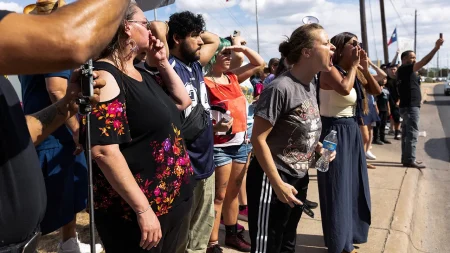
As Netanyahu’s visit approaches, the question of protests has become almost as significant as the warrant drama itself. Mamdani has consistently defended the right of New Yorkers to demonstrate, and he has framed that defense in entirely civic terms. When asked in July what frustrated New Yorkers should do during Netanyahu’s visit, Mamdani pointed to protest as an option. “One of the bedrocks of our city is protest,” he said. “It is something that has been a part of what makes our city so special, that New Yorkers can express themselves whether they are in support or in opposition no matter on whatever topic.” Yet he has been careful to separate the right to protest from an endorsement of specific action. Last week, he clarified that he had no plans to participate in any demonstrations surrounding Netanyahu’s visit, and he repeated that he had never encouraged New Yorkers to take to the streets. “To New Yorkers, I have never encouraged them to protest,” Mamdani said. “What I have always told them is that they have the right to do so in the city.” That distinction may seem fine, but in the current political climate, it is loaded with meaning. Supporters see a mayor who is upholding civil liberties while making a forceful moral stand against a leader he regards as guilty of crimes against humanity. Critics see a political figure who is quietly stoking the flames of anger while pretending to stay above the fray. Either way, Mamdani’s language keeps him at the center of the story. The coming days will test his approach. Large protests are expected, and the police department will have to manage them without provoking the kind of scenes that could dominate headlines and reinforce Netanyahu’s narrative of a city turned against Jews. Mamdani’s position gives him some distance from the crowds, but it also puts him in a difficult spot: if the protests become violent, he will be held responsible as the city’s chief executive, regardless of what he said or did not say.
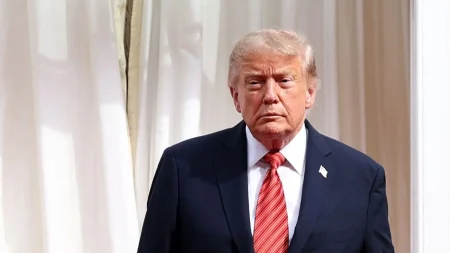
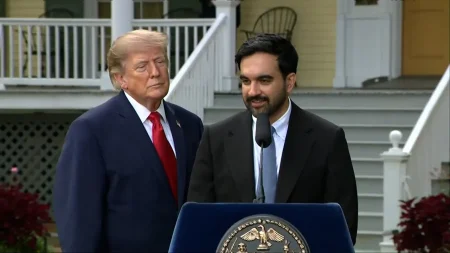
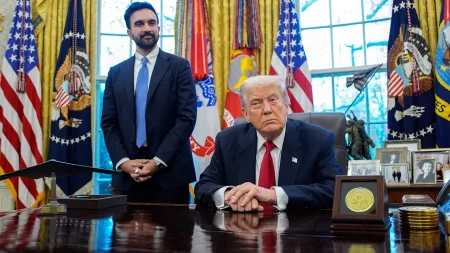
The feud has also spilled into national politics, most visibly through Mamdani’s meeting with President Donald Trump on Monday. In that meeting, the mayor and the president sat down to discuss issues affecting New York City. Afterward, Mamdani was asked whether he and Trump discussed Netanyahu. Mamdani said their conversation remained focused on the city and its residents. The mayor’s office later said that the two discussed affordability and economic development, issues that have been central to Mamdani’s political identity. When pressed on Netanyahu, Mamdani said, “And when it comes to the prime minister, though, I’ve made very clear where I stand on that.” The meeting is significant on multiple levels. Trump has been one of Netanyahu’s most steadfast defenders, and his administration has provided diplomatic cover for Israel in international institutions. Mamdani, by contrast, has described Netanyahu as a genocidal war criminal and said he should not be welcome in New York. Yet the two American politicians met in a spirit of ordinary municipal cooperation, at least publicly. That in itself shows how the conflict has reorganized traditional alliances. Trump is courting voters who support Israel and who are alarmed by the rise of anti-Israel sentiment among progressive Democrats. Mamdani is consolidating support among voters who are outraged by the humanitarian catastrophe in Gaza and who want a fundamental change in American Middle East policy. Their meeting reflects a broader dynamic in American life: the Gaza war has made strange bedfellows and ruptured old loyalties. Mamdani’s refusal to discuss Netanyahu in the meeting was perhaps a sign of pragmatism. He knows that he needs the president’s cooperation on federal funding, transit, infrastructure, and other issues vital to New York City, and there is little to be gained in a public confrontation with the president over the Israeli prime minister. But the symbolic force of the two meetings — Mamdani with Trump, and Netanyahu soon after at the U.N. — underscores how deeply the Israeli-Palestinian conflict has become interwoven with domestic American politics and with the leadership of the city that is home to one of the largest Jewish populations in the world.
At its heart, this is not just a clash of personalities. It is a struggle over language, values, and memory. Mamdani speaks in the language of international law, human rights, and collective Palestinian suffering. He invokes the ICC, the killing of children in Gaza, and the morality of protests. Netanyahu speaks in the language of national survival, collective trauma, and Jewish security. He invokes the October 7 massacre, the hostage crisis, and the fear of a resurgent global anti-Semitism. Each man is convinced that he is telling the truth, and each man sees the other as not merely wrong but dangerous. Their feud is likely to intensify in the coming days. Netanyahu will stand before the General Assembly and deliver a speech that he has promised will be blunt, and Mamdani will be watching from New York, with his own public comments likely to generate just as much attention. The arrest warrant will hang over every moment of the visit, even if the U.S. government makes clear it has no intention of enforcing it. The mayor’s supporters will see a leader willing to confront a prime minister accused of war crimes. Netanyahu’s supporters will see a sovrano leader standing against a mob that protests in the streets and finds allies in City Hall. Neither side is likely to change the other’s mind. But the confrontation will serve as a marker of how far the discourse has shifted. New York City, long a center of Jewish life and culture, is now also a place where the Israeli prime minister is publicly called a war criminal by its own mayor. The fact that this does not seem shocking is itself a sign of the times. Whatever happens in the next few days, the relationship between Benjamin Netanyahu and the city he is visiting will not be repaired overnight. The wounds are too deep, the language too harsh, and the stakes too high. This feud is no longer just about policy disagreements; it is about who gets to define the moral meaning of one of the most consequential conflicts of our era. And neither one of them is interested in yielding.