





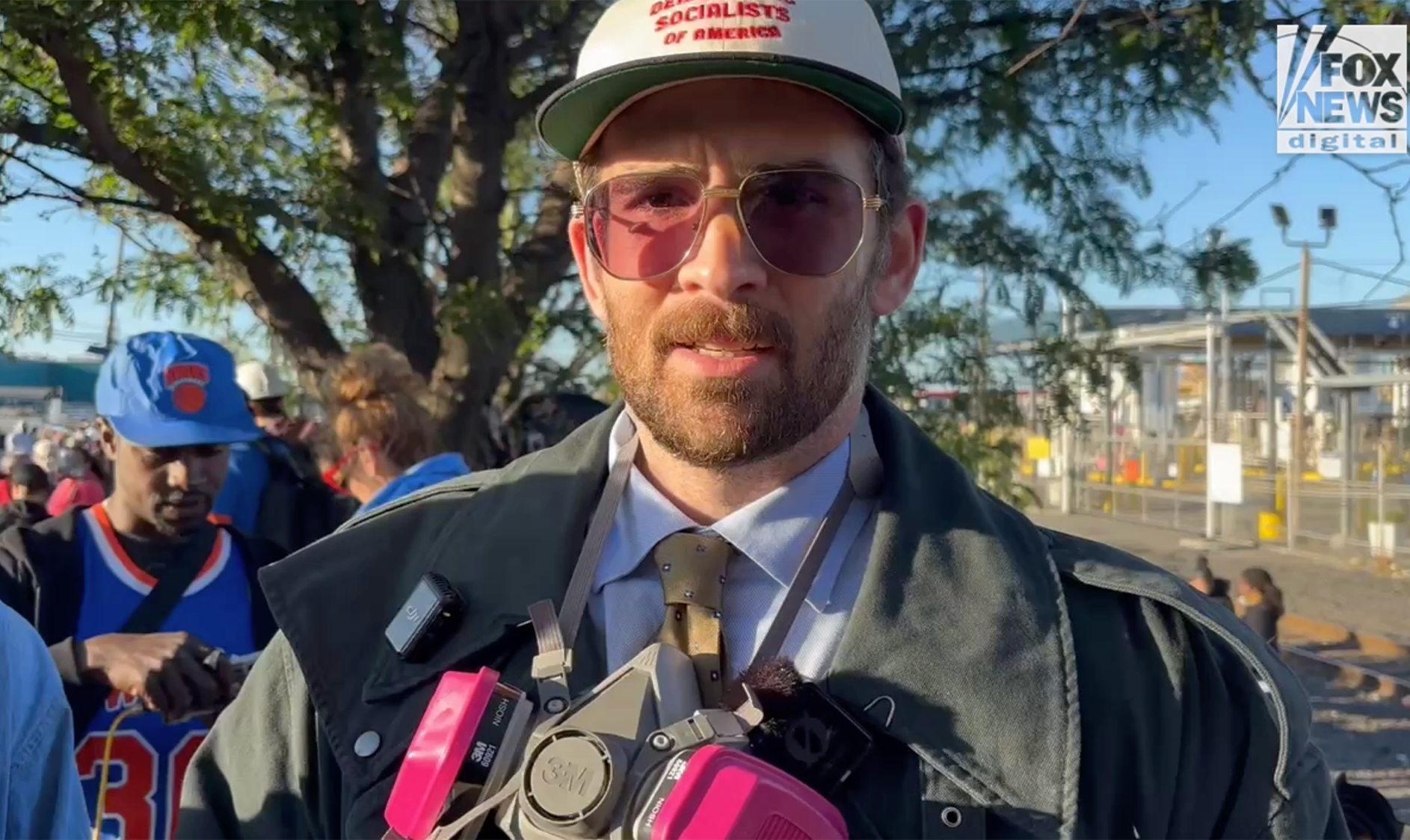
For years, Hasan Piker has reigned as one of the most polarizing and financially successful figures of the modern digital left, commanding a massive, loyal audience on the livestreaming platform Twitch from the comfort of a high-tech studio. To his millions of followers, the Turkish-American commentator is an intellectual champion of anti-capitalist, anti-imperialist, and Marxist perspectives, blending pop culture with heavy geopolitical critique. Yet, the insulated sanctuary of the internet, where controversies can often be managed with a clever comeback or a swift chat moderation, has recently given way to a harsh, cold reality. Over a tumultuous few days, the boundary between Piker’s curated online empire and the unforgiving physical world collapsed in spectacular fashion. The first sign of trouble manifested not on a screen, but on the damp streets of Newark, New Jersey, during a protest outside an Immigration and Customs Enforcement (ICE) facility. There, isolated from his digital moderators, Piker found himself physically confronted by aggressive hecklers who bypassed political debate to launch deeply personal attacks. He was branded a hypocritical fraud, a “fake-ass grifter” enriching himself off working-class outrage, and even a “dog abuser”—a reference to controversial online allegations regarding his training of his dog, Kaya. Being told to “go back to the desktop” was a stinging reminder that to his detractors, his activism is merely a profitable performance. This public confrontation, however, was just a prelude to a much more formidable challenge, as the machinery of state power—both in his home country and across the Atlantic—began grinding against him, signaling that his brand of provocative, anti-establishment commentary has crossed a threshold from online entertainment into a matter of national security and international diplomacy.
The most legally perilous component of this gathering storm arrived in the form of an official administrative subpoena from the United States Treasury Department’s Office of Foreign Asset Control (OFAC). This federal intervention thrust Piker’s ideological crusades directly into the crosshairs of national security and international sanctions enforcement. At the heart of the government’s inquiry is a contentious trip Piker took to Cuba in March, a journey framed by his supporters as an educational and humanitarian endeavor to deliver aid to an island suffering under decades of American embargoes. However, federal investigators are looking at the trip through a far more skeptical lens, seeking to determine whether Piker’s travels, logistics, and financial transactions violated stringent U.S. laws designed to prevent doing business with the Cuban communist regime. By demanding a comprehensive paper trail of Piker’s financial records, logistical arrangements, and communication histories, Uncle Sam has forced the streamer to confront the very real possibility of criminal or civil penalties. The trip itself was not a spontaneous solo venture, but rather a structured event organized under the umbrella of Progressive International, a left-wing global organization co-founded by former Greek finance minister Yanis Varoufakis and activist David Adler. While Piker has consistently defended his participation as a moral necessity to counter imperialist policies, journalists and national security experts have raised alarms that Progressive International and its affiliates are operating as conduits for a sophisticated foreign influence campaign orchestrated by the Cuban Communist Party. For a political commentator who built his brand on dissecting state hypocrisy, finding himself labeled as a potential pawn or violator of federal sanctions has introduced an unprecedented level of real-world legal jeopardy that cannot be hand-waved away during a stream.
As the federal investigation mounted at home, Piker’s international mobility suffered a sudden and devastating blow when British authorities denied his application for an Electronic Travel Authorization (ETA). For American citizens, an ETA is typically a routine, easily obtained digital permit that facilitates seamless entry into the United Kingdom without the arduous process of securing a formal visa. Piker had envisioned a high-profile, week-long British tour that would have cemented his status as a global intellectual and influencer, featuring prominent speaking engagements at the prestigious Oxford Union, a live podcast recording, and collaborative appearances at the SXSW London festival alongside prominent European leftists like Yanis Varoufakis. Instead, the sudden rejection of his travel document left him stranded in his American home, legally barred from crossing British borders. In the grand scheme of international relations, this denial is far more than a simple bureaucratic oversight; it represents a momentous decision by a major Western government to draw a firm line against the importation of highly divisive, radical ideologies. For British authorities, admitting an individual whose rhetoric has been accused of inciting social discord and exacerbating domestic tensions was deemed a risk to public order. This administrative lockout reflects a growing apprehension among European policymakers who fear that digital firebrands, when allowed a physical stage, can act as catalysts for civil unrest and political polarization. Interestingly, the British government’s hardline stance on Piker did not occur in a vacuum; it closely followed the Home Office’s decision to revoke the travel authorization of Piker’s own uncle, Cenk Uygur, the firebrand founder of “The Young Turks,” on the grounds that his presence would not be “conducive to the public good.”
The emotional toll of this international rejection was laid bare during a grueling, long-form Twitch stream where a visibly deflated Piker broke the news to his audience. Punctuating his remarks with deep sighs, exasperated cursing, and flashes of raw anger, he loudly decried the decision as a manifestation of “straight-up fascism” and a coordinated campaign to silence political dissent across the Western world. He vehemently rejected accusations of antisemitism, arguing that his fierce criticisms of the State of Israel were being deliberately conflated with a hatred of Jewish people in order to delegitimize his anti-Zionist platform. Yet, his explanation during the stream quickly veered into highly controversial territory when he accused pro-Israel and Jewish advocacy groups of exercising an “unbelievable amount of power” over the British government’s foreign and domestic policy decisions. This assertion, which critics argue borders on classic conspiratorial tropes regarding Jewish influence, only served to validate the concerns of the British organizations that had lobbied for his exclusion. Groups like the Jewish Leadership Council and the Community Security Trust, alongside Labour Member of Parliament David Taylor, had aggressively campaigned to block Piker’s entry. They pointed to a long history of inflammatory remarks, including his infamous assertion that the United States “deserved” the September 11 terrorist attacks as a natural, predictable consequence of its foreign policy, as well as his past commentary regarding Hamas and Hezbollah. For these organizations, Piker’s brand of activism is not harmless political discourse, but a toxic strain of rhetoric that threatens the safety and cohesion of Britain’s Jewish community during a period of heightened domestic and global tension.
Beyond the immediate public relations firestorm and travel bans, the scrutiny surrounding Piker has illuminated a vast, complex web of transnational activist networks that governments are increasingly viewing with suspicion. During his recent broadcasts, Piker himself acknowledged that the Treasury Department’s investigation into his Cuban expedition might not actually be centered on his individual actions, but rather on a larger, more elusive target: Neville Roy Singham. Singham, an American-born multimillionaire tech mogul currently residing in Shanghai, has become a figure of intense interest for Western intelligence and law enforcement agencies. Investigators believe Singham uses his immense fortune, often cloaked behind a facade of progressive non-profit foundations, to fund and orchestrate a global network of activist organizations designed to advance pro-Beijing, anti-Western, and Marxist-Leninist doctrines. This network includes prominent anti-war and socialist groups such as CodePink, the Party for Socialism and Liberation, and the ANSWER Coalition—all of which have been at the forefront of organizing disruptive, highly polarization-inducing demonstrations across the United States and Europe since the October 7, 2023, terror attacks in Israel. By utilizing slogans that call for the dismantling of the Israeli state, these groups have been accused of fostering an increasingly hostile and unsafe environment for Jewish communities worldwide. While Piker has defended these organizations and their leadership as “wonderful people” dedicated to global justice, national security analysts and federal lawmakers argue that these entities operate as sophisticated foreign influence operations, exploiting Western democratic liberties to sow social discord, weaken trust in democratic institutions, and amplify anti-American sentiment on behalf of foreign adversaries.
Ultimately, the compounding crises of the past week have exposed the profound vulnerability of the modern internet influencer when confronted by the hard realities of state power and geopolitical conflict. For years, creators like Piker have enjoyed the luxury of commentating on global upheavals from a safe, highly profitable distance, building lucrative empires by commanding the outrage of a digital landscape that prioritizes spectacle over substance. However, as Western governments increasingly grapple with the concrete fallout of online radicalization, domestic polarization, and foreign influence operations, the theoretical boundary protecting digital commentators is rapidly dissolving. At the conclusion of his broadcast, the trademark confidence and theatrical bravado that had built Piker’s career were conspicuously absent. He appeared visibly exhausted, deflated, and frustrated, repeating to his chat in a tone of quiet disbelief, “Bro, they banned me from the UK,” before abruptly ending the stream with a weary declaration: “I’m done for the day.” This raw, human moment of defeat captured the essence of a larger, systemic shift. It is a stark reminder that the virtual playground of the internet is ultimately subject to the physical laws of sovereign nations, legal subpoenas, and international borders. As the geopolitical landscape continues to fracture, the freewheeling era where digital firebrands could move effortlessly across borders and escape the real-world consequences of their rhetoric may be drawing to an end, leaving even the most popular influencers to face the sobering music of a much more complicated and less forgiving world.