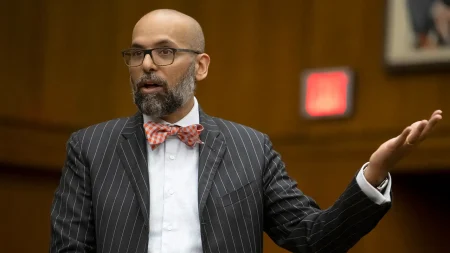




It began as a personal political rift inside one Michigan household and has since rippled outward into the broader, volatile landscape of the 2024 Senate race. Jason Turkish, a prominent Jewish Democratic attorney and the fiancé of Democratic Congresswoman Haley Stevens, made a stunning announcement that cut against the grain of his party’s unity push: he will not be voting for Democratic Senate nominee Abdul El-Sayed. Instead, Turkish declared his intention to cast his ballot for Republican challenger Mike Rogers, a decision he framed not as an act of partisan betrayal, but as a matter of conscience rooted in deep, unshakable fears about the safety of his community. The setting for his declaration was loaded with symbolism—a Rogers campaign event hosted by the Republican Jewish Coalition at the Townsend Hotel in the affluent Detroit suburb of Birmingham. Standing on the sidelines of a room filled with Jewish conservatives, Turkish told reporters he had spent months waiting, watching, and hoping for El-Sayed to moderate his rhetoric. That moderation never came. Instead, as the general election campaign wore on, Turkish argued, the candidate’s messaging grew more strident, more divisive, and in his view, more dangerous.
Turkish, a lawyer by trade who has donated to Democrats across the country and occasionally supported Republicans, did not mince words when explaining his reasoning. He accused El-Sayed, a former Detroit health official and longtime progressive activist who won a bitter primary against Stevens, of not merely failing to bridge divides but of actively driving communities apart. The central grievance was El-Sayed’s relentless characterization of the war in Gaza as a “genocide”—a term that carries profound legal, historical, and emotional weight. For Turkish, the repeated invocation of that word, alongside El-Sayed’s refusal to condemn an advertisement that allegedly blamed Jews for rising grocery prices, was not just politically objectionable but existentially threatening. “When he says genocide over and over again, when he refuses to condemn an ad that says Jews are to blame for the price of bananas, he makes my community less safe,” Turkish told reporters. “Every time he talks about genocide, Jews get death threats.” This was not a hyperopic policy disagreement; it was a visceral, personal warning from a man who believes his own community is being imperiled by the very person his party is asking him to support. Turkish’s language was stark, suggesting that in his memory, no Senate candidate had ever acted with such reckless disregard for the safety of Jewish Americans.
The controversy surrounding El-Sayed is far from new, but it has intensified dramatically in the months since he emerged victorious from Michigan’s contentious August primary. A physician and Rhodes Scholar who served as executive director of the Detroit Health Department, El-Sayed has been a vocal and unapologetic critic of Israel’s military operations in Gaza. He has consistently rejected the framing of Israel’s actions as a legitimate defense against Hamas, instead describing the campaign as a genocidal assault on Palestinian civilians. Israeli officials and their supporters counter that the war is a necessary fight against terrorists who deliberately embed themselves among civilians, and they point to evacuation warnings and other measures as evidence of efforts to limit casualties. In the feverish atmosphere of Democratic politics, where the Gaza conflict has exposed deep generational and ideological fractures, El-Sayed’s stance has made him a lightning rod. His refusal to soften his rhetoric, even as a general election audience includes substantial Jewish voting blocs in places like Oakland County, has worried moderate Democrats and energized his opponents. For Turkish, El-Sayed’s position is not a matter of foreign policy nuance; it is an existential threat that transcends the candidate’s other policy platforms.
Perhaps the most inflammatory thread in Turkish’s critique was El-Sayed’s relationship with Hasan Piker, the left-wing Twitch streamer known for his massive online following and his history of provocative statements. Piker had previously faced backlash for suggesting that America “deserved” the September 11 attacks, a comment that has haunted his reputation and drawn accusations of antisemitism and anti-Americanism. El-Sayed has faced persistent questions about his association with Piker, who has been a vocal supporter of his campaign, and has repeatedly declined to condemn the streamer’s remarks or distance himself entirely. Turkish seized on this, describing El-Sayed’s behavior when confronted about Piker as “verbally combative,” lashing out at reporters who dared to raise the issue. “I watch him in recent weeks as he has become verbally combative with any reporter who has the gall, as he sees it, the gall to ask him about Hasan,” Turkish said. The implication was clear: El-Sayed was not simply failing to address a problematic ally; he was actively defending him, or at least refusing to engage in good faith. Turkish framed the entire pattern as one of “equivocation”—a constant, maddening attempt to “explain away hate” rather than repudiate it, a quality he insisted Michigan voters would ultimately reject at the ballot box.
Amid all this, Representative Haley Stevens remains an island of defiance, insisting that despite the man she plans to marry voting for the Republican, she stands firmly behind El-Sayed. Stevens, a moderate Democrat who represents a suburban Detroit district, lost to El-Sayed in a bitter, expensive primary earlier in the summer. The race was marked by accusations, recriminations, and a considerable amount of internal party bloodletting. After her defeat, Stevens eventually issued an endorsement of El-Sayed, but her support has been noticeably tepid. Critics within her own party have lambasted her for refusing to appear on the campaign trail with him, and she was memorably ripped by fellow Democrats who told her to “stay the f— off television” unless she was willing to give an unambiguous, full-throated endorsement. In a CNN interview, Stevens shrugged off the contradictions of her household, telling the network, “Like a lot of households across America, we’re a house divided.” She reaffirmed her desire for El-Sayed to win, citing the high stakes of the race, but her language was careful, almost clinical—a far cry from the passionate advocacy seen from other party loyalists. The optics of her fiancé campaigning for her party’s opponent are extraordinary, a public testament to the fractured state of Michigan Democratic politics in this cycle.
The emergence of Turkish as a Rogers supporter follows a pattern that the Republican campaign is clearly eager to exploit. Turkish is the second major figure connected to Stevens’ orbit to cross party lines in recent days; her former campaign chair, attorney David Kramer, announced the previous Tuesday that he, too, would be voting for Rogers. These defections serve as powerful ammunition for the GOP, allowing them to argue that even those closest to the Democratic establishment cannot stomach their own nominee. At the Birmingham event, Rogers was characteristically blunt in his attacks on El-Sayed. “This is not someone we can let into the United States Senate,” Rogers declared. “If you don’t know Iran is our enemy and you can’t condemn a Hezbollah-inspired attack, you have no business being in the United States Senate.” He made no direct mention of Turkish’s endorsement, perhaps not wanting to appear to gloat or alienate the very Democratic voters he is courting, but the symbolism was undeniable. For Turkish, the decision is a genuine sacrifice, an act of putting “country before party” in a hyperpartisan era where such cross-voting is rare and often punished. He predicts, with a mix of hope and trepidation, that Michigan will ultimately reject El-Sayed, but he also knows that his own family remains divided, a microcosm of the very polarization that animates American politics today.