





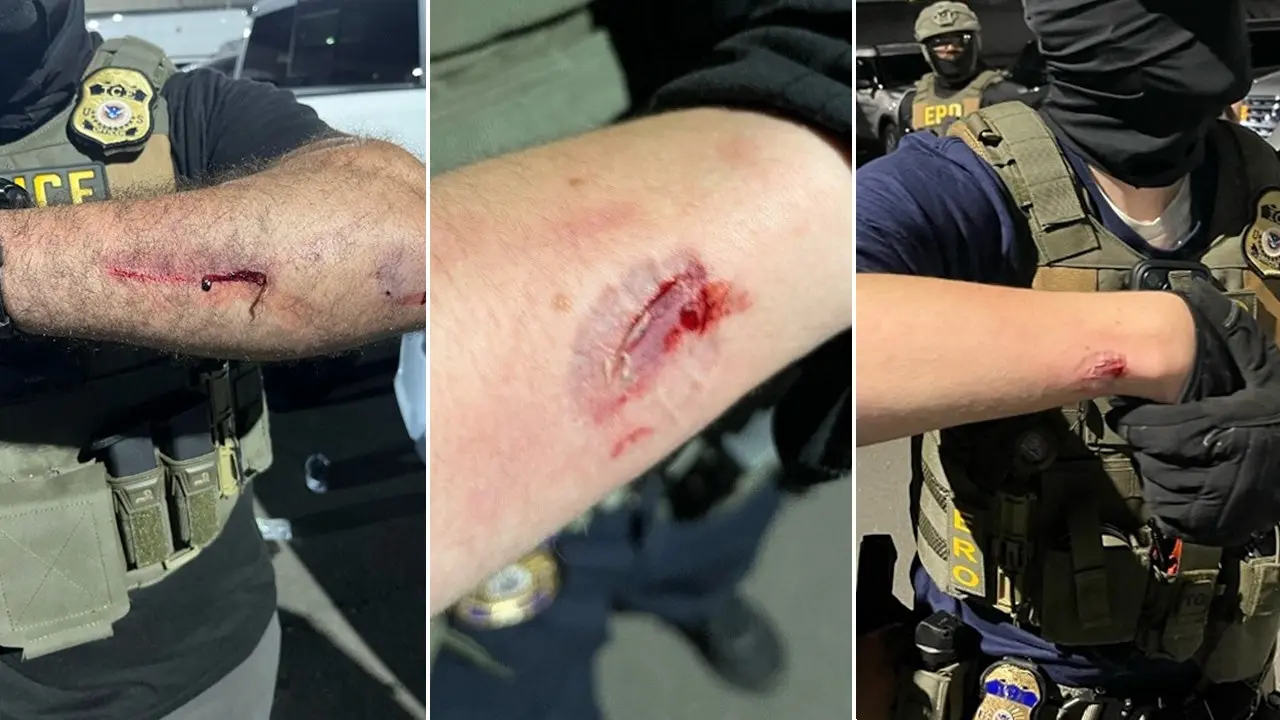
The gravel and asphalt outside the Delaney Hall detention center in Newark, New Jersey, have transcended their geographic reality to become a visceral, sweat-soaked battleground where the nation’s deepest ideological fractures are fought with flesh and bone. On a tense Thursday evening, this industrial stretch of Newark transformed into a scene of chaotic physical violence that culminated in the federal arrest of Brendan John Geier, a twenty-six-year-old resident of Madison, New Jersey. Geier, who had joined a crowd of impassioned anti-immigration activists blocking the roadway near the facility, became the central figure in a harrowing physical confrontation when Immigration and Customs Enforcement (ICE) deportation officers moved in to clear the thoroughfare. What began as a loud, chanting demonstration rapidly degenerated into a desperate struggle of flailing limbs and raw anger. According to federal prosecutors, Geier did not merely resist arrest; he engaged in a savage, close-quarters physical struggle with the officers, kicking wildly before sinking his teeth deeply into the forearm of one deportation officer and the knuckle of another. The brutal reality of the clash was laid bare when both injured federal agents had to be rushed to a local hospital, their skin torn and bloodied from bite wounds that highlighted the increasingly dangerous, highly personal nature of these street-level political confrontations.
In the immediate aftermath of the violence, the sterile rooms of the federal courthouse in Newark played host to the opening salvos of Geier’s legal battle, where he was brought before U.S. Magistrate Judge Cari Fais to face heavy charges of assaulting federal officers and causing bodily injury. The federal response was swift, unyielding, and highly visible, designed to signal that the government would not allow its agents to be treated as physical scapegoats for systemic political grievances. Acting Attorney General Todd Blanche took the unusual step of taking to the digital public square, posting graphic, unsettling photographs on social media that displayed the deep, blood-red bite marks left on the arms of the law enforcement officers. Blanche’s public statements radiated a profound sense of outrage, a defensive reaction born from a desire to humanize the uniform and remind the public that behind the badges are individuals who go to work hoping to return home safely to their families. He fiercely rejected the notion that such conduct could ever be classified under the umbrella of constitutional advocacy, declaring that peaceful protest does not translate to violently attacking federal law enforcement officers who are simply carrying out their mandated duties to protect United States property and facilities.
This explosive incident underscores a much larger, increasingly hostile ideological culture war that has put federal immigration officers directly in the crosshairs of polarized local communities. Department of Homeland Security Secretary Markwayne Mullin and U.S. Attorney Robert Frazer both issued stern, uncompromised condemnations of the assault, framing Geier’s alleged behavior as an unacceptable violation of the social contract. From the federal perspective, the escalating violence represents a direct assault on the rule of law itself, an environment where political dissent is used to justify bodily harm against civil servants who have no hand in drafting the policies they are hired to enforce. Secretary Mullin made it clear that the federal government under the current administration would stand resolutely with its law enforcement personnel, promising that anyone who resorts to such primal violence will be prosecuted to the absolute limit of the law. The rhetoric from these officials reflects a deep-seated anxiety within the federal apparatus—a realization that the division over immigration policy has reached a critical boiling point where government workers are viewed by some activists not as human beings, but as faceless symbols of systemic oppression deserving of physical destruction.
The ongoing demonstrations outside Delaney Hall have now dragged into their second grueling week, evolving from organized vigils into localized urban warfare characterized by barricades, flying debris, and prolonged standoffs. Over the course of the multi-day siege, federal agents have found themselves dodging heavy wooden pallets, loose mattresses, and other makeshift projectiles launched by demonstrators determined to disrupt the facility’s operations. This steady escalation of tactics paints a picture of a protest movement that has partially splintered, with radical elements abandoning traditional civil disobedience in favor of active, physical sabotage. Acting Special Agent in Charge Spiros Karabinas of Homeland Security Investigations (HSI) Newark sought to draw a bright, legal line between protected First Amendment speech and the criminality unfolding on the streets. For Karabinas and his fellow agents, the repetitive nature of these assaults turns the protest site into an exhausting, high-stress gauntlet where the line between an activist and an assailant has blurred, leaving front-line officers in a constant state of hyper-vigilance as they try to maintain control of a volatile perimeter.
Compounding the physical danger for the federal officers is a bitter, highly public political feud between federal authorities and New Jersey state leadership, which has created a dangerous jurisdictional vacuum on the ground. DHS Secretary Mullin openly criticized New Jersey Governor Mikie Sherrill, accusing her administration of intentionally withholding local police support and forbidding municipal law enforcement from cooperating with federal immigration agencies. This political standoff left federal agents largely isolated during the height of the riots, forcing them to defend the facility’s perimeter without the tactical backup typically provided by local police departments. The emotional toll of this political abandonment is palpable, as federal officers felt left to fend for themselves in a hostile environment due to partisan disagreements. The crisis reached such a peak that Governor Sherrill, who had previously spent the Memorial Day weekend showing solidarity with the crowds protesting outside Delaney Hall, was forced to pivot, announcing that she would instruct the New Jersey State Police to take over public safety responsibilities outside the detention center in an effort to restore order and stem the tide of violence.
As the weekend sun rose over Newark, the atmosphere outside Delaney Hall remained thick with tension, characterized by an uneasy, heavily policed standby. The geographic layout of the street now mirrors the deep polarization of the country itself, with bike-mounted police officers forming a thin, moving human wall to separate the growing crowds of anti-ICE agitators from counter-protesters who had gathered to show their support for law enforcement. The presence of the New Jersey State Police has introduced a new, disciplined variable to the scene, but the anger on both sides of the barricades remains red-hot and unresolved. The story of Brendan John Geier and the bloodied arms of the ICE agents he allegedly bit is more than just a localized criminal case; it is a chilling snapshot of a nation struggling to navigate its moral, legal, and political identity. In this quiet, suburban-adjacent industrial corner of New Jersey, the high-minded debates of Washington have been stripped of their diplomatic language, replaced instead by the raw, bruising reality of human beings clashing in the dark over where the boundaries of law, humanity, and justice truly lie.