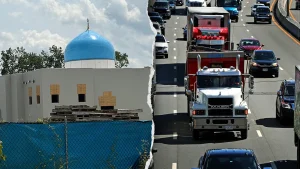


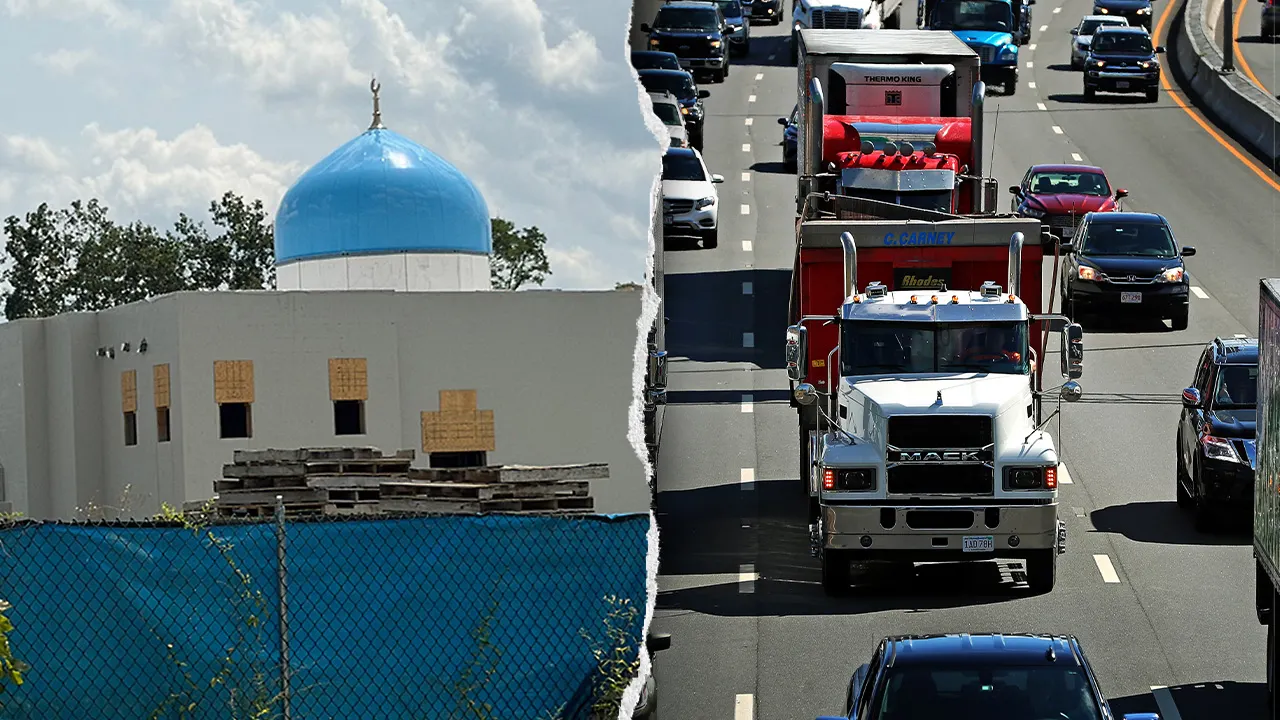
The small Warren County village of Maineville, Ohio, population roughly 1,400, still looks like the kind of place where cornfields outnumber stoplights and the loudest sound at dusk is the hum of tractors heading home. But about a mile north of its only real intersection, something new has risen out of the farmland: a mosque, its graceful archways and minaret taking shape behind a fence, slowly becoming a landmark on a landscape that has been quiet for generations. For the past four years, the Islamic Center of Maineville has been under construction, approved by Hamilton Township in April 2022 after what local officials described as a routine permitting process. For many newcomers in the area, the mosque is a sign of hope and belonging, a spiritual home for a growing Uzbek community that has transformed parts of southwest Ohio in ways both visible and difficult to measure. But for many longtime residents, the mosque has become a focal point of a more complicated anxiety, one rooted not in religion itself, but in a series of troubling questions involving money, trucking, government links to a foreign country, and the safety of the roads their families drive every day. A Fox News Digital exclusive review has uncovered significant financial ties between the mosque, a network of Uzbaki trucking companies, and the government of Uzbekistan, raising concerns that what may look like a simple story of immigrant faith and hard work is actually tangled up in a much murkier web of regulatory failures, safety violations, and fraud allegations. The story in Maineville is not just a story about a building; it is a story about how a community has been profoundly reshaped in a few short years, and whether the institutions rising up to serve that community are doing so in ways that respect American laws and protect American lives. The sense of unease is not born of ignorance or bigotry, locals say; it is born from watching too many semi trucks and too many fatal crashes, and asking aloud whether anyone in charge is really listening.
The financial trail from the mosque to the trucking industry is extensive and, to many observers, deeply troubling. Public records and Telegram screenshots reviewed by Fox News Digital reveal a pattern of large donations from trucking companies with serious safety and compliance problems, and the numbers are hard to dismiss. Buraq Limited, a Springboro trucking company tied to Rukhshona Sultonova, donated at least $28,000 to the Islamic Center over 28 separate gifts, according to the messaging app. Federal records show the company has been cited for dozens of violations, including multiple English-proficiency failures, four electronic logging device violations, three invalid commercial driver’s license violations, four expired medical cards, and four hours-of-service violations. Premier Trucking Group Inc., owned by Sam Avazov, has donated at least $25,000 to the mosque, and in September the Islamic Center posted a screenshot of a $1,000 gift from the company. Premier’s federal record includes more than 100 violations, ranging from unsafe driving to invalid CDLs, the kind of citations that suggest drivers may be behind the wheel without the training, language skills, or physical qualifications to operate a large commercial vehicle safely. Foko Logistics LLC, based in Hilliard and owned by Abubakr Olimov, gave $20,000 in a single gift, and its safety record shows 52 violations across 37 inspections in the Federal Motor Carrier Safety Administration’s current 24-month cycle, including damaged brake hoses, an inoperable tractor protection valve, and severely underinflated tires. More alarming still, ten of the company’s 24 vehicle inspections resulted in an out-of-service designation, a rate of 41.7 percent, meaning nearly half the time a federal inspector looked at one of these trucks, it was found too dangerous to continue driving. Maca Transportation and Services LLC, based in Dayton and owned by Muminkhuja Kholkhujaev, donated at least $7,000 across eight gifts, while accumulating 120 violations over 72 inspections, including English-proficiency failures, false or incomplete hours-of-service records, brake problems, tire problems, and other serious maintenance issues. Fourteen of its 36 vehicle inspections put trucks out of service, a rate of 38.9 percent. These are not abstract numbers on a spreadsheet; these are trucks barreling down the same interstates and rural roads where children are picked up for school, where families drive home from work, where one mistake can end a life. And the fact that these companies are also major financial supporters of a religious institution raises difficult questions about whether the mosque’s leadership has done enough to ask where the money is coming from and what it means for the community’s reputation.
The largest single donation traced to the mosque came from Phoenix Cargo, a trucking company that gave $150,000 and helped organize the broader fundraising effort, but when Fox News Digital asked about the gift, the company said the mosque approached it repeatedly for donations and that the total represented only a fraction of the mosque’s construction budget. Phoenix Cargo, whose own federal record includes hundreds of citations for safety problems, including English-proficiency issues, ELD tampering, and unsafe driving, insisted it was not even among the project’s top 100 donors. The mosque itself did not respond to requests for comment, though earlier this month it released a statement saying it is “committed to operating responsibly and in accordance with applicable law.” For Nodawolf, an online researcher who lives in the area and has spent months documenting alleged trucking fraud in southwest Ohio, the pattern of giving is deeply concerning. Nodawolf, who was granted anonymity because he says he has received death threats, told Fox News Digital that the fundraising worries him because a large percentage of the Uzbek truck companies that donate to the mosque have been repeatedly cited for the same kinds of serious inspection violations. “Those violations suggest a pattern of non-compliance with our laws and regulations among the donors,” he said, “which is troubling given the community’s concentration in the freight industry in Maineville.” The concern is not theoretical. Earlier this year, authorities say an Uzbek truck driver named Bekhzod Asrarov, who lives in Maineville and was unable to communicate effectively in English at the scene of the crash, struck and killed 21-year-old Ohio soccer player Tobias “Toby” Forsythe. Asrarov has been accused of removing and concealing his dashcam after the accident. Fox News Digital asked the mosque whether an administrator on its Telegram channel using the name “Bek A” was the same man, but the mosque did not respond. For the Forsythe family and the wider community, the case has become a heartbreaking illustration of what can happen when a system of oversight fails, and they are left to wonder how many more warnings signs have to pile up before someone takes meaningful action.
Beyond the trucking companies themselves, the mosque’s Telegram channel and the records of the nonprofit that owns the land suggest close ties to the government of Uzbekistan, a fact that complicates the reassuring statements the mosque has made about its independence. The Islamic Center’s website says it does not solicit donations from any foreign government, organization, association, partnership, or individual, and that any such attempt should be reported immediately. But the organization’s own Telegram account tells a different story. Hamkor Uz Cincinnati Association, a nonprofit established in 2020 to unite Uzbeks in the Cincinnati area and support community projects, including the construction of religious and cultural centers, is identified by Hamilton Township records as the owner of the roughly 6.7-acre property where the mosque is being built. Telegram screenshots reviewed by Fox News Digital show the organization’s deep connections to former Uzbek government officials. One image shows the Mason office of Erkinbay Abdulla, with a caption describing him as a former Uzbek official who “creates the trucking companies.” Another screenshot contains a community statement attributed to Sukhrob Norbekov, identified in an accompanying message as another former Uzbek official who represents the mosque. The material places former government officials from Uzbekistan directly alongside an organization involved in the mosque project and with individuals involved in creating local trucking companies. Current Uzbek officials also appear to be involved. Photos posted on the mosque’s Telegram channel show a six-member delegation that traveled to the United States in April 2025, including Ambassador Furqat Sidiqov, regional government officials, and three officials from Uzbekistan’s Ministry of Digital Technologies. Separate posts invite entrepreneurs and truck company managers to an April 19 IT conference hosted by Hamkor Uz Cincinnati at a banquet hall in Loveland, Ohio. The Hamkor Uz Telegram channel, which includes current and former Uzbek government officials as administrators, advertises local trucking companies, removable truck signs, English courses for truck driving school, and legal counseling, along with posts from the mosque owner providing guidance on “Shariah compliant banking” and “speaking English with the police.” Nodawolf says the government ties are troubling because the trucking companies appear to be tightly organized, with patterns that look almost like a shared blueprint. “Given the documented safety and compliance problems in many of these companies, it’s reasonable to ask whether gaps in U.S. regulations are being systematically exploited,” he said. Several locals who spoke to Fox News Digital said they have tried to raise these concerns with elected officials, but have largely been ignored. A resident from nearby Middletown, Ohio, who posts information about trucking companies online under the name GHOSTOPSUZ, said politicians are scared of being called Islamophobic or racist. “But it’s not that at all,” he told Fox News Digital. “It’s about safety, it’s about accountability, and it’s about everyone being held to the same standard.”
One elected official who has decided to act is Ohio Republican state Rep. Michelle Teska, who represents most of Warren County, including Maineville. Teska has introduced legislation to strengthen commercial driver’s license requirements, including a measure that would require driver examinations to be administered in English. She calls that the “low-hanging fruit of the problem,” after discovering that Ohio allows CDL tests to be taken in ten different languages. “That, to me, common sense says that’s insanity,” she told Fox News Digital. Teska says she has seen the problem “firsthand” while driving around her district, calling it rampant. She described watching a man pull a semi truck cab into a BMV parking lot on a Saturday, taking up four spaces and clearly having no idea how to handle the vehicle. She walked over and asked if he spoke English. “He replied, no, I don’t speak English. Asked him where he was from. He was from Uzbekistan.” The moment crystallized for Teska why the issue matters: it is not about immigration, not about religion, but about whether the people operating massive machines on public roads have the basic skills to do so safely. Law enforcement in Warren County appears to be taking notice as well. The Hamilton Township Police Department issued a statement saying it actively monitors traffic safety concerns, works with public safety partners, and recently participated in a targeted traffic enforcement initiative focused on commercial motor vehicles, alongside partner agencies to identify safety violations and improve roadway safety. Warren County Prosecutor David Fornshell stressed that there is nothing inherently wrong with mosque fundraising and that he has not received any information that any laws have been broken. But he acknowledged, in carefully measured terms, that clearly “there’s something going on” within the Uzbek community in southwest Ohio that “warrants at least awareness on the part of law enforcement.” Since 2021, Fornshell said, the area has seen an influx of cases involving Uzbeks that has prompted the hiring of more court interpreters and city employees who speak the language, particularly in the lower courts that handle traffic offenses. “I would say hardly a week goes by where we don’t have some felony case involving an Uzbek, it’s pretty frequent at this point,” he said. The statement was startling in its frankness, a rare official acknowledgment that what began as a story about a mosque and a trucking boom has become a public safety concern touching every level of the criminal justice system.
The human dimensions of this story are as complicated as they are tragic. Census data from 2024 shows that roughly 1,500 people born in Uzbekistan live in Greater Cincinnati, while about 3,800 Uzbekistan-born residents live across Ohio. But Uzbek community leaders say the actual population is far higher, estimating that roughly 4,000 Uzbek families live in southern Ohio, including U.S.-born children. That would put the true population in the tens of thousands, a dramatic change for a region that, a decade ago, had almost no visible Uzbek presence. For many of these families, the mosque is the center of a new life, a place to gather for prayers, celebrate holidays, teach children their heritage, and feel at home in a country their children will grow up in. Hamkor Uz board member Nodirjon Ernazarov told the Cincinnati Enquirer through a translator last week that “this is our motherland now, from now on,” and that “Uzbek people are very hardworking people,” adding that the mosque is being built by the help of all Uzbeks. The article highlighted the Uzbek population’s efforts to become part of the community, and noted that the influx of Uzbeks was driven in part by the area’s proximity to the trucking industry. But the article did not mention that Ernazarov himself owns a trucking company, Ray Cargo Corp., which has donated tens of thousands of dollars to the mosque and has been cited for numerous safety violations, including unsafe driving and driver fitness. That omission matters, because it illustrates the central tension of the entire story: the same people who are working so hard to build a community, to put down roots, to contribute to the economy, are also deeply connected to an industry rife with fraud, safety problems, and foreign government influence. For the residents of Maineville, there is no easy answer. They do not want to punish people for the crimes of a few, nor do they want to see a growing, vibrant community judged by its worst members. But they also do not want to wait until the next family receives the kind of devastating phone call that the Forsythe family received, a call that no parent should ever have to take. Fox News Digital reached out to every trucking company mentioned in the article for comment, and none offered any meaningful response. The mosque, too, remained silent, leaving the community to wonder whether its leaders are truly committed to transparency, whether the safety violations are being taken seriously, and whether the faith that is meant to inspire good works has also been used as a shield to protect a system that is failing to keep people safe. In the end, the story of the Islamic Center of Maineville is not a story about one mosque, or one trucking company, or even one tragic crash. It is a story about the choices a community makes when change arrives quickly, when money flows in from uncertain sources, and when those in power are asked to choose between looking away and speaking up. For the people who live and drive and pray and work in southwest Ohio, the question is no longer whether there is a problem. The question is whether anyone will solve it before the next fatal crash, the next fraudulent CDL, the next family shattered by a weight that should have never been put on a public road.